Yoga and Meditation Wall Art: Calm, Mindful Decor for Home Practice
The Heva Team
Art Curators & Interior Design Enthusiasts · May 7, 2026 · 13 min read
The right canvas does more for your practice than another cushion. Here are six soft, low-contrast picks for a calmer yoga or meditation room, plus how to hang and style them for a seated eye line.
A meditation room is not just a place. It is a cue. The moment you walk in, your shoulders drop, your jaw softens, and your breath finds its slower rhythm. Wall art is the easiest way to build that cue, and the right canvas can do more for your practice than another cushion ever will.
Ready to browse? Explore the full zen and meditation wall art collection at HEVA Unique Art Gallery or keep reading for our top picks, the science behind calming imagery, and exactly how to hang it for your home practice.
Why Wall Art Belongs in Your Yoga and Meditation Room
Most home practitioners overlook the visual field of their practice. They invest in a good mat, a bolster, maybe a salt lamp, then face a blank wall. That blank wall is doing work, just not the work you want. The eye keeps scanning for information, and the mind follows.
A single, intentional piece of art changes the equation. It gives the eye one place to rest, which makes it easier for the breath to slow and the spine to lengthen. In our experience guiding customers through meditation room setups, the wall in front of the cushion is the highest-leverage surface in the entire room.
The science backs this up. The National Center for Complementary and Integrative Health notes that mindfulness practice reduces measures of stress, anxiety, and blood pressure, with strongest effects when practitioners maintain a regular, friction-free routine. Removing visual noise from your space is one of the simplest ways to lower the friction that keeps people from sitting down.
For deeper context on how nature imagery in particular supports the nervous system, our biophilic design and nature wall art guide walks through the research on cortisol, attention restoration, and parasympathetic activation in detail.
The Psychology of Calming Imagery and Colour
Three visual qualities make imagery feel calming: low contrast, slow lines, and a restrained palette. Sumi-e ink paintings, lotus motifs, and misty landscapes all hit those notes by design. They were drawn for contemplation in the first place, which is why they translate so well to a modern home sanctuary.
Colour matters too. Soft greens read as nature and lower visual arousal. Warm whites and creams reflect light evenly without glare. Inky blacks add a grounding weight that feels like a long exhale. Touches of gold or terracotta can carry sunrise energy for an early practice without derailing the calm.
A widely cited review in Frontiers in Psychology on emotional responses to colour reports that soft greens, blues, and earth tones consistently rank highest for perceived calm and lowest for perceived arousal. This is the palette your meditation room should default to.
Avoid heavy patterning, photographic crowds, or hyper-saturated abstracts. They are wonderful in a hallway or a maximalist living room. In a yoga sanctuary, they pull the eye in too many directions at once and drain the very attention you came in to gather.
For a deeper look at how minimal compositions support calm, see our minimalist wall art guide and our Japandi wall art guide, which both pair beautifully with a meditation practice.
Six Wall Art Picks for Yoga and Meditation Rooms
These six pieces are our most-recommended canvases for home practice spaces. Each works on its own as a single statement and holds up to daily looking, which matters when you sit with a piece for years rather than scroll past it.
1. Lotus Flower Canvas: a quiet symbol of practice
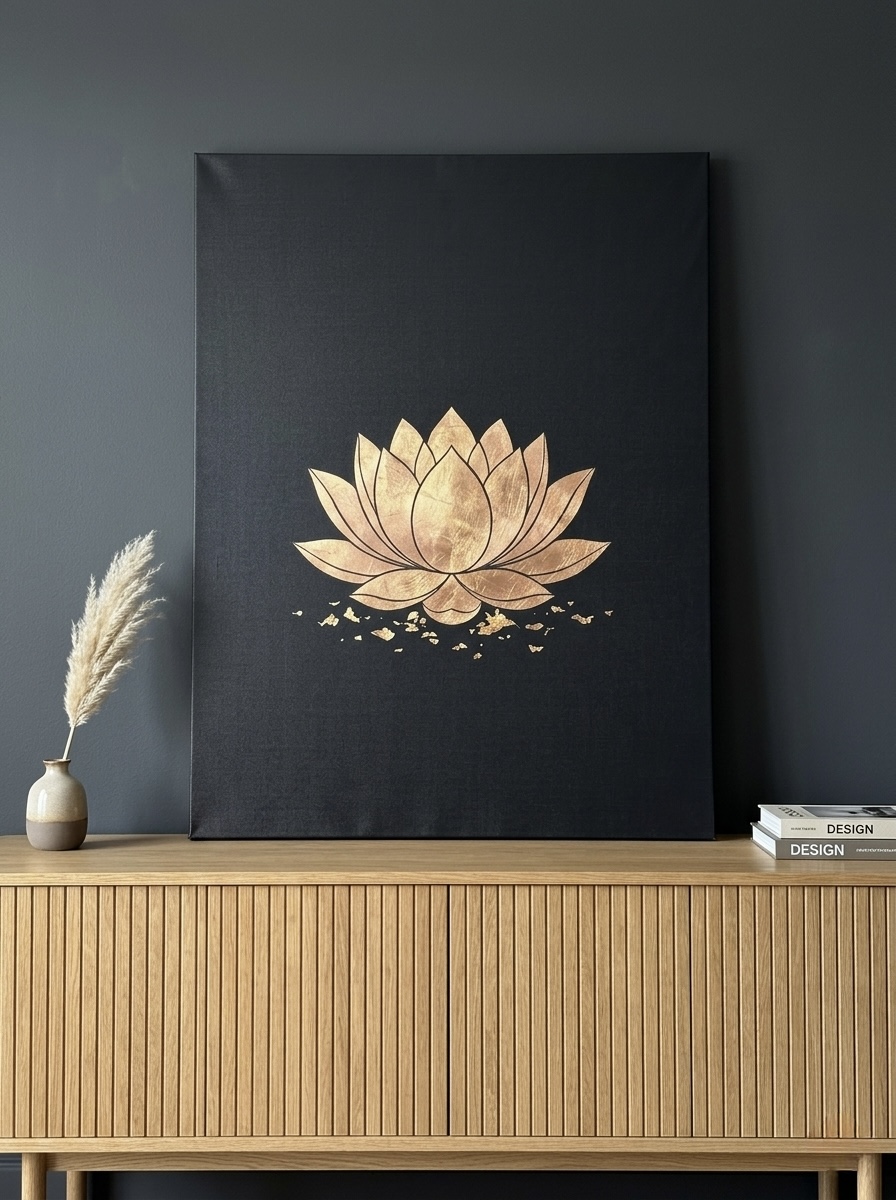
The lotus is the quietest, most universally legible meditation symbol there is. Across yoga, Buddhist, and many mindfulness traditions, it stands for clarity rising out of muddy water, which is exactly what a sit feels like on a hard day. The gold leaf detail catches morning light without ever feeling loud.
We love this canvas in a primarily neutral room with cream walls, a natural rug, and one warm-toned cushion. It is also the single best piece for a small meditation nook, because the black background visually pushes the wall back and makes the corner feel deeper than it is.
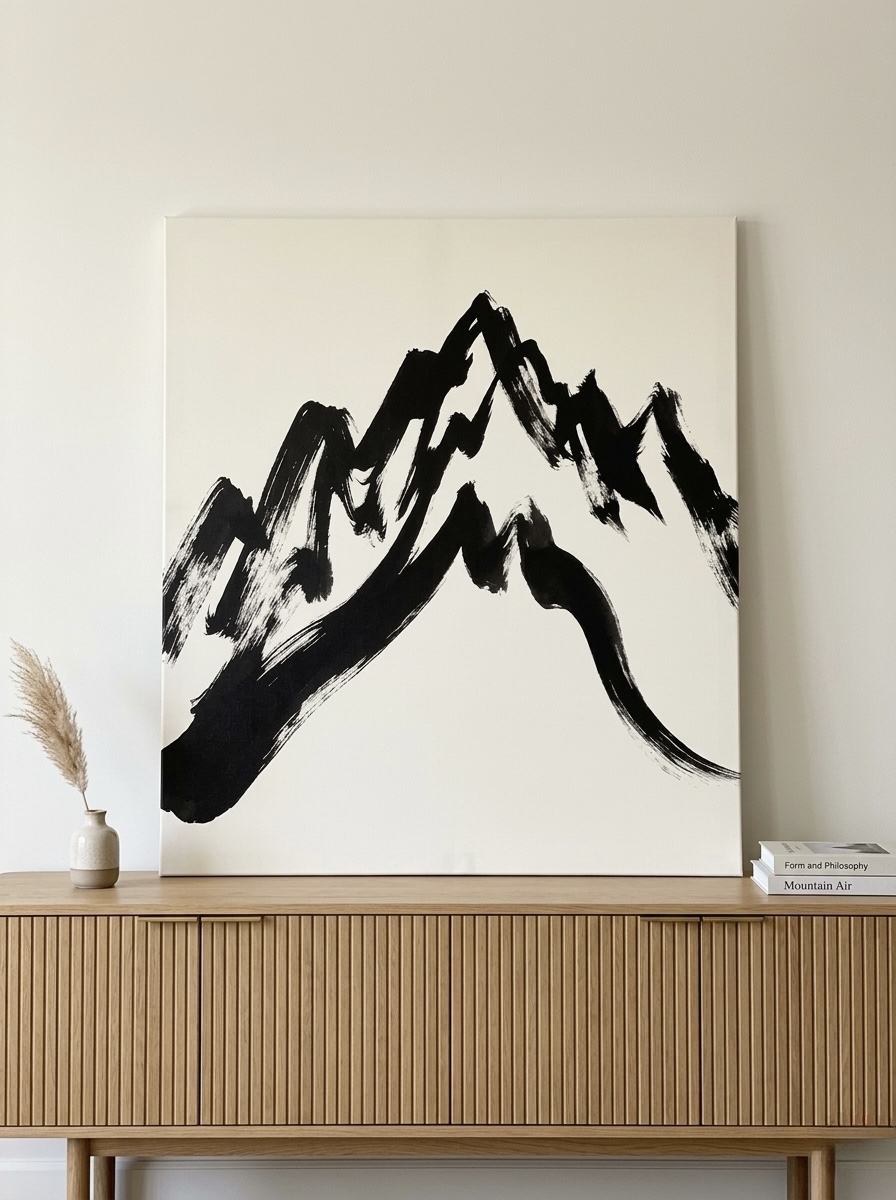
2. Enso Circle Zen Ink: one breath, one brushstroke
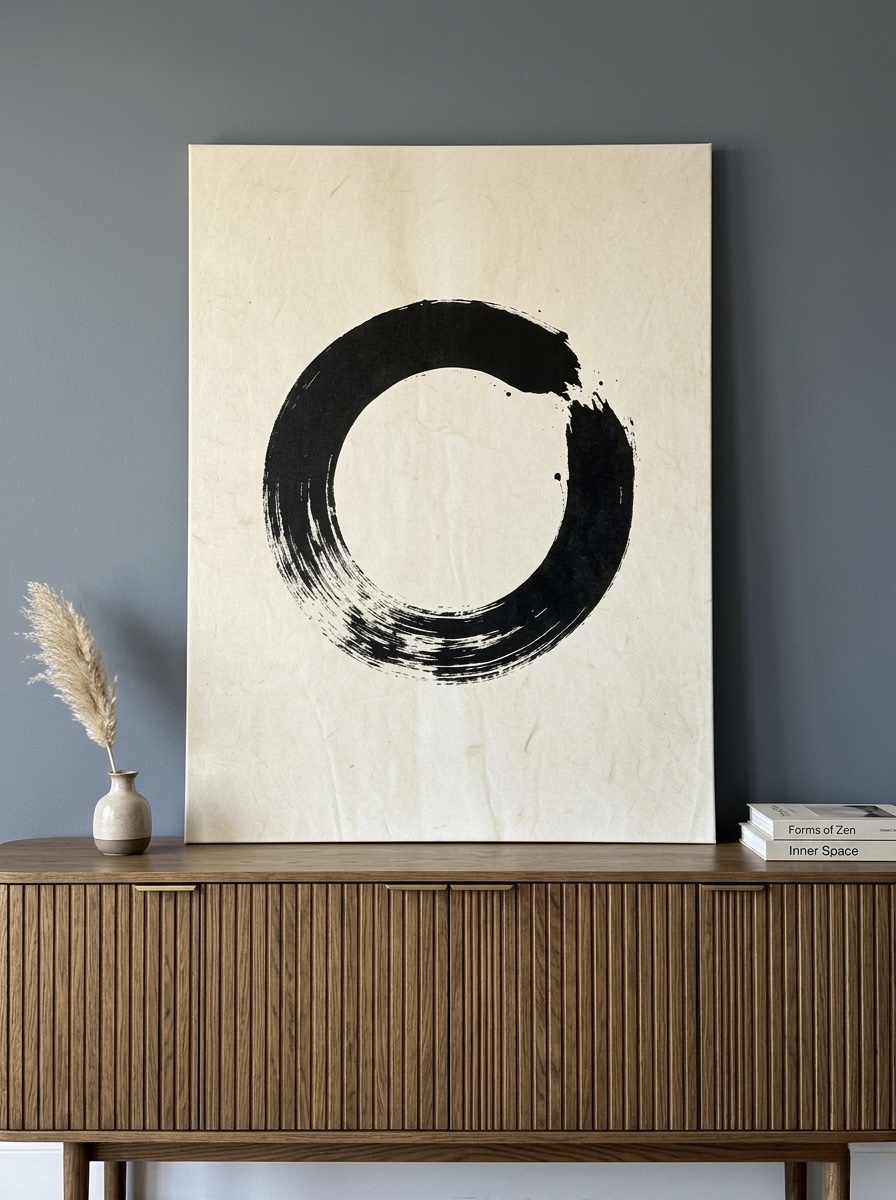
In Japanese Zen tradition, an enso is drawn in one continuous breath. The result is the practice itself, frozen on the page. Whether the circle closes neatly or leaves a small gap, the artist accepts the outcome. That is a useful idea to face every time you sit down to meditate.
Black ink on cream pairs effortlessly with linen curtains, raw wood furniture, and matte ceramics. It is also the easiest piece on this list to layer with a small shelf below for a singing bowl or candle, building a quiet altar without needing any other decor.
3. Zen Stones and Bamboo: spa stillness brought home
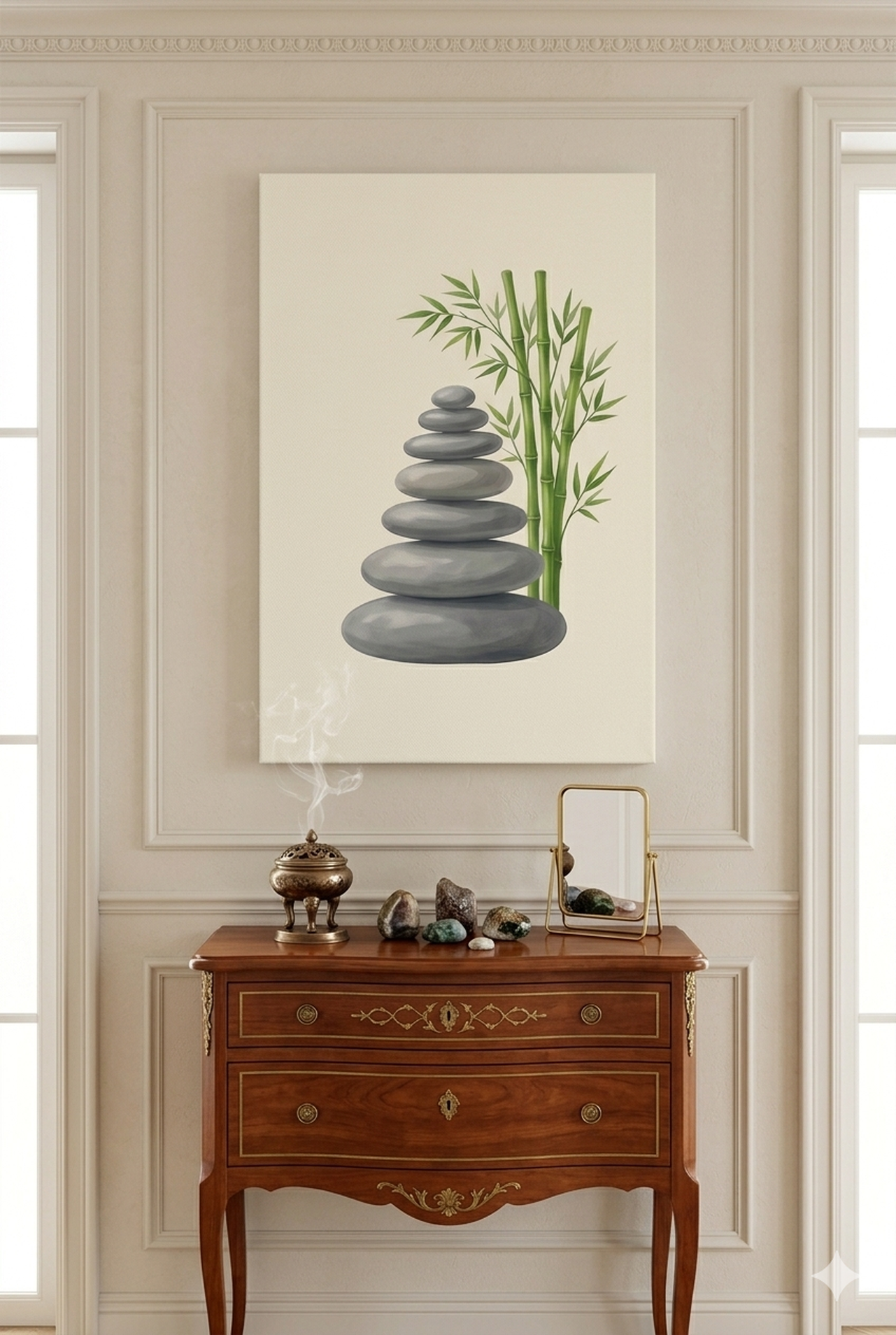
If your home practice doubles as a wellness corner, this is the canvas to start with. Stacked stones speak to balance, the bamboo introduces a living green note, and the soft grey palette reads as spa without veering into hotel-lobby territory.
Customers tell us they often pair this print with a warm wood diffuser and a small plant on the floor underneath. The result is a self-contained calm zone in less than a square metre of wall, which is ideal for renters and apartment dwellers.
Explore the Zen Stones Bamboo Print
4. Misty Mountain Valley: open space for the breath
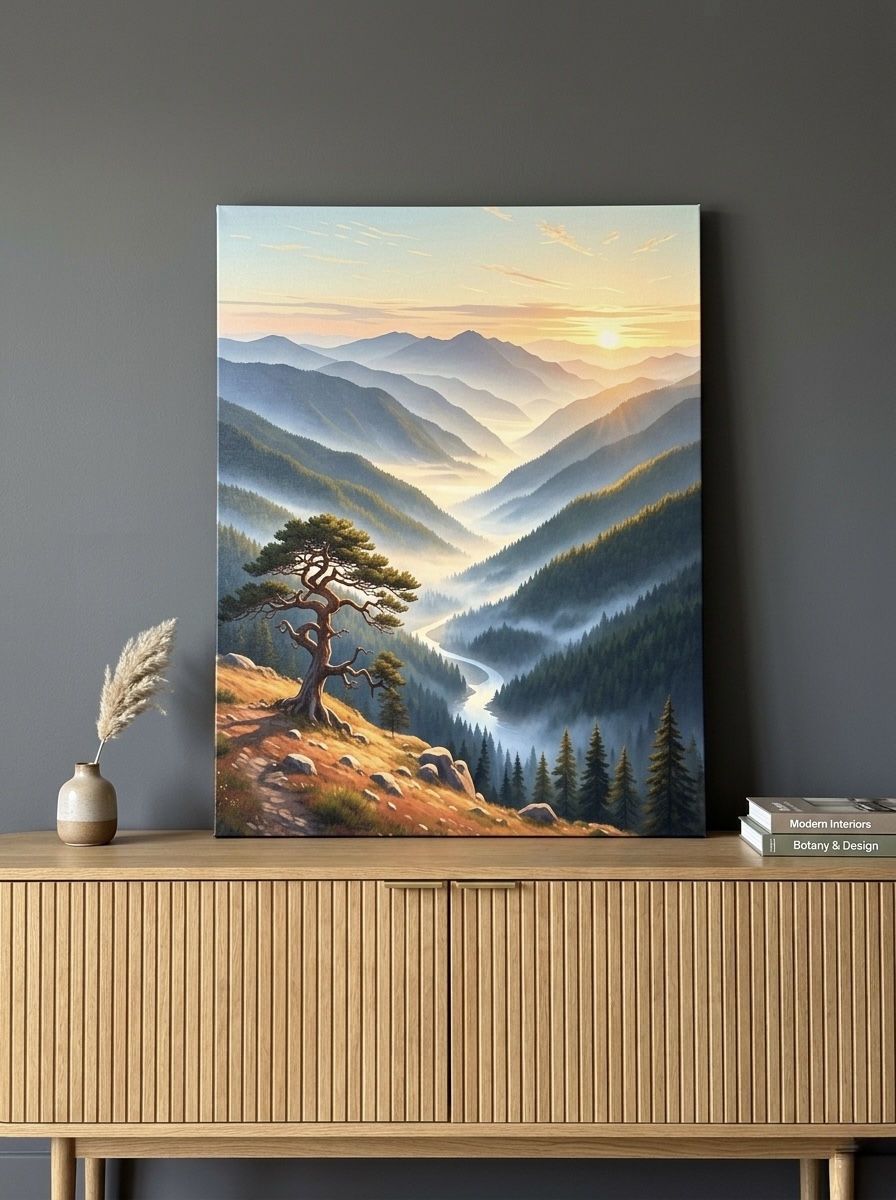
Some practices ask for a sense of vastness, especially open-awareness or breath-focused meditation. A misty mountain valley delivers that without distraction. The fog softens the contrast naturally, and the warm terracotta sunrise grounds the bottom edge so the eye does not float.
For a fuller look at how landscape imagery supports a settled mind, our mountain wall art guide walks through scale, placement, and complementary colour palettes for restorative spaces.
Browse the Misty Mountain Valley Print
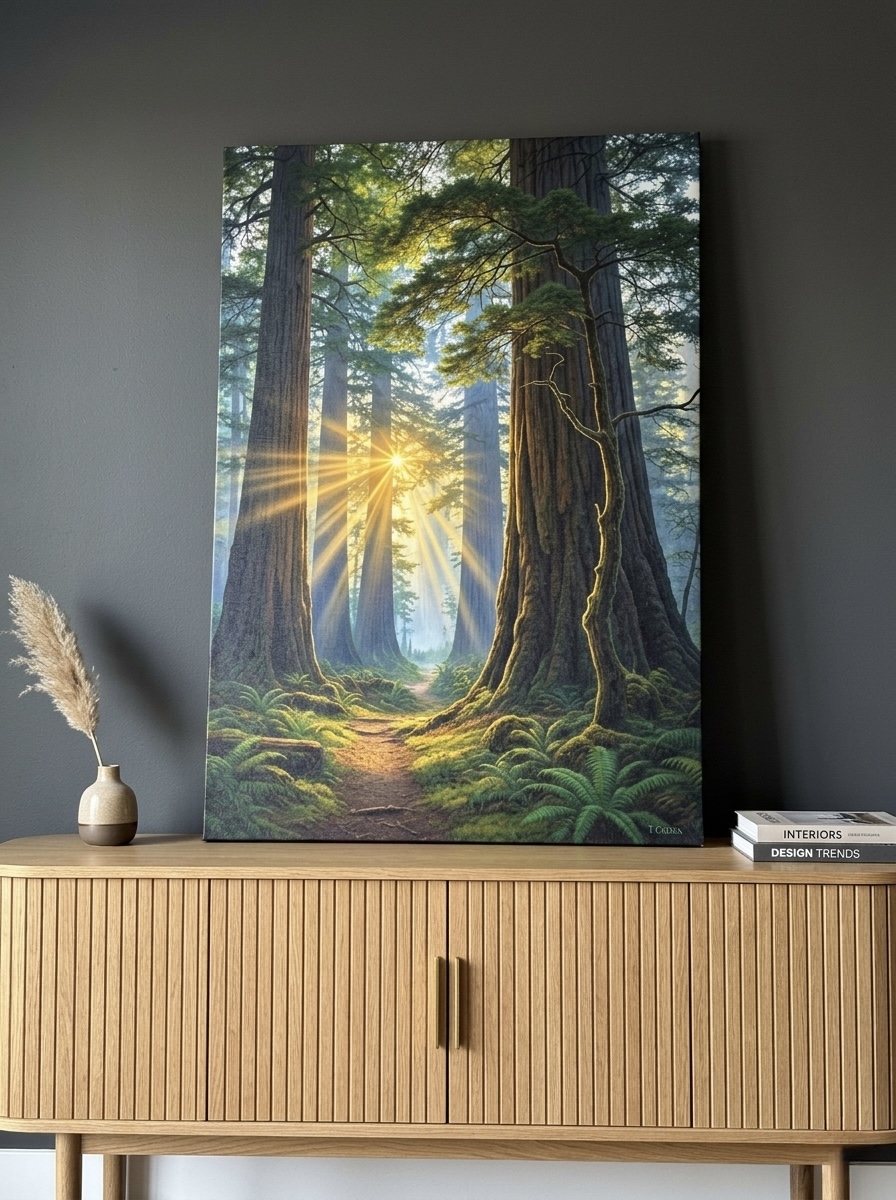
5. Sunbeam Forest: filtered light, slow attention
Forest scenes are some of the most regulated visuals available, partly because of how the human eye evolved among trees. The vertical trunks act as natural rhythm lines, almost like the bars of a metronome, while the warm gold sunbeams keep the piece from feeling cold or dark.
We recommend this canvas for taller practitioners who feel cramped in low-ceilinged rooms. The vertical light beams add visual height and read like a window into deeper space. Pair it with our forest wall art guide for sourcing companion pieces if you want to extend the woodland feeling across multiple walls.
Discover the Sunbeam Forest Print
6. Yin Yang Cranes: balance and partnership on the wall
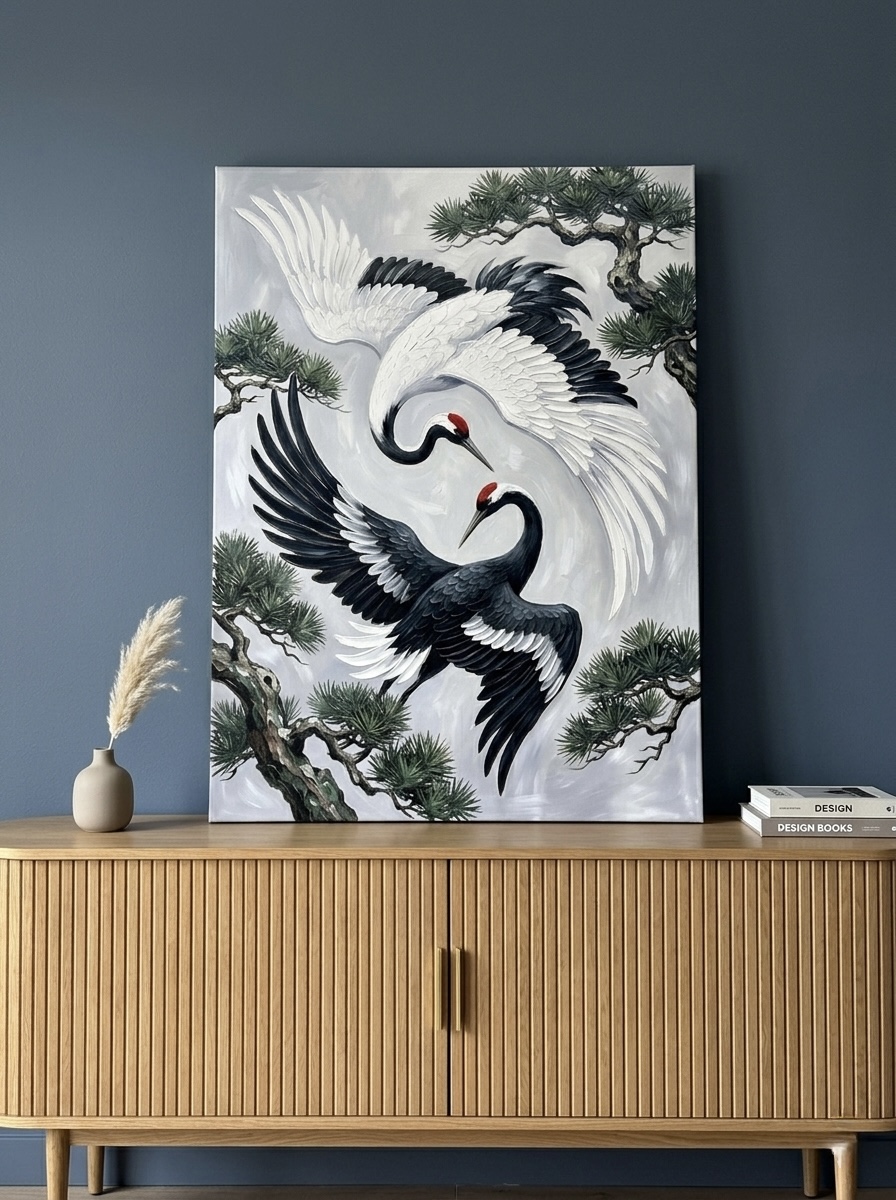
The two cranes circle one another in a yin-yang composition that reads instantly as balance. For partner yoga, couples meditation, or any shared sanctuary, this canvas is hard to beat. The single red accent gives the eye a tiny anchor without breaking the calm of the rest of the piece.
It also works well in primary bedrooms used for evening practice. The Japanese ink lineage ties the print into a long tradition of mindful brushwork, and our Japanese wall art guide covers how to layer it with shoji-inspired screens, tatami textures, and natural fibre rugs.
How to Hang and Style Wall Art in a Meditation Space
Most general hanging guides assume a standing eye line of 145 to 152 cm (57 to 60 inches) from the floor to the centre of the artwork. That works for hallways and living rooms.
A meditation room is different. You spend most of your time seated, often on a cushion only 15 to 20 cm (6 to 8 inches) thick, so the standard rule leaves the canvas floating well above your gaze.
In our experience setting up home practice rooms, dropping the centre of the artwork to roughly 122 to 132 cm (48 to 52 inches) from the floor lets the piece sit just above your seated eye line. You look up gently to soften the gaze, which mirrors the same micro-instruction many yoga teachers give for the drishti, or focused gaze.
For wall coverage, the artwork should fill 50 to 65 percent of the empty wall width above any furniture. A single 50 x 75 cm (20 x 30 inch) portrait canvas suits a wall up to 120 cm (48 inches) wide.
For walls between 150 and 200 cm (60 to 79 inches), step up to a 60 x 90 cm (24 x 36 inch) canvas, or use a pair with a small gap. The pair option works especially well for a primary bedroom doubling as an evening practice space, where two slightly smaller pieces feel softer than one looming statement.
Lighting matters almost as much as the piece itself. The Harvard Medical School guide on relaxation techniques recommends low, warm lighting for breath-focused practice. Use a dimmable wall sconce or a small picture light at around 2700 K rather than overhead daylight bulbs, which read as office light and pull you out of the calm.
For wall colour, soft greens, warm whites, clay, and pale oat all set off these canvases beautifully. Even a single accent wall in clay or sage behind the artwork shifts the whole room toward sanctuary, and most landlords are comfortable with one paintable wall in a rental.
If you cannot paint at all, lean into textiles instead. A linen curtain, a wool rug, and a single canvas already do most of the work of a calm room without a single nail in a wall you do not own. Our wabi-sabi wall art guide covers companion textures and palettes in more detail.
Common Mistakes to Avoid
Hanging too high
The single most common mistake is hanging the canvas at a standing eye line and then trying to meditate seated. Your gaze has to lift uncomfortably, and the piece feels remote. Drop the centre by 15 to 25 cm (6 to 10 inches) for a seated practice and the room will feel completely different.
Choosing imagery that is too busy
A vibrant, high-contrast abstract is gorgeous in a living room. In a sanctuary, it competes with the breath. If you find yourself studying the piece more than settling into your sit, the canvas is too active. Soft contrast, slow lines, and calm palettes win every time.
Filling every wall
Empty wall space is not a problem to solve in a meditation room. It is part of the design. Resist the urge to add a second or third piece. One thoughtful canvas plus breathing room beats four nice pieces packed in. The American Psychological Association covers how clutter, including visual clutter, raises stress in their guide to mindfulness meditation.
Mixing too many spiritual traditions
A lotus, an enso, a Christian cross, and a mandala on the same wall can feel less like reverence and more like a gift shop. Pick the visual lineage that matches your practice and let it lead. You can absolutely respect more than one tradition, just not all on the same square metre of wall.
Forgetting the floor
Wall art ties the room together, but it works best when the floor below it is intentional. A thin, hard floor under a beautiful canvas reads as unfinished. Add a wool rug, a tatami mat, or a soft jute layer in earth tones. The piece above instantly looks more grounded.
Yoga and Meditation Wall Art FAQ
What kind of wall art works best for a meditation room?
Soft, low-contrast imagery works best: lotus flowers, enso circles, misty mountains, zen stones, sumi-e ink landscapes, and slow, balanced compositions. Avoid busy patterns, harsh colour blocks, or anything that asks your eye to keep working. The art should settle the nervous system, not stimulate it.
Where should I hang art in a yoga or meditation space?
Hang the centre of the piece roughly 145 to 152 cm (57 to 60 inches) from the floor when you stand, but adjust lower if you mostly sit on a cushion. Place it on the wall you face during your practice so it becomes a soft visual anchor for the breath.
What size canvas should I choose for a small meditation corner?
For a small nook around 90 to 120 cm (36 to 48 inches) wide, a single 50 x 75 cm (20 x 30 inch) portrait canvas feels intentional without crowding the space. Resist the urge to fill every wall. In a sanctuary, breathing room matters more than coverage.
Are bright colours bad for a meditation room?
Not bad, just intentional. Touches of gold, ochre, or terracotta can warm the room and signal sunrise energy for morning practice. Save high-saturation reds and electric blues for other rooms. The dominant palette should be muted greens, soft whites, warm neutrals, and inky blacks.
Does looking at calm art actually help my practice?
Research summarised by the National Center for Complementary and Integrative Health shows mindfulness practices reduce stress, lower blood pressure, and improve sleep. While the meditation itself does the heavy lifting, a calm visual environment removes friction. Your brain spends less energy filtering visual noise and more energy noticing breath.
Can I use the same art in a yoga studio at home and a guest bedroom?
Yes, especially soft landscapes and zen ink pieces. They translate beautifully across calm-leaning rooms. Just keep dimensions appropriate to each wall and avoid using the exact same print twice in adjacent spaces, which can flatten the visual identity of each room.
Quick Reference Table
| Product | Best For | Dominant Colours | Link |
|---|---|---|---|
| Lotus Flower Canvas | Symbolic anchor, small nooks | Black, gold, cream | View |
| Enso Circle Zen Ink | Daily breath practice, altars | Black, cream, white | View |
| Zen Stones Bamboo | Spa-style wellness corners | Cream, grey, green | View |
| Misty Mountain Valley | Open-awareness practice | Gold, blue, terracotta | View |
| Sunbeam Forest | Low-ceiling rooms, slow attention | Green, gold, brown | View |
| Yin Yang Cranes | Couples practice, evening sit | Black, white, red | View |
A meditation room rewards restraint. Choose one canvas that matches the lineage of your practice, hang it just above your seated eye line, and let the rest of the space breathe. Whether you sit for five minutes or fifty, whether the practice is breath, mantra, or movement, the right piece on the wall removes one more bit of friction between you and the cushion. The wall is no longer a problem to fill. It becomes the quiet partner that meets you on your mat every morning.