Scandinavian Wall Art: Clean Lines, Calm Spaces, Nordic Style
The Heva Team
Art Curators & Interior Design Enthusiasts · March 26, 2026 · 20 min read
Scandinavian design has one secret weapon: restraint. Where other styles add more, Nordic interiors take away. And at the center of that calm, uncluttered living space is often a single, perfectly chosen piece of wall art. Not a gallery wall crammed with frames, not a bold statement mural competing for attention -- just one piece that breathes, that earns its place, that quietly anchors the whole room.
If you have ever walked into a Nordic-inspired home and felt an immediate sense of ease -- a kind of involuntary exhale -- that is not an accident. It is the result of deliberate, principled design choices that stretch back centuries across Denmark, Sweden, Norway, and Finland. Scandinavian wall art is one of the most powerful tools in that design vocabulary, and in this guide we explore exactly what it is, why it works, and how to bring it into your own home.
Ready to browse? Explore our full collection of Scandinavian-inspired wall art at HEVA Unique Art Gallery and find the piece that transforms your space.
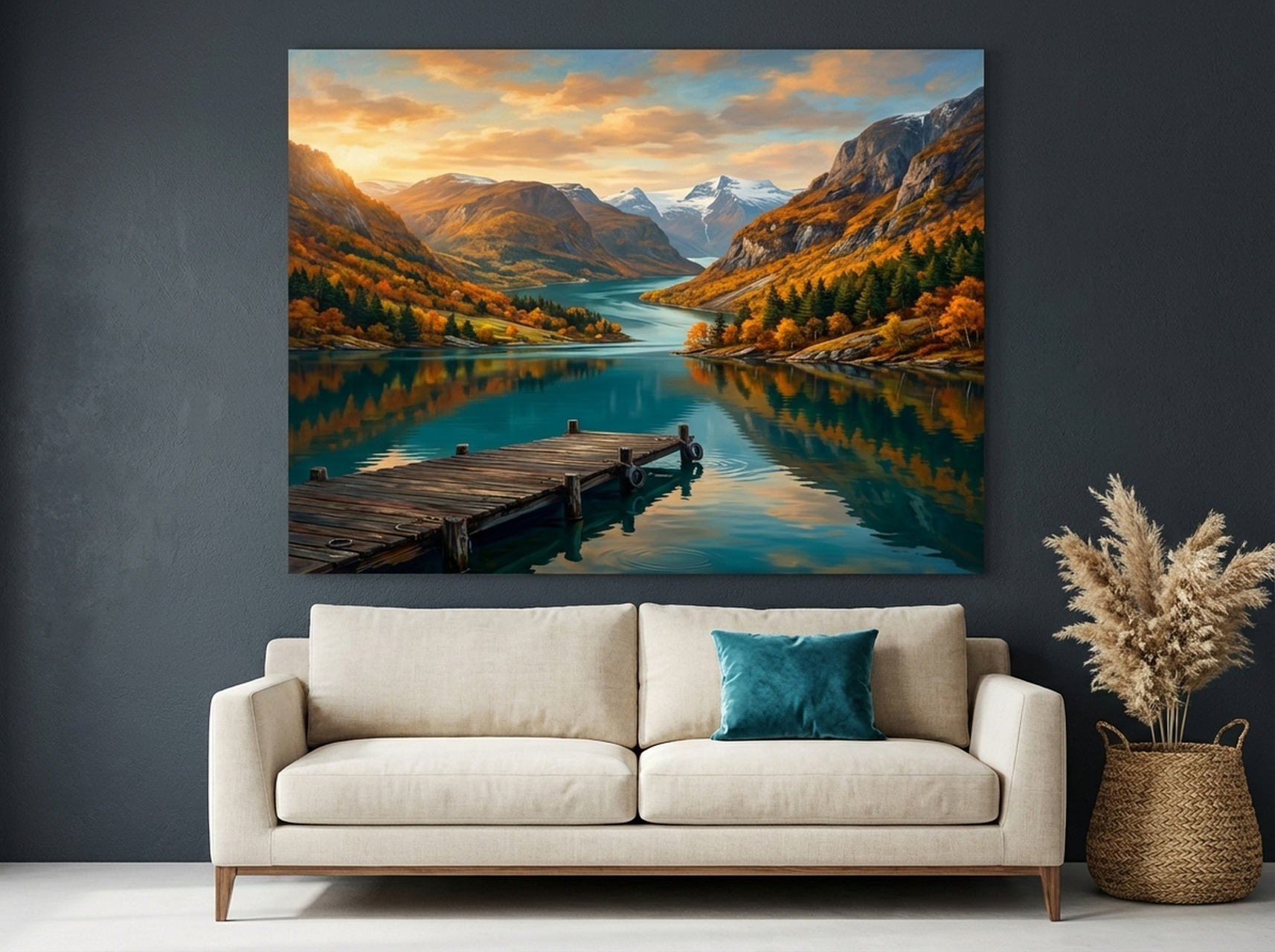
This Norwegian fjord painting captures the dramatic, soul-settling beauty that has defined Scandinavian art for generations: towering mountains, still water, a muted palette that communicates quiet power rather than drama. It is a perfect example of what makes Nordic art so distinct from its louder, more decorative counterparts.
For more on pairing Nordic art with other calm design traditions, see our guide to japandi wall art -- the Japanese-Scandinavian fusion style that has taken interior design by storm.
The Philosophy Behind Scandinavian Design: Hygge, Lagom, and Friluftsliv
To understand Scandinavian wall art, you first have to understand the cultural values that produced it. Nordic design is not merely an aesthetic preference -- it is a set of deeply held philosophies about how human beings should live in relation to their homes, their communities, and the natural world. Three concepts above all others define this worldview: hygge, lagom, and friluftsliv.
Hygge: The Danish Art of Coziness
The word hygge (pronounced "hoo-gah") is Danish and Norwegian, and the Oxford English Dictionary defines it as "a quality of coziness and comfortable conviviality that engenders a feeling of contentment or well-being." As VisitDenmark explains, hygge is about taking time away from the daily rush to be together with people you care about -- or even by yourself -- to relax and enjoy life's quieter pleasures.
In the context of home decor, hygge is felt rather than described. It is the warm glow of candlelight on a whitewashed wall. It is a chunky knit throw draped over a simple wooden chair. And it is the piece of art on the wall that does not demand your attention but rewards it when you pause -- a landscape that invites you inward, a bird in flight that suggests freedom without shouting it. Hygge-inspired wall art tends to use warm, muted tones, natural imagery, and simple compositions that create a sense of calm rather than stimulation.
Crucially, hygge is not about spending more. Most Danes are clear that living hyggeligt is about choosing fewer, better things that genuinely foster comfort and contentment. A single beautifully framed canvas print on an otherwise bare wall is far more hygge than a cluttered gallery arrangement.
Lagom: The Swedish Philosophy of "Just Right"
Sweden contributes the concept of lagom -- a word that roughly translates as "just the right amount." As this analysis of Swedish design principles explains, lagom aims for a comfortable but simple interior that finds the sweet spot between too much and too little. It is moderation as a form of elegance.
Lagom applied to wall art means choosing one piece rather than three, selecting a frame that complements rather than competes, and hanging the art so it has room to breathe rather than crowding it with adjacent objects. The lagom mindset asks: does this piece add real value to this space, or am I adding it just to fill a gap? If the honest answer is the latter, leave the wall bare. Empty space is not a design failure in Nordic interiors -- it is an intentional choice.
Friluftsliv: The Norwegian Devotion to Open-Air Living
Friluftsliv (literally "open-air life") is a Norwegian concept that describes the deep psychological and physical value of spending time outdoors in nature. Research consistently shows that exposure to natural environments reduces stress, boosts mood, and enhances overall well-being. Friluftsliv is not just a weekend hobby -- it is a philosophy that nature is essential to human health.
For home decor, friluftsliv translates into a desire to bring the outdoors inside. Nature-themed wall art -- fjord landscapes, birch forests, wildlife portraits, mountain scenes -- serves as a daily connection to the natural world even when you are indoors. In the long, dark Scandinavian winters, a painting of a sunlit mountain or a misty forest is not decoration for decoration's sake; it is a genuine wellness tool, a window onto the natural world that nourishes the mind.
Together, these three concepts -- hygge, lagom, friluftsliv -- explain why Scandinavian wall art is characterised by restraint, natural imagery, and quiet emotional resonance. These are not accidental aesthetic choices. They are the visual expression of a way of life that has been proven, over centuries, to support human happiness. For a complementary philosophy, explore our guide to biophilic design and nature art which explores the science behind why nature imagery in the home improves well-being.
Scandinavian Art Styles: What Makes Nordic Art Distinctive
Not every minimalist print is Scandinavian, and not every Nordic painting is minimalist. Scandinavian art encompasses a surprisingly rich range of styles -- from stark geometric line art to lush impressionist landscapes -- but they are unified by a set of aesthetic principles that make them immediately recognisable.
Minimalist Line Art
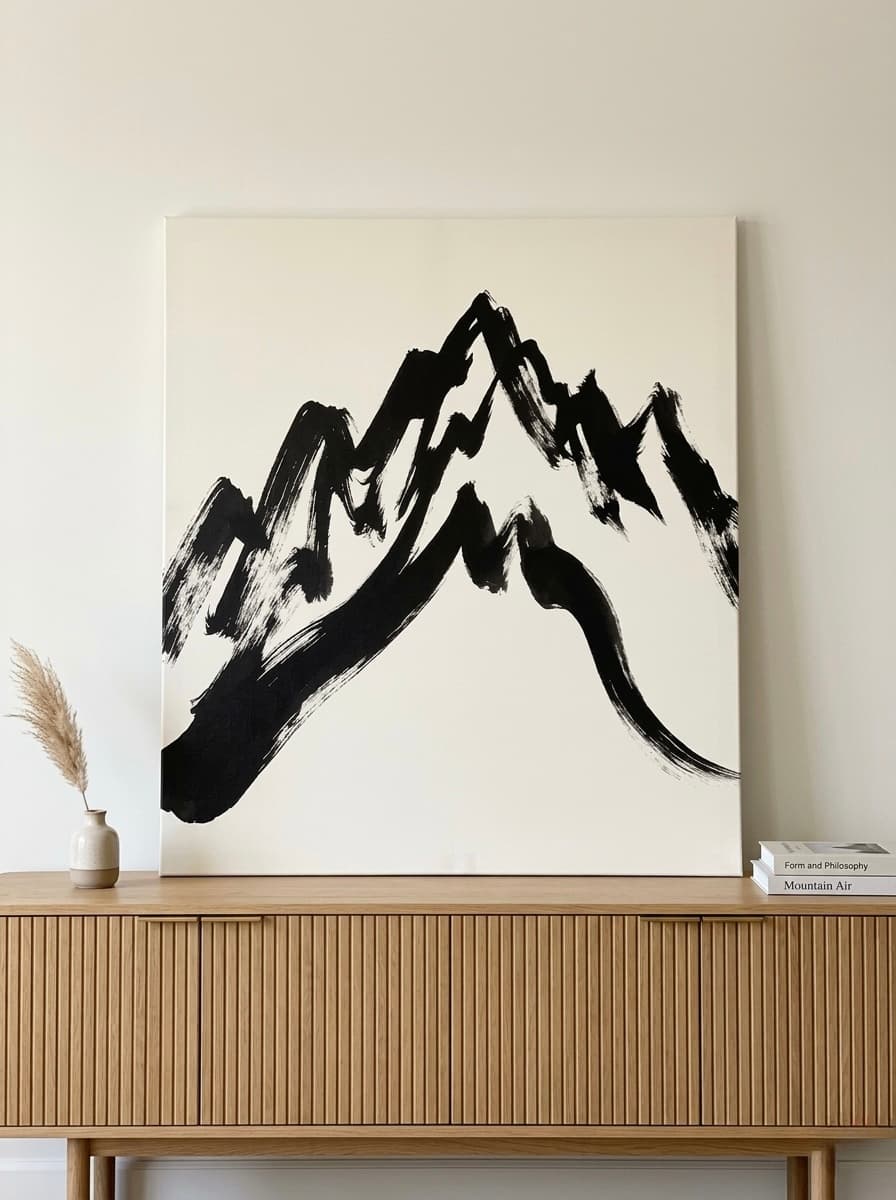
Perhaps the most iconic Scandinavian art style is minimalist line art: simple, clean contour drawings of animals, plants, faces, or abstract forms on white or cream backgrounds, rendered in black or a single muted tone. The appeal is pure lagom -- just enough information to convey the image, with nothing extraneous. These prints work beautifully in almost any Nordic interior because they contribute visual interest without adding visual noise.
Line art prints look exceptional in bedrooms, home offices, and bathrooms where the goal is calm rather than impact. They pair naturally with natural wood frames (light oak or pine) and float mounts in warm white.
Nature Landscapes: Fjords, Forests, and Mountains
Nature landscape art is the soul of Nordic design. Fjords, birch forests, alpine meadows, misty lakes, winter wilderness -- these subjects carry deep cultural resonance for Scandinavian peoples because they represent the landscapes that shaped their history, their values, and their sense of identity. As Daily Scandinavian notes, incorporating nature-themed art is one of the most effective ways to achieve a truly Nordic aesthetic in your interior.
Landscape prints in Nordic interiors tend to use a restrained palette: deep teals and navy blues for fjords and lakes, soft grey-greens for forests, warm amber and gold for autumn scenes, pale icy blues for winter. High-contrast drama (bright reds, electric blues, neon accents) is unusual -- the goal is to evoke the quiet grandeur of nature, not to replicate a postcard.
Wildlife Portraits
Nordic wildlife -- wolves, elk, bears, eagles, blue jays, cranes, owls -- features prominently in Scandinavian art. These animals carry symbolic weight in Norse and Nordic culture: the wolf represents loyalty and resilience; the eagle, freedom and clarity; the elk, quiet strength. A well-executed wildlife portrait painted in a muted, naturalistic palette captures the friluftsliv spirit without any accompanying landscape.
Muted Color Palettes
Across all Scandinavian art styles, color is approached with care. The dominant palette draws from the Nordic natural environment: warm greys, soft creams and off-whites, deep forest greens, teal and slate blues, warm taupes, dusty sage, and occasional touches of warm amber or gold. Bright, saturated primaries are rare; earth tones and desaturated naturals are the norm. This color restraint is not timidity -- it is a deliberate choice to create art that harmonises with its environment rather than competing with it.
When selecting Scandinavian wall art, look for a color palette that could plausibly appear in a Nordic forest or fjord at different seasons: the grey-green of pine needles, the blue-white of fresh snow, the amber of autumn birch leaves, the inky blue of a midnight sky. If a print uses these tones, it will likely feel at home in a Nordic-inspired interior.
This overlaps with principles from other calm design traditions. See our guide to wabi-sabi inspired art for another approach to finding beauty in restraint and natural imperfection.
Sizing and Placement for Scandinavian-Style Spaces
In Nordic design, how you hang art matters as much as what you hang. The principles here are direct expressions of the hygge and lagom philosophies: give the art room to breathe, hang it at a height that feels natural rather than architectural, and resist the urge to fill every inch of wall space.
Recommended Sizes
Scandinavian interiors tend to prefer a single statement piece rather than multiple smaller prints. As a guide for choosing the right size:
- Bedroom wall art: A canvas around 60x80 cm (24x32 inches) works beautifully above a bed or on a feature wall. It is large enough to have presence without overwhelming the calm atmosphere a bedroom requires.
- Living room wall art: Aim for 80x100 cm (32x40 inches) or larger for a sofa wall or main feature wall. A single large canvas creates more Nordic impact than two or three smaller pieces arranged together.
- Home office or study: 50x70 cm (20x28 inches) is often sufficient -- enough to inspire without distracting from work.
- Hallway or entryway: 40x60 cm (16x24 inches) to 50x70 cm (20x28 inches), depending on wall width. One piece, hung alone, sets the tone for the whole home.
Hanging Height
The widely accepted standard for hanging art at eye level is to position the center of the piece at 145 to 155 cm (57 to 61 inches) from the floor. This places it at a comfortable viewing height for most adults whether standing or seated. In Scandinavian interiors, where furniture tends to sit lower and rooms feel more horizontal than vertical, erring toward 145 cm (57 inches) often feels more harmonious.
The Rule of Space
Nordic design treats empty wall space as a positive element, not a problem to solve. When hanging a single canvas, leave at least 20 to 30 cm (8 to 12 inches) of bare wall on every side. Above a sofa, the canvas should be roughly two-thirds the width of the sofa and centered -- with wall visible on both sides and at least 20 cm (8 inches) of space between the top of the sofa and the bottom of the frame.
Never stack prints vertically or arrange multiple pieces in a grid on the same wall -- this contradicts the lagom principle and creates visual busyness that undermines the calm Nordic atmosphere. If you love a piece and want to display it well, give it the whole wall. For an upgrade in quality and presentation, read our guide to framed canvas art to understand why a quality frame transforms a print into a genuine statement piece.
Framing
Scandinavian design favors natural materials in frames. Light oak, blonde pine, and natural ash are ideal. Thin metal frames in matte black or brushed brass work when the print has strong graphic qualities. Avoid ornate gilded frames or heavy baroque-style mouldings -- they sit outside the Nordic aesthetic entirely. For prints with pale backgrounds, a white or natural wood float mount adds breathing room between the art and the frame and reinforces the sense of space that Nordic interiors prize.
Our Top 6 Scandinavian Wall Art Picks
Every piece below has been selected because it embodies one or more of the core Nordic design principles -- restraint, nature connection, muted palette, or quiet emotional depth. Each is available as a framed canvas print from HEVA Unique Art Gallery.
1. Norwegian Fjord Mountain Painting
This is the archetypal Nordic landscape: a fjord carved between mountain walls, rendered in deep teals, moody blue-greys, and the kind of atmospheric mist that feels like you can breathe it. It embodies friluftsliv perfectly -- the open-air life of Norway condensed into a single canvas. The muted palette pulls greys and teal-greens from the image, making it an ideal anchor for a living room that uses slate, cream, or sage as its base tones. It suits Scandinavian, Japandi, and coastal interiors equally well, and works particularly powerfully when hung as a single statement piece on a large wall with generous space around it.
2. Lotus Flower Gold Leaf Black Minimalist Print
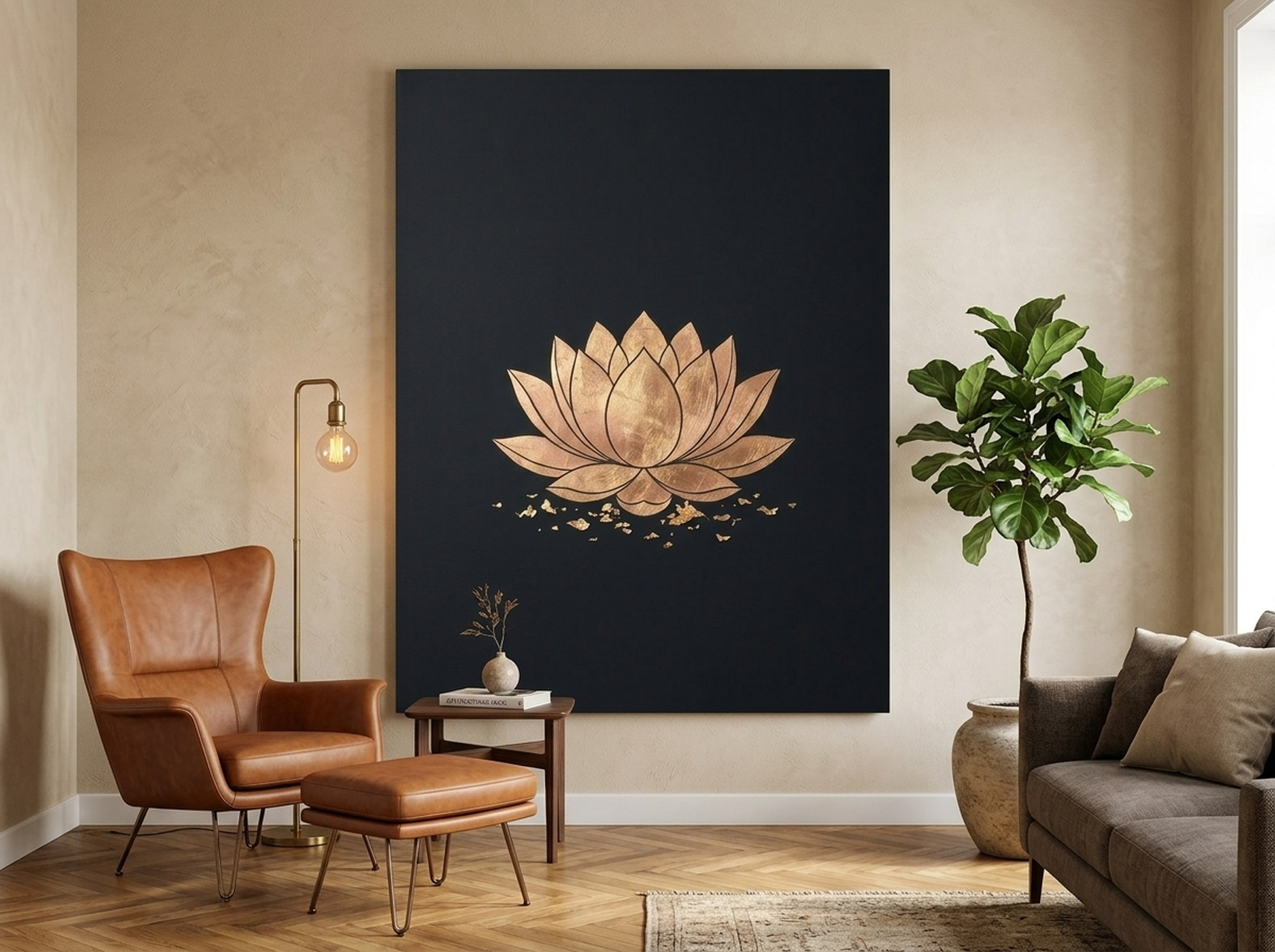
The lotus is a universal symbol of stillness rising from depth -- perfectly aligned with hygge's emphasis on finding peace within simplicity. This print pairs a precise, minimalist botanical composition with a matte black background and restrained gold detailing that adds warmth without excess. The black-and-gold palette is a modern Nordic statement: dramatic but controlled, rich but not loud. It suits bedrooms that use dark linen, charcoal, or midnight navy as base tones, and pairs naturally with brushed brass hardware and natural wood. For more about this style, see our guide to black and white wall art and how high-contrast minimalism works across design styles.
View the Lotus Minimalist Print
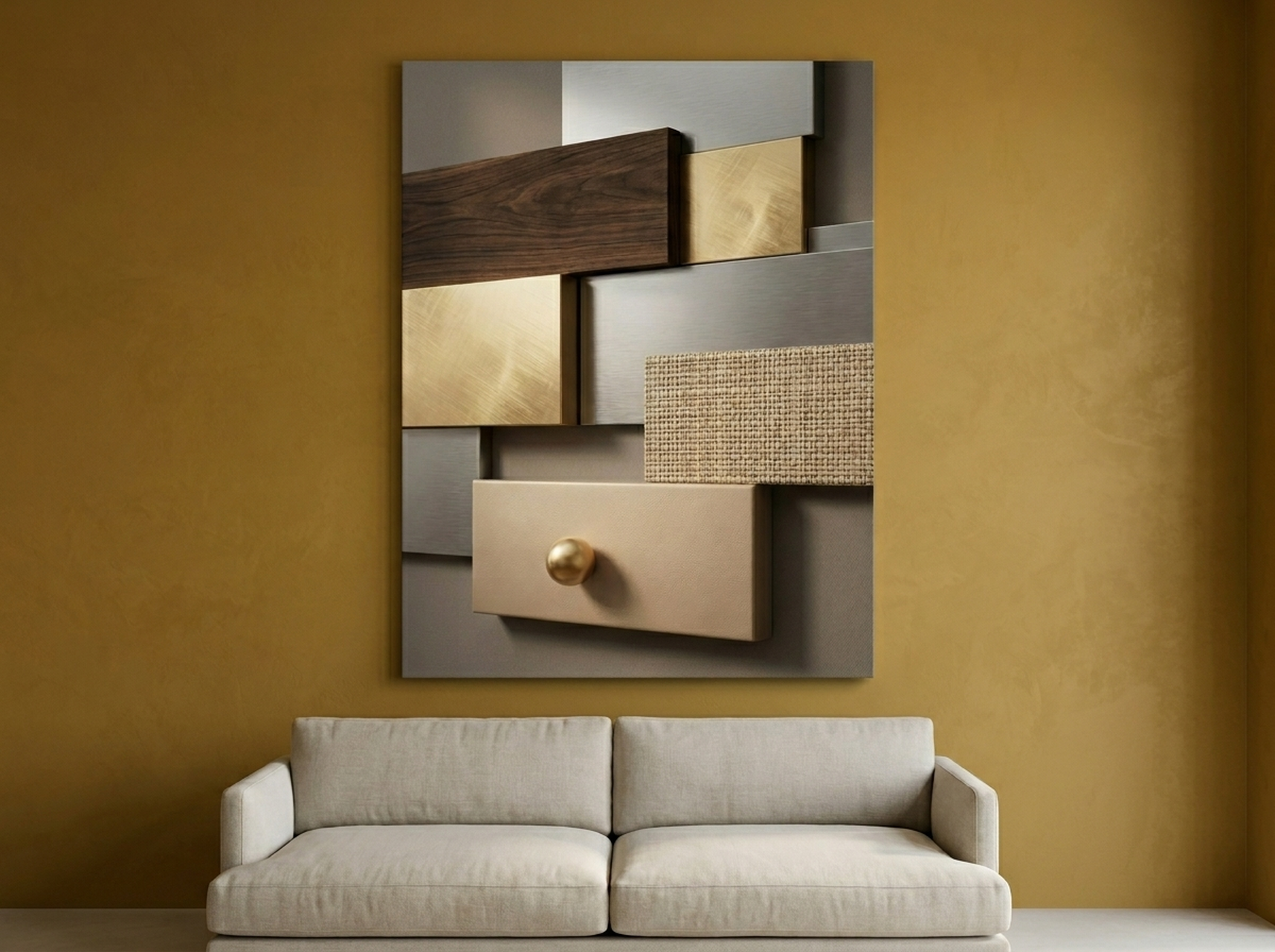
3. Geometric Texture Panels Walnut Gold Abstract Print
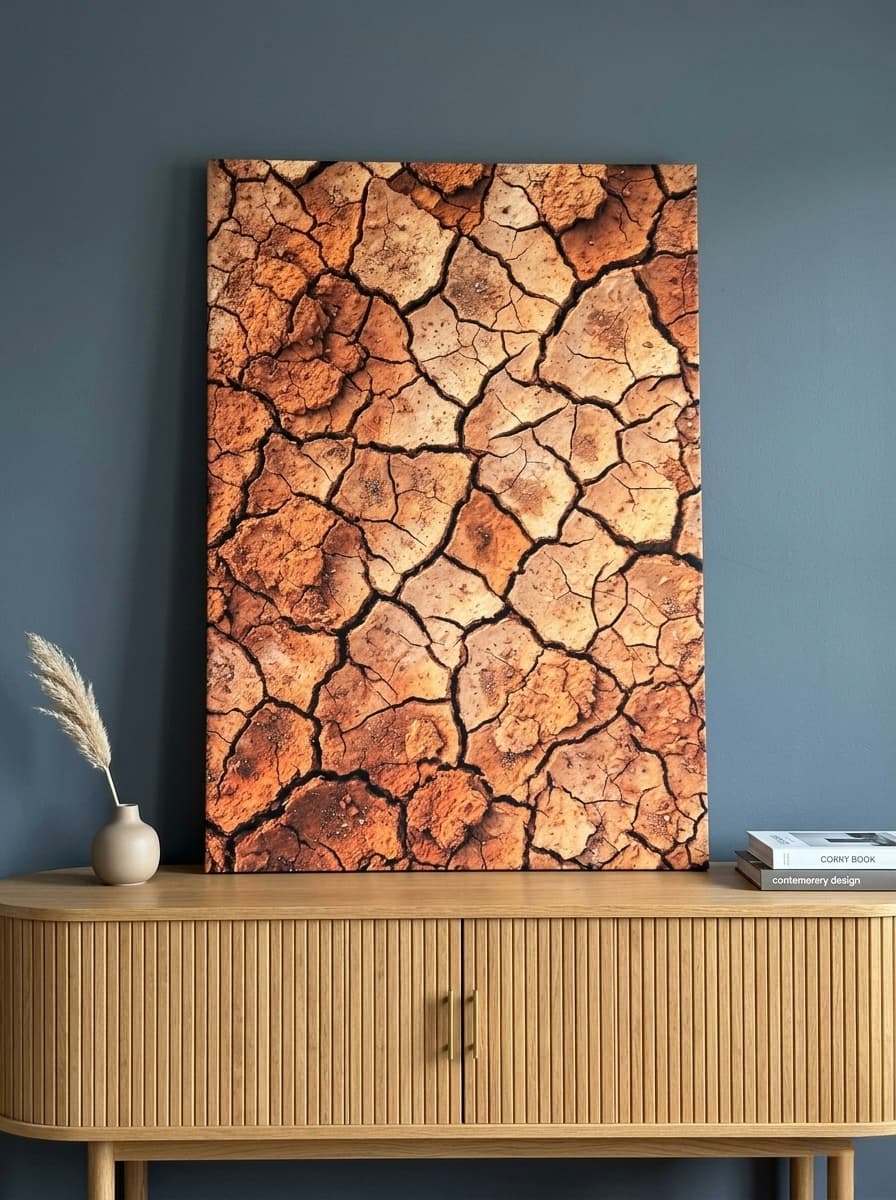
Abstract geometric art is a strong thread in Nordic design, rooted in the tradition of functional beauty and visual clarity. These walnut and gold texture panels bring warmth and earthy sophistication to a wall without a single representational image -- just form, texture, and tone working in harmony. The warm walnut browns and aged gold tones pull from the autumn palette of Nordic forests, making this print feel natural and grounded despite its abstract nature. It works beautifully in living rooms, home offices, or dining areas with warm wood furniture, terracotta accents, or cream upholstery. Hang it as a single large canvas for maximum Scandinavian impact.
View the Geometric Texture Panels
4. Blue Jay Minimalist Bird Painting
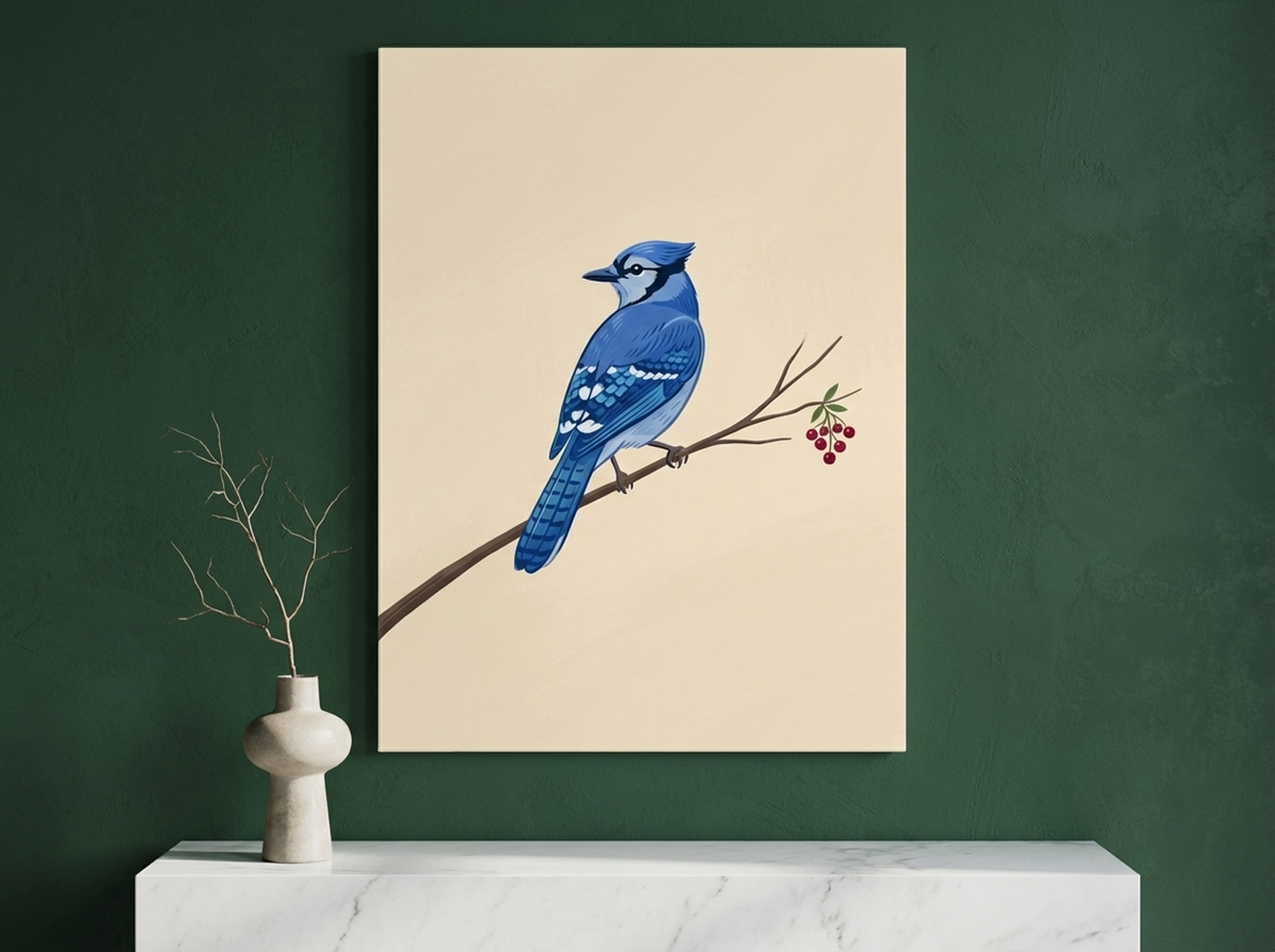
Wildlife bird art sits at the intersection of Nordic nature reverence and minimalist restraint. This blue jay portrait strips away all landscape context and focuses purely on the bird -- its posture, its distinctive crest, its striking cobalt and white plumage against a warm sand background. The result is a piece that feels both naturalistic and graphic, nature-connected and design-forward. The sand and soft blue palette fits seamlessly into Scandinavian bedrooms, nurseries, or reading corners that use cream, warm grey, or dusty blue as base colors. It carries the friluftsliv spirit -- a daily visual reminder of the living natural world outside -- in the most restrained possible form.
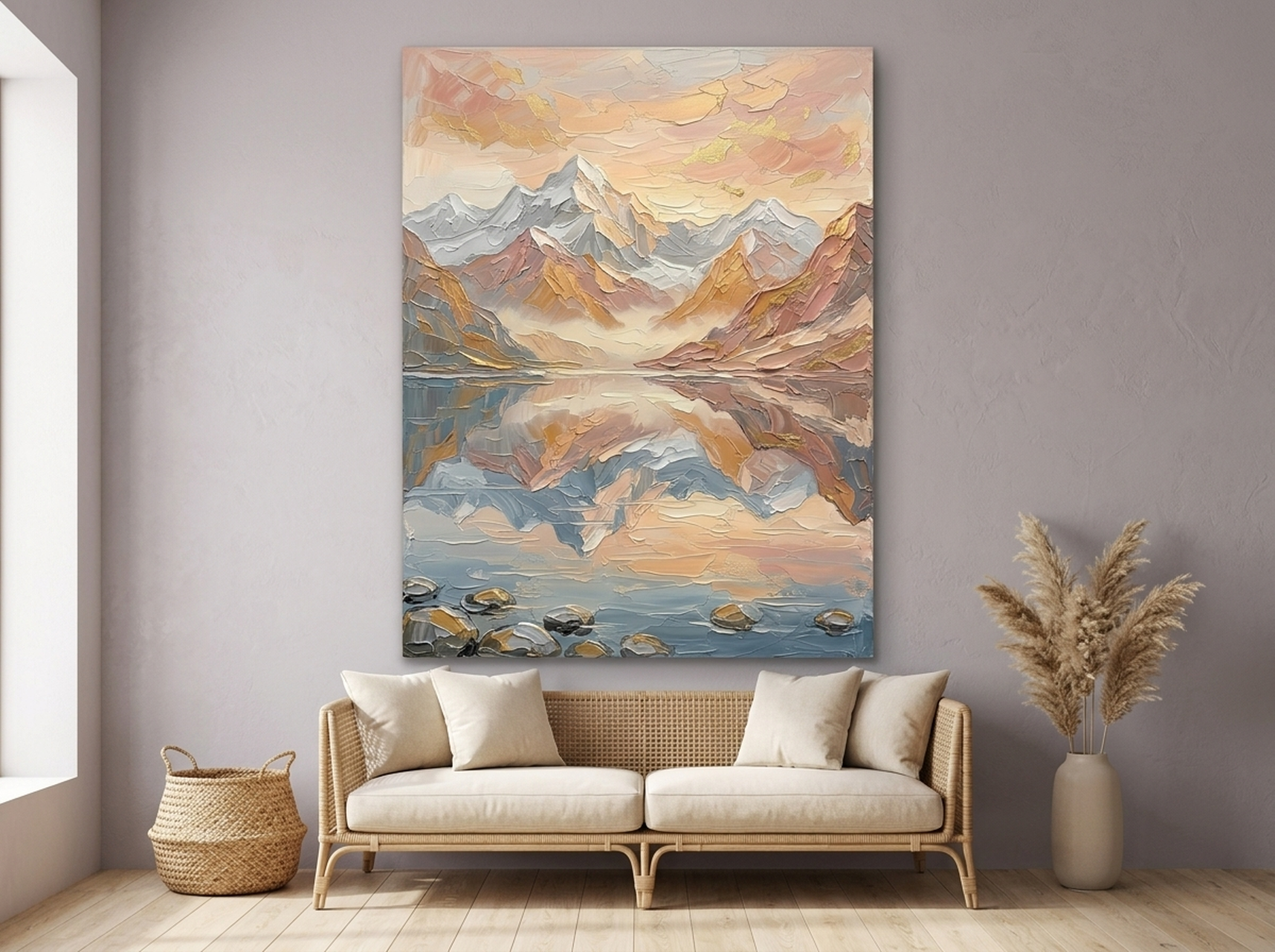
5. Alpine Mountain Impasto Reflection Peach Gold Print
This alpine mountain reflection is a masterclass in using warm color within a Nordic palette. Peach, blush gold, and warm cream tones -- rarely associated with Scandinavia's cooler reputation -- actually appear in abundance in Nordic summer and alpine sunsets, and this impasto-style rendering captures that golden-hour warmth with genuine beauty. The textured brushwork adds depth and tactility that elevates this beyond a flat print into something that repays close looking. It suits Scandinavian living rooms that lean warm: cream linen sofas, light oak floors, amber candlelight. A 80x100 cm (32x40 inches) version above a sofa would be exceptional.
View the Alpine Mountain Print
6. Birch Forest Autumn Trees Oil Painting
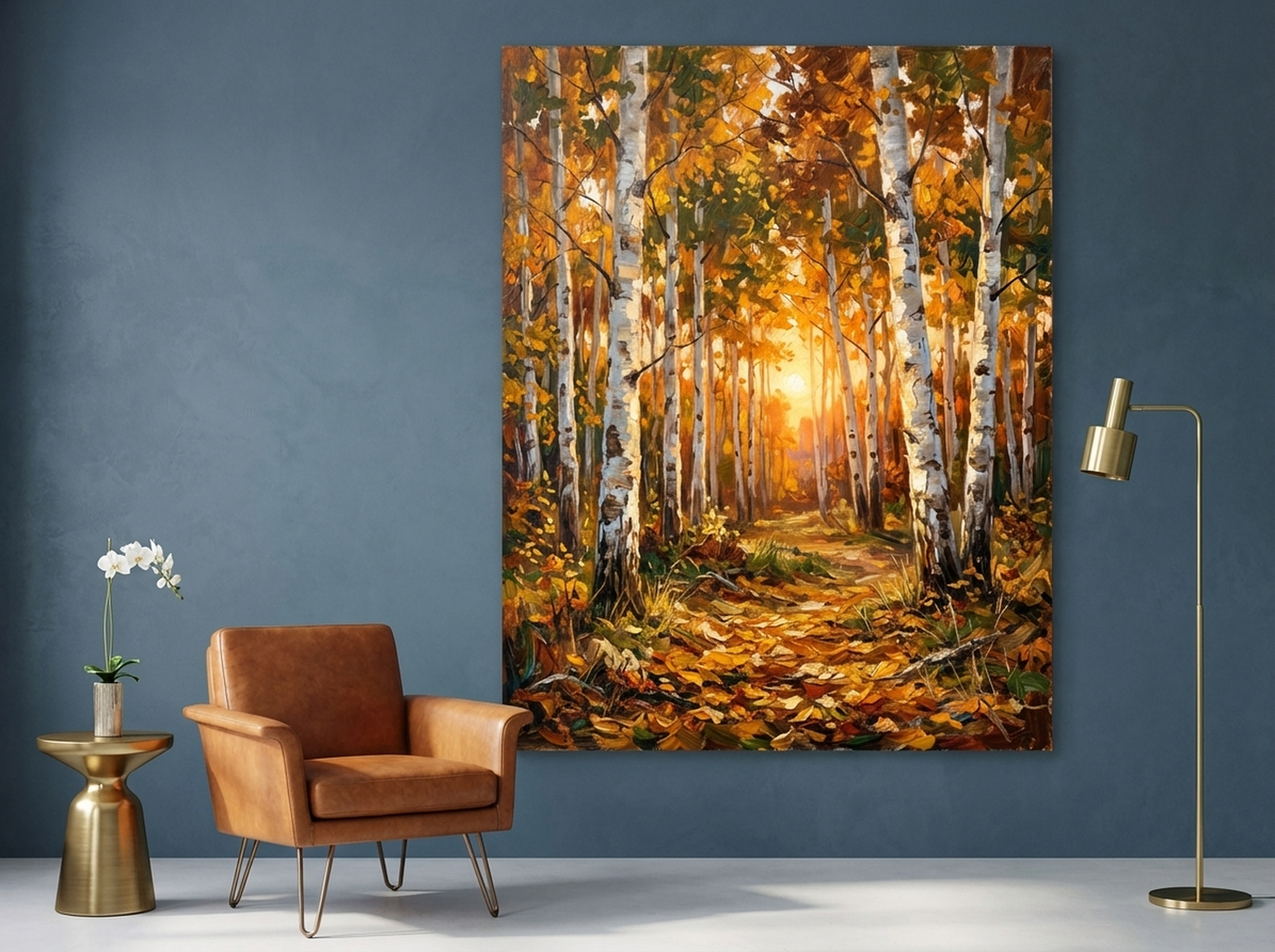
Birch forests are the defining landscape of Nordic countries -- pale silver trunks rising from a carpet of autumn leaves, their canopy flickering between gold and copper. This oil-style canvas painting captures that quintessentially Scandinavian scene with genuine painterly quality: warm amber and copper foliage against the white-silver of birch bark, light filtering through the upper branches. It is a deeply hygge piece -- warm, sheltering, beautiful in a quiet and unhurried way. It works powerfully in living rooms, bedrooms, and dining rooms that use natural wood, warm neutrals, or autumnal color schemes. Hang it at 145 cm (57 inches) center height with generous wall space on all sides for full Nordic effect.
5 Common Mistakes When Styling a Scandinavian Space With Art
Scandinavian design is deceptively simple. Achieving the genuine Nordic look requires avoiding a set of very common errors that undermine the principles of hygge, lagom, and friluftsliv.
Mistake 1: Overcrowding the Wall
The most common error is treating art like wallpaper. Gallery walls with 10, 15, or 20 frames are the opposite of Nordic design. Choose one piece per wall -- two at most in a large room -- and give each piece significant breathing room. Empty wall space in a Scandinavian interior is not neglect; it is restraint. It is intentional. It is the design principle of lagom made physical.
Mistake 2: Using Art to Fill a Gap Rather Than Tell a Story
In Nordic interiors, art is selected because it means something to the occupant -- a landscape that evokes a beloved place, a wildlife subject that carries personal resonance, a color palette that makes the room feel the way you want to feel in it. Buying art simply because it fills an empty space results in a room that looks furnished rather than lived in. Choose deliberately, and choose less.
Mistake 3: Choosing a Palette That Fights the Room
Scandinavian art should harmonize with its environment, not compete with it. A vivid abstract with electric blues and hot pinks will undermine a carefully assembled Nordic palette of cream, grey, and sage. Select art whose dominant colors appear elsewhere in the room -- in the upholstery, the wood tones, the textiles -- so that the piece feels native to the space rather than imported.
Mistake 4: Hanging Art Too High
This is nearly universal. Most people hang art at architectural height -- where it looks good in an empty room -- rather than at viewing height. In Nordic interiors where furniture sits lower and the emphasis is on comfort and connection, art hung too high feels disconnected from the living space. Center at 145 to 155 cm (57 to 61 inches) from the floor, consistently throughout the home. Above a sofa or headboard, leave 15 to 25 cm (6 to 10 inches) between the top of the furniture and the bottom of the frame.
Mistake 5: Choosing the Wrong Frame Material
An ornate gold baroque frame on a minimalist Nordic print is a category error. Natural wood frames -- light oak, pine, ash, or walnut -- reinforce the connection to natural materials that defines Scandinavian design. Thin matte black metal frames work for graphic, high-contrast pieces. Avoid plastic frames with faux wood grain, heavy gilded mouldings, or ornate carved details. The frame should be as restrained and honest as the art itself.
Frequently Asked Questions About Scandinavian Wall Art
- What is Scandinavian wall art?
- Scandinavian wall art is art that reflects the design principles of Nordic countries -- Denmark, Sweden, Norway, and Finland. It typically features minimalist compositions, nature-inspired subjects (landscapes, wildlife, botanicals), muted natural color palettes (greys, creams, teals, forest greens, warm ambers), and a quiet emotional restraint. It is guided by cultural concepts like hygge (Danish coziness), lagom (Swedish moderation), and friluftsliv (Norwegian nature connection).
- What colors are typical in Scandinavian wall art?
- The dominant palette draws from the Nordic natural environment: warm grey, soft cream and off-white, deep forest green, teal and slate blue, warm taupe, dusty sage, and accents of amber or gold. Bright saturated primaries are rare. The goal is a palette that harmonizes with the environment rather than competing with it -- colors that could plausibly appear in a Nordic forest, fjord, or winter sky.
- How does Scandinavian wall art differ from minimalist art?
- All Scandinavian art tends toward restraint, but not all Scandinavian art is minimalist in the strict sense. Nordic art encompasses rich landscape paintings, detailed wildlife portraits, and impressionist forest scenes that have significant visual complexity -- just without excess. The difference is that Scandinavian art is always nature-connected and emotionally grounded, whereas minimalist art can be purely geometric or abstract. Scandinavian art uses restraint in service of a feeling; minimalism uses restraint as an end in itself.
- What size art suits a Scandinavian living room?
- For a Scandinavian living room, a single canvas of 80x100 cm (32x40 inches) or larger is recommended for a sofa wall. One large piece is more Nordic in character than multiple smaller prints. The canvas should be roughly two-thirds the width of the sofa and hung so its center sits at approximately 145 to 155 cm (57 to 61 inches) from the floor.
- Can I mix Scandinavian art with other decor styles?
- Yes -- Scandinavian art pairs particularly well with Japandi (the Japanese-Scandinavian fusion), wabi-sabi, coastal, and biophilic design styles, all of which share the Nordic commitment to natural materials, muted palettes, and visual calm. It can also work with contemporary and transitional interiors as long as the surrounding palette is restrained. The one mismatch is maximalist or heavily ornate styles (Hollywood Regency, baroque, eclectic) where Scandinavian art's quietness tends to get lost.
- What is hygge in home decor?
- Hygge (pronounced "hoo-gah") is a Danish concept describing a quality of coziness and comfortable well-being. In home decor, hygge is achieved through warm lighting, natural textures, and the deliberate choice of objects -- including art -- that create comfort rather than stimulation. Hygge wall art tends to feature warm, muted tones, nature subjects, and simple compositions that invite you to slow down rather than demanding attention. It is the feeling of sitting in a candlelit room, warm and content, looking at a painting of a birch forest in autumn light.
Quick Reference: Scandinavian Wall Art at a Glance
| Product | Best For | Dominant Colors | View |
|---|---|---|---|
| Norwegian Fjord Mountain | Living room feature wall, large spaces | Teal, slate blue, mist grey | View |
| Lotus Gold Leaf Minimalist | Bedroom, dark accent walls | Matte black, warm gold | View |
| Geometric Texture Panels | Home office, dining room | Walnut brown, aged gold, cream | View |
| Blue Jay Minimalist Bird | Bedroom, nursery, reading corner | Cobalt blue, warm sand, white | View |
| Alpine Mountain Impasto | Warm living rooms, above sofa | Peach, blush gold, cream | View |
| Birch Forest Autumn Trees | Living room, bedroom, dining room | Copper, amber gold, silver white | View |
Bring Nordic Calm Into Your Home
Scandinavian wall art is not just a trend. It is the visual expression of a set of values -- restraint, nature connection, genuine comfort, and the courage to choose less -- that have made Nordic countries among the happiest and most livable places on earth for generations. When you hang a single, well-chosen piece of Nordic-inspired art on your wall and give it the space it deserves, you are not simply decorating. You are practicing hygge. You are applying lagom. You are bringing a fragment of friluftsliv indoors.
The pieces in this guide are a starting point, but HEVA Unique Art Gallery offers a wide range of Scandinavian-inspired and nature-themed canvas prints across every price point and room type. Each is produced as a high-quality framed canvas, ready to hang, with the color fidelity and print quality that Nordic-style interiors demand.
Browse the full collection, find the piece that speaks to your space, and give it the wall it deserves.
Browse All Scandinavian Wall Art
Looking for related inspiration? Explore our guides to japandi wall art, biophilic design and nature art, and framed canvas art -- all part of our commitment to helping you create a home that genuinely feels like yours.