Abstract vs Landscape Wall Art: Which Style Is Best for Your Home?
The Heva Team
Art Curators & Interior Design Enthusiasts · April 6, 2026 · 18 min read
You're standing in a furniture store, staring at two canvas prints side by side: one is a swirling, color-drenched abstract, the other a sweeping mountain vista at golden hour. Your gut pulls you in two directions at once, and you leave empty-handed. We know exactly how that feels, and we're here to end the confusion for good.
Ready to browse both styles? Explore the full HEVA collection and discover your perfect piece.
What Is Abstract Wall Art?
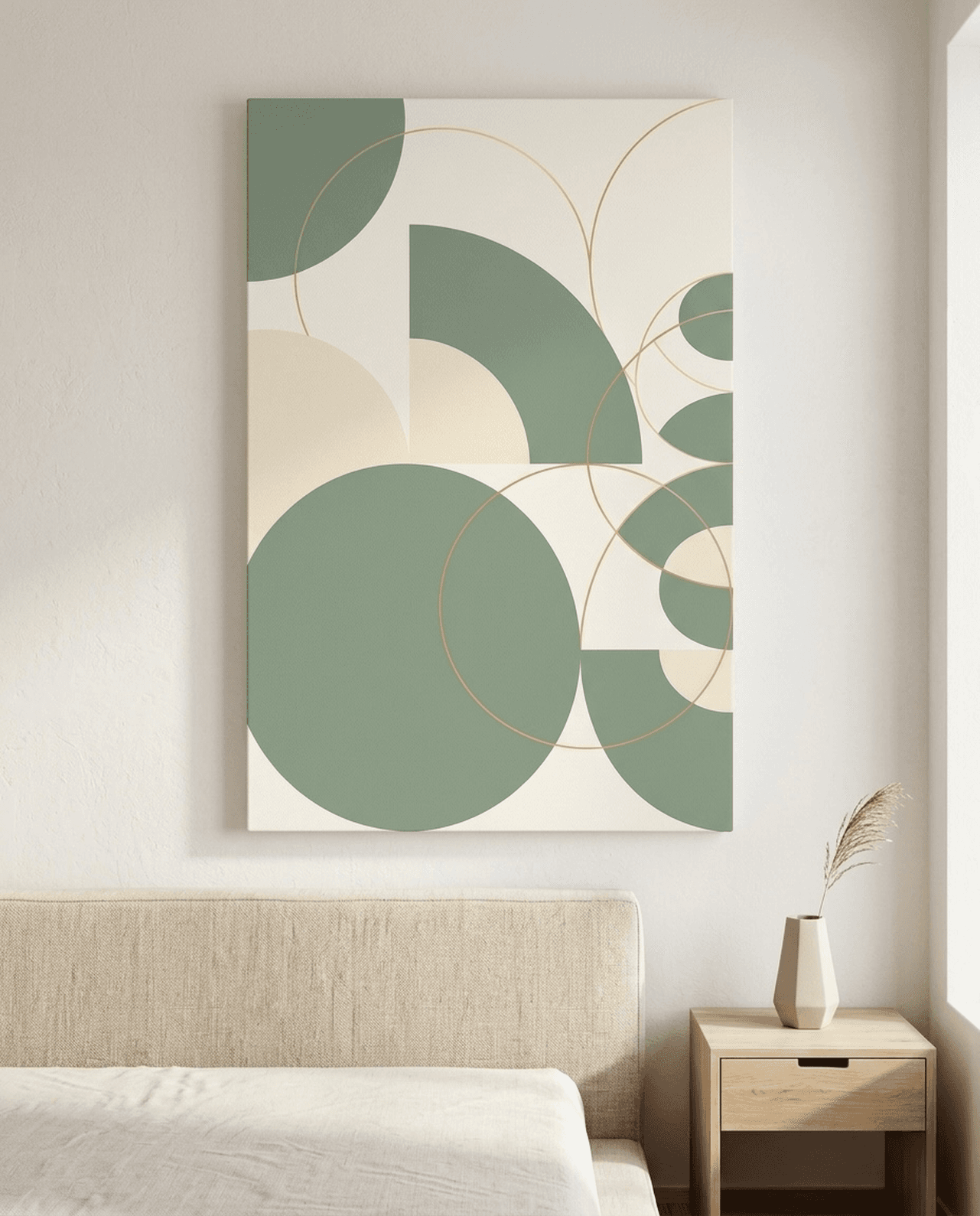
Abstract wall art is any work that does not attempt to represent an accurate picture of visual reality. Instead, it uses shapes, colors, forms, and gestural marks to achieve its effect. In our experience working with hundreds of home decorators, abstract art is the style that sparks the most conversation in a room, because every person who looks at it brings their own interpretation to the piece.
The roots of abstract art stretch back to the early 20th century, when Wassily Kandinsky, widely regarded as the father of abstract painting, argued that color and form could communicate emotion the same way music does. Today, that philosophy lives on in everything from bold geometric canvases to fluid, layered pour paintings. According to the Association for Psychological Science, the brain actually finds pleasure in processing abstract art, because the open-ended imagery activates the brain's reward systems as it searches for meaning. Research published in Frontiers in Psychology (Frontiers, 2019) confirms that engaging with art directly links aesthetic emotion to psychological well-being.
Abstract art works across an enormous range of interior styles. A high-contrast black and white geometric piece can anchor a minimalist Scandinavian living room, while a warm amber and terracotta pour painting softens an industrial loft. We've found that abstract art is particularly effective in rooms where you want energy, dynamism, or a focal point that is not tied to a specific place or season. It is also the go-to style when you need to introduce color without committing to a figurative subject, giving you maximum flexibility as your decor evolves over time.
Price-wise, abstract canvas prints typically range from around $40 to $200 (roughly $40 to $200 USD or 35 to 180 euros) depending on size and framing, with gallery-wrapped canvases commanding a modest premium for their clean, frame-free look. At HEVA, our abstract pieces start at sizes as small as 20 x 25 cm (8 x 10 inches) and scale up to statement-making 60 x 90 cm (24 x 36 inches) formats.
What Is Landscape Wall Art?
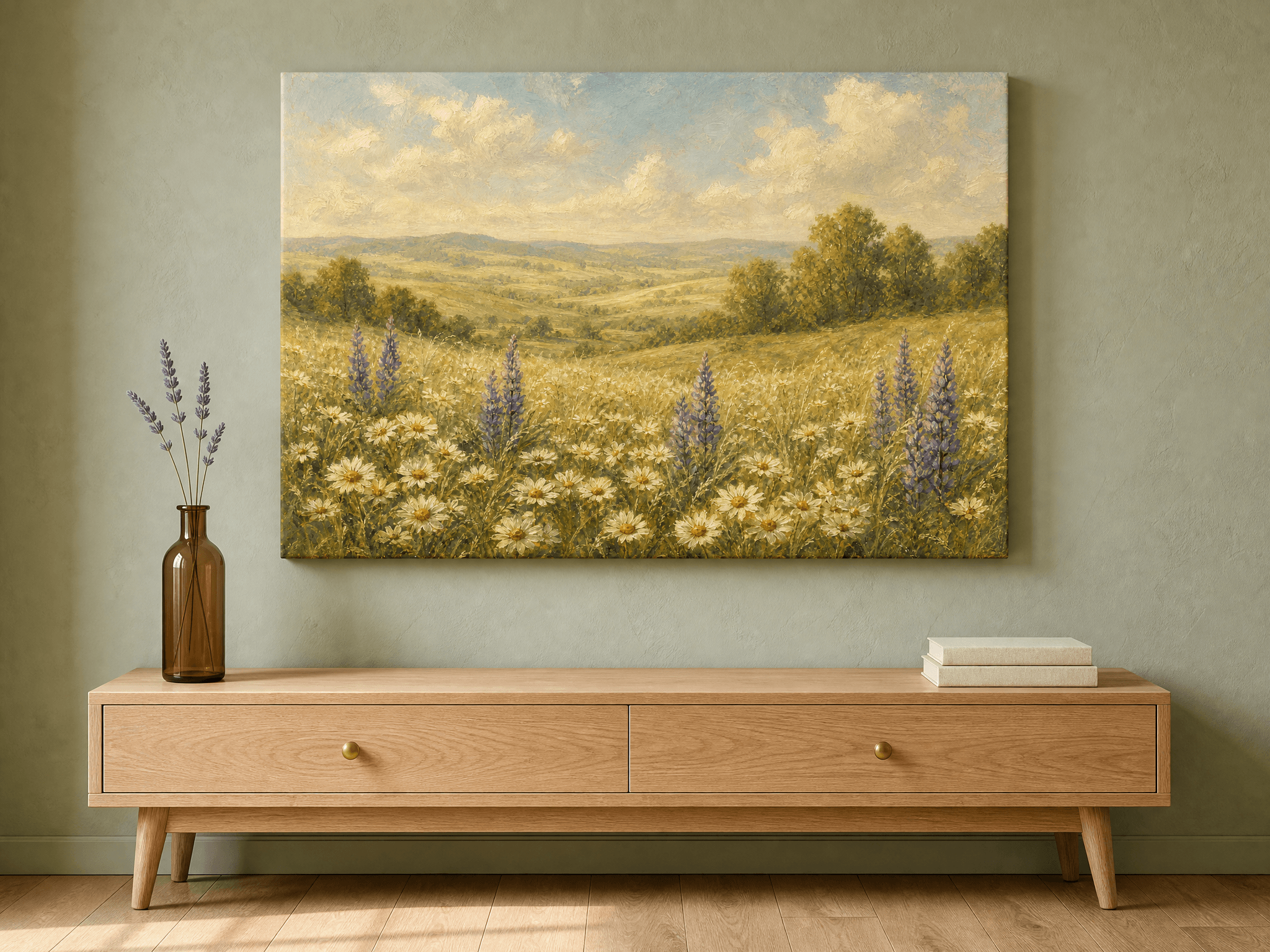
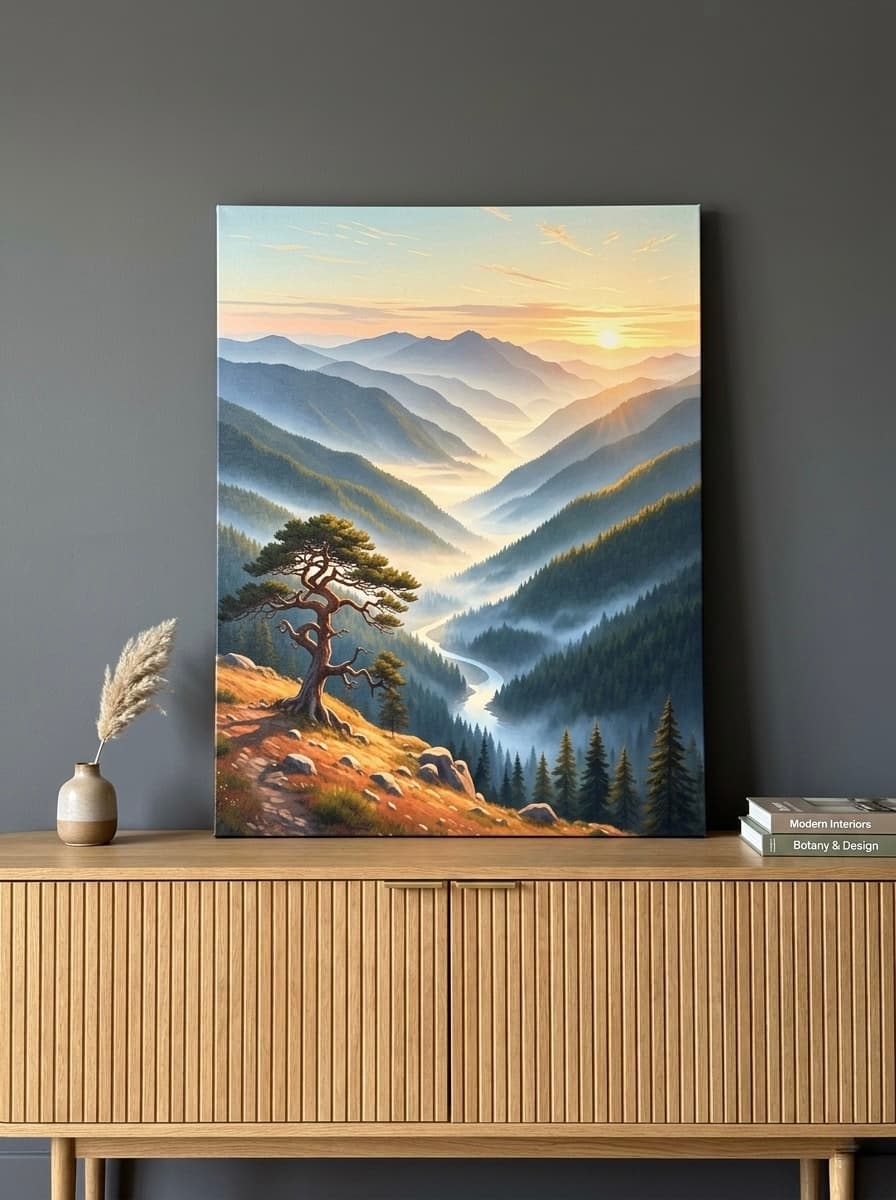
Landscape wall art depicts natural environments: mountains, forests, oceans, deserts, meadows, or the sweeping drama of an aurora borealis. It is the oldest genre in decorative art, tracing a lineage from the Dutch Golden Age painters of the 1600s all the way to today's high-resolution photographic prints. Our customers tell us that landscape art is the style they reach for when they want a room to feel calm, grounded, and connected to something larger than the four walls around them.
The appeal of landscape art is backed by science. A scoping review published in PMC (PubMed Central, PMC, 2021) found consistent evidence that viewing nature-themed visual art reduces self-reported stress. Separate research from Frontiers in Psychology showed that cortisol levels, the body's primary stress hormone, dropped measurably in participants after spending just 20 minutes engaging with nature imagery. For rooms like bedrooms, reading nooks, and home offices, that physiological calming effect is genuinely valuable.
Landscape art also has a powerful ability to visually expand a space. A wide-format panoramic print of a Norwegian fjord, hung on the far wall of a narrow hallway, creates an illusion of depth that can make the space feel up to 30% more open. In our experience, this is one of the most underused tricks in apartment decorating. When you cannot knock down a wall, you hang a landscape.
The tonal range of landscape art is almost infinite. Cool blue and teal fjord scenes work beautifully in bathrooms and bedrooms. Warm terracotta canyon prints energize dining rooms and entryways. Forest greens bring life to home offices. Whether photorealistic or painterly in style, landscape art carries a timeless quality that does not go out of fashion the way trendy decor accessories sometimes do.
Comparing Styles: Which Room Benefits Most?
Choosing between abstract vs landscape wall art is rarely about one style being objectively better. It is about fit: the room, the light, the function, and the feeling you want to cultivate. Here is how we break it down room by room.
Living Room
The living room is the highest-stakes wall in most homes, because it sets the tone for guests and family alike. We've found that abstract art excels here when your furniture is neutral, because a single bold abstract canvas, ideally 90 x 60 cm (36 x 24 inches) or larger, gives the room a personality without competing with upholstery patterns. Landscape art works equally well in living rooms when you want a more welcoming, serene atmosphere, particularly in open-plan spaces where the living area flows into a dining area and you want continuity rather than contrast. Check out our guide on choosing the right wall art size for more advice on scale in large rooms.
Bedroom
The bedroom is where landscape art has a clear edge, in our opinion. The restorative quality of nature imagery supports sleep hygiene in ways that high-energy abstract art does not. Soft forest scenes, misty mountain views, and calm ocean horizons all promote a sense of safety and ease. That said, abstract art in muted, tonal palettes, think soft grays, dusty blush, or warm cream with gentle gestural marks, can work beautifully above a bed as a headboard alternative. The key is to avoid high-contrast, visually stimulating abstract pieces in the bedroom.
Home Office
For home offices, the data leans toward landscape art. Research consistently shows that nature imagery reduces cognitive fatigue during sustained mental work. A 50 x 70 cm (20 x 28 inch) landscape positioned at eye level in your peripheral vision can provide micro-restorative breaks without pulling your focus. That said, many creatives, designers, writers, and artists prefer abstract art in their workspaces, because the open-ended imagery keeps the imagination active. Know your working style before choosing.
Dining Room
Dining rooms are social, convivial spaces, and abstract art thrives here. A vibrant abstract piece sparks conversation over dinner in a way that a calming landscape rarely does. We recommend warm-toned abstract works in terracotta, amber, gold, or deep red for dining spaces, as these hues are known to stimulate appetite and social engagement. See our post on creating a focal point with accent wall art for specific dining room strategies.
Hallway and Entryway
Hallways benefit enormously from landscape art due to the depth illusion effect mentioned earlier. A horizontal panoramic landscape, 90 x 30 cm (36 x 12 inches) or wider, can make a narrow corridor feel twice as spacious. Abstract art works in entryways when you want to make a bold first impression, but keep the scale proportionate since entryways are usually tight spaces where very large abstract pieces can feel overwhelming.
How to Choose Based on Your Personality
Interior designers will tell you that your instinctive response to art is a reliable guide to what you actually live with happily. Here is a simple framework we use with our customers.
You are drawn to abstract art if: You enjoy ambiguity and open interpretation. You like your home to feel current, creative, and a little unexpected. You gravitate toward statement pieces rather than safe choices. You redecorate often and want art that can travel between different rooms as your style evolves. You respond more to color and mood than to narrative or subject matter. Psychology Today notes that people who score higher on the personality trait of openness to experience consistently prefer abstract art over representational styles, which aligns with what we see in our own customer data.
You are drawn to landscape art if: You want your home to feel like a sanctuary. You find nature calming and restorative. You prefer art that tells a clear story or transports you to a specific place. You entertain guests who may not share your aesthetic sensibility and you want broadly appealing art that everyone enjoys. You have a neutral, natural palette in your furnishings and want the art to complement rather than dominate. Our customers who choose landscape art consistently describe their decorating goal as creating a home that feels like a deep exhale after a long day. That is an entirely valid and beautiful design intention.
You cannot decide: Choose a piece that bridges both worlds. Fluid abstract landscape art, think impressionistic seascapes, painterly forest scenes, or abstract mountain ranges, gives you the expressive freedom of abstract art while retaining the grounding quality of a recognizable natural subject. This hybrid category is one of our best-performing styles at HEVA, and it is our top recommendation for decorators who feel pulled in both directions. For more on how art interacts with different wall colors, see our guide on wall art for green walls and nature pairings.
Our Top 6 Product Picks
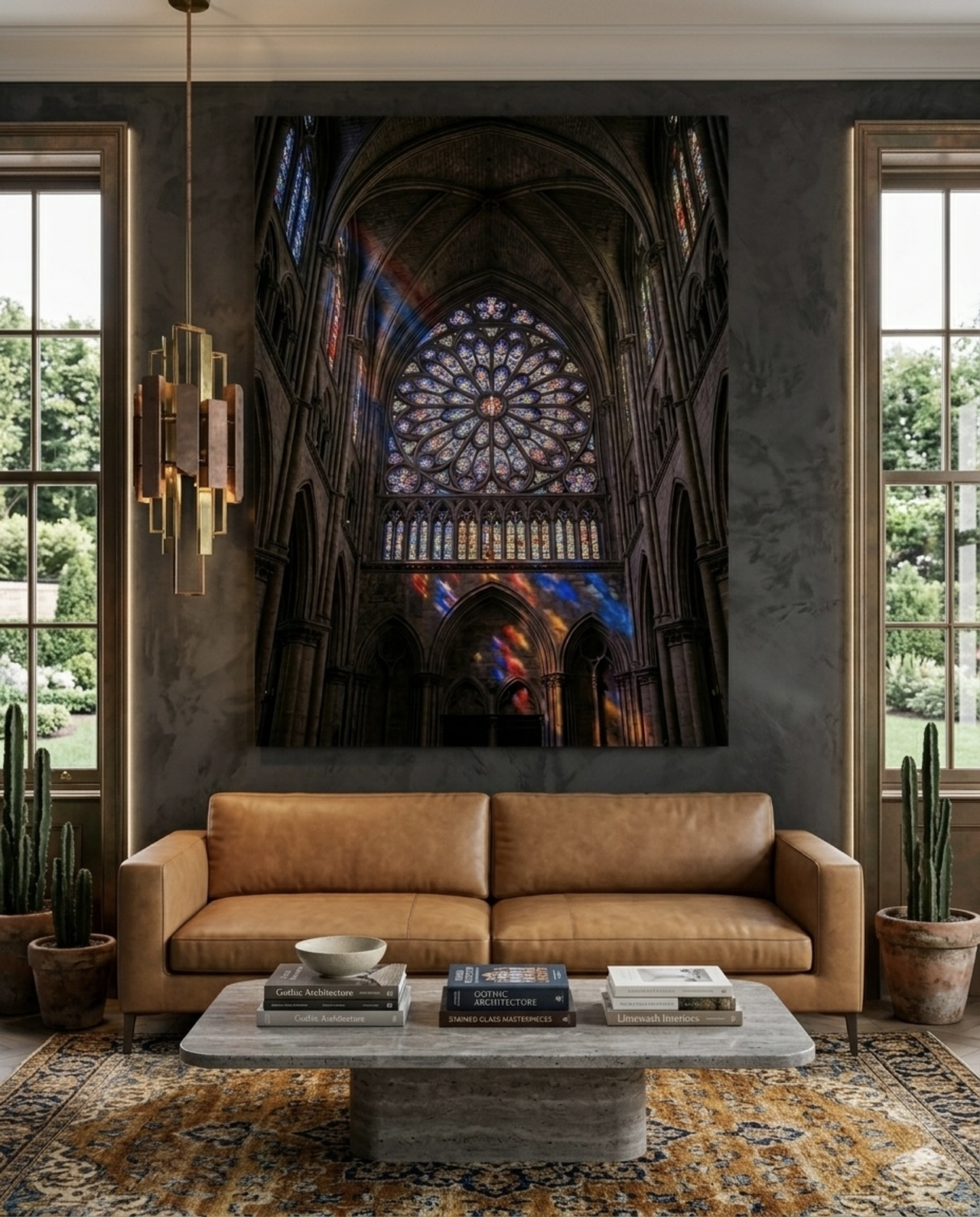
We hand-selected these six pieces to represent both styles at their best. Each one has been chosen for quality, versatility, and the ability to anchor a real room in a real home.
1. Geometric Texture Panels Canvas Wall Art
This striking piece proves that abstract art can be both bold and warm. The walnut and gold tonal palette brings a sophisticated richness that feels at home in both modern and transitional interiors. We've found it works especially well as a set piece above a credenza or console table in a dining room or entryway, where the geometric structure creates a sense of order without feeling cold. At 60 x 90 cm (24 x 36 inches), it commands attention without overwhelming a standard wall. View Geometric Texture Panels
2. Northern Lights Canvas Wall Art
This is landscape art at its most transportive. The deep navy and electric green of an aurora borealis scene creates a sense of wonder and scale that is genuinely difficult to achieve with any other subject. Our customers tell us this piece transforms bedrooms and living rooms with equal ease, its cool color palette promoting calm in sleeping spaces while its dramatic sky creates a conversation-stopping focal point in social rooms. Hang it at 150 cm (59 inches) from the floor to the center of the canvas for the most natural, gallery-like effect. View Northern Lights
3. Norwegian Fjord Canvas Wall Art
The Norwegian fjord is one of the most naturally dramatic landscapes on earth, all vertical cliffs, glassy water, and teal blue sky, and this canvas captures that drama with painterly precision. In our experience, teal-dominant landscape art is one of the most versatile color choices for a home, pairing beautifully with warm wood tones, white walls, and even deep charcoal or navy furniture. This piece is ideal for bathrooms, bedrooms, and home offices where the cooling tones support relaxation and focus. We recommend sizing up to at least 50 x 70 cm (20 x 28 inches) for this scene to give the fjord the space it deserves. View Norwegian Fjord
4. Canyon Aerial Desert Landscape Canvas Wall Art
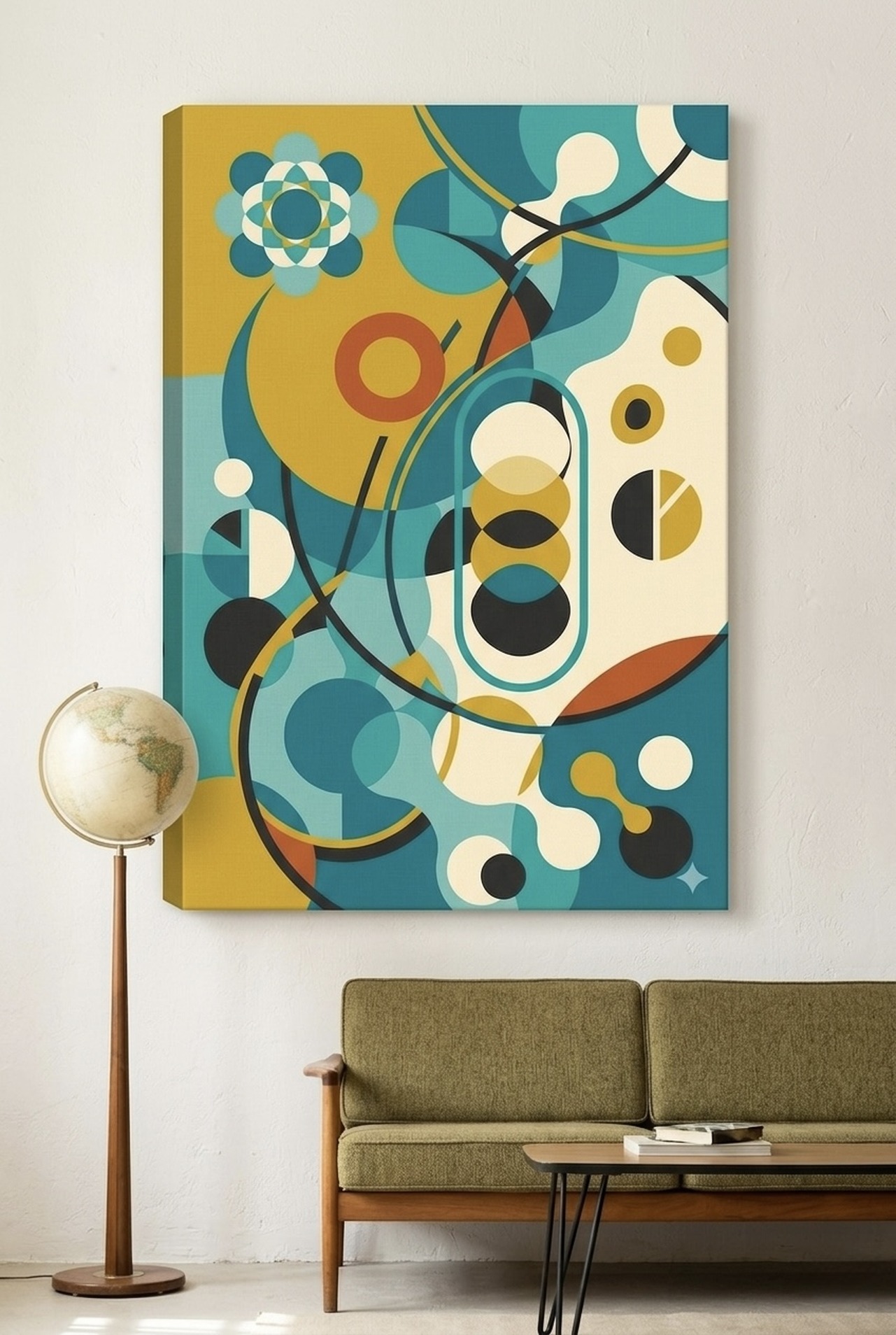
Seen from above, the American Southwest becomes pure abstract geometry: ribbons of terracotta, amber, and rust carving through ancient rock. This aerial canyon view sits perfectly at the intersection of landscape and abstract art, making it our top pick for decorators who cannot choose between the two styles. The warm earth tones make it an outstanding choice for dining rooms, living rooms with leather or natural linen furniture, and any space that leans into a Southwestern or bohemian aesthetic. It pairs beautifully with rattan, raw wood, and woven textiles. View Canyon Aerial Landscape
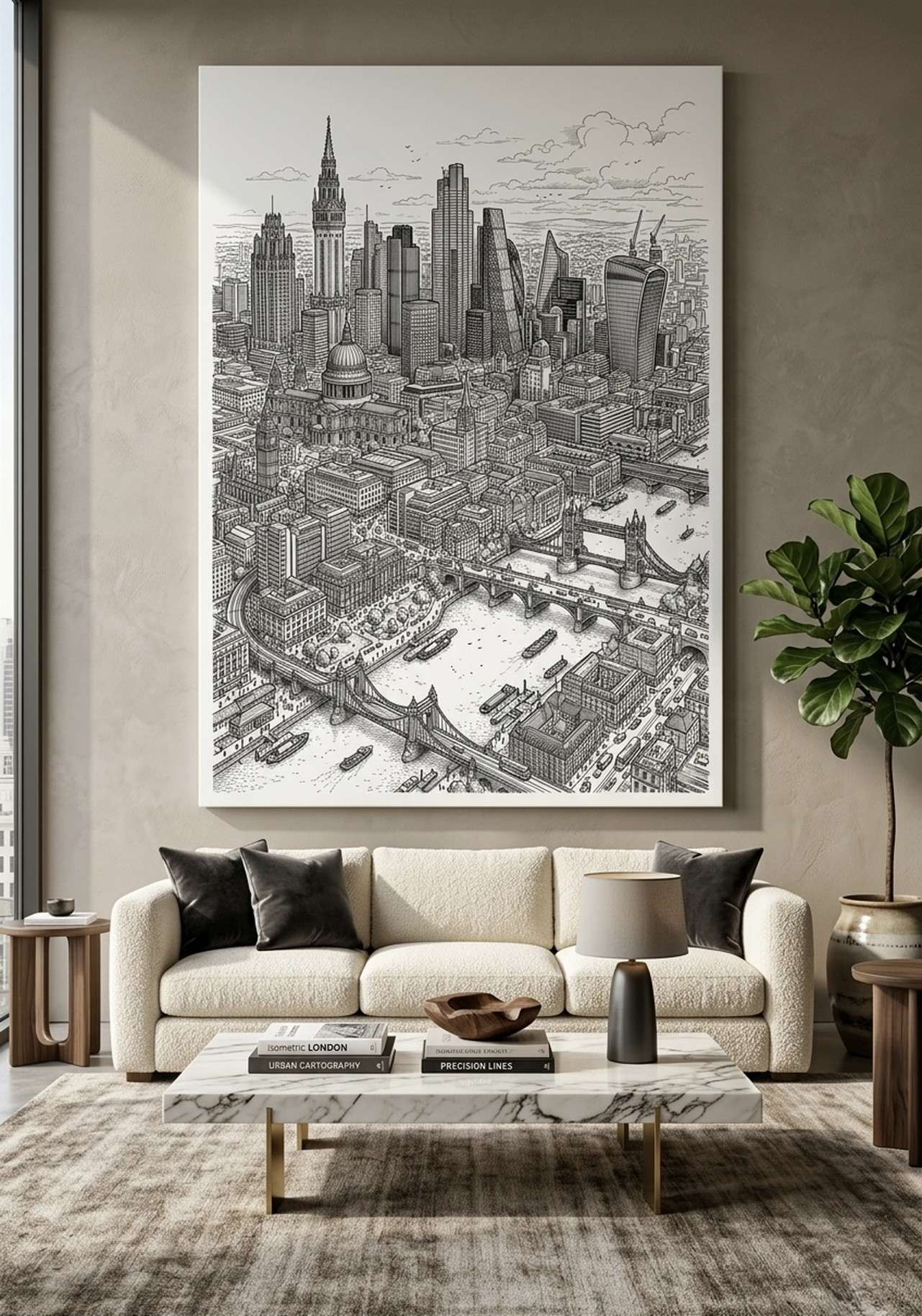
5. Bear Canvas Wall Art Abstract Grizzly
This painterly abstract grizzly bear is a masterclass in how figurative and abstract art can coexist in a single piece. The teal and moody palette gives this wildlife portrait an almost dreamlike quality, making it feel like art rather than a naturalistic illustration. We've found this piece resonates deeply with customers who want to express a connection to nature and wilderness without choosing a traditional landscape scene. It works exceptionally well in living rooms, cabins, reading nooks, and any space with a masculine, adventurous, or outdoor-inspired sensibility. View Bear Abstract Grizzly
6. Disco Ball Forest Green Canvas Print
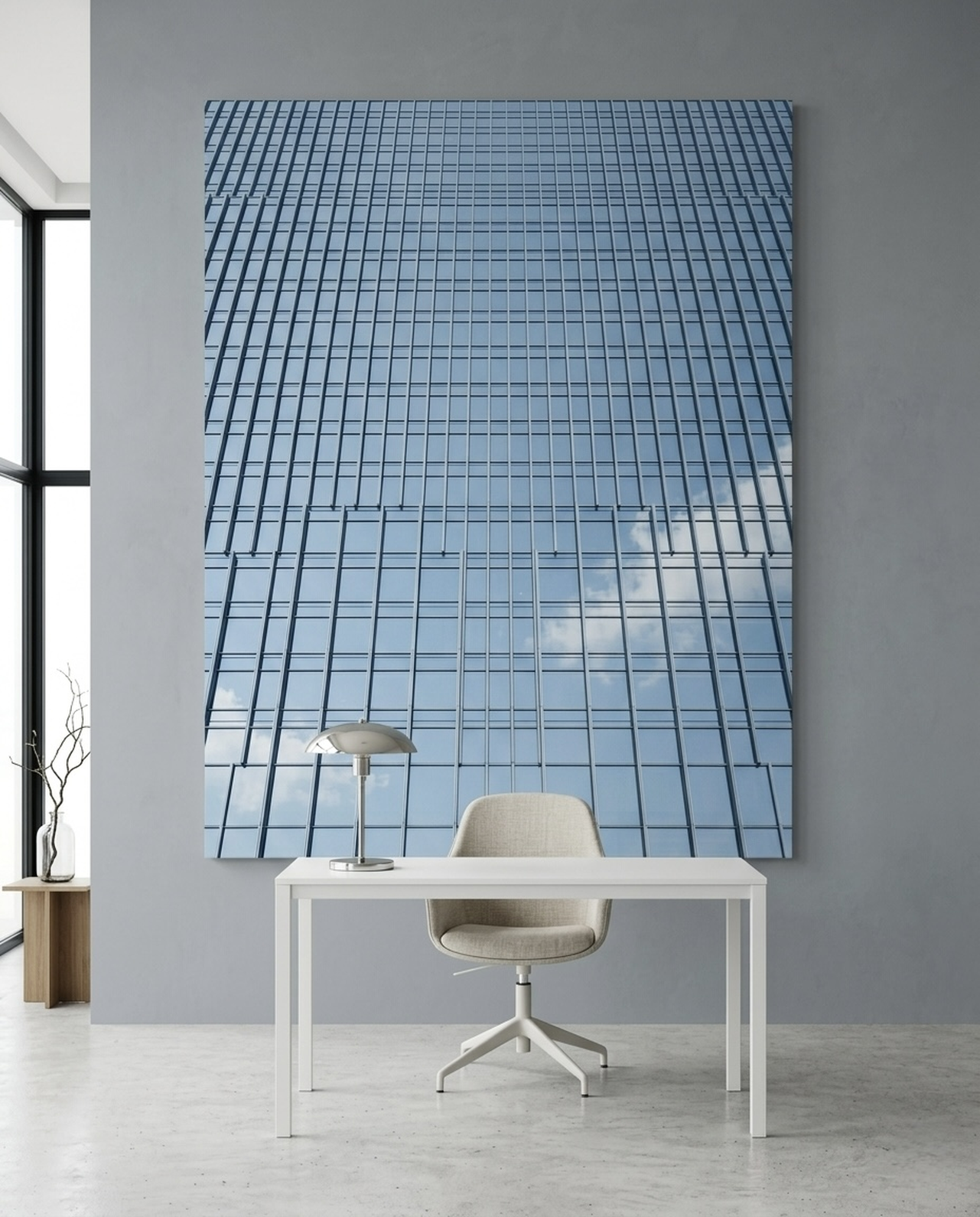
This is the most unexpected piece in our selection, and deliberately so. A disco ball set against deep forest green is neither purely abstract nor purely landscape, it is conceptual, playful, and unapologetically original. Our customers who choose this piece tend to be decorators who have already mastered the basics and are ready to add a layer of personality and wit to their spaces. It is ideal for maximalist living rooms, creative studios, home bars, and any space where you want to signal that you take your design choices seriously but not yourself. Do not overlook how the reflective quality of the disco ball imagery brings an almost physical sense of light into a room. View Disco Ball Forest Green
Placement Guide with Measurements
Even the most beautiful piece of art will underperform if it is hung in the wrong spot or at the wrong height. Here is our definitive placement guide for both abstract and landscape canvas wall art.
Hanging Height
The universal rule is to hang art so that its center sits at approximately 145 to 152 cm (57 to 60 inches) from the floor, which corresponds to average human eye level. In a room with standard 240 to 250 cm (94 to 98 inch) ceilings, this creates a balanced relationship between the art and the space above and below it. When hanging art above furniture such as a sofa, dresser, or console table, leave a gap of 15 to 20 cm (6 to 8 inches) between the top of the furniture and the bottom of the frame. Art that floats too high above furniture feels disconnected; art that sits too close feels cramped.
Size Recommendations by Room
For a standard living room sofa (180 to 210 cm, or 70 to 83 inches wide), the art above it should span 60 to 75% of the sofa's width, so aim for a canvas between 110 and 155 cm (43 and 61 inches) wide. For a bedroom wall above a queen-size bed (153 cm, or 60 inches wide), a canvas of 90 to 130 cm (35 to 51 inches) wide works well. For a hallway, keep widths to 30 to 60 cm (12 to 24 inches) and favor horizontal formats to enhance the sense of flow and depth. For a home office feature wall, a 50 x 70 cm (20 x 28 inch) piece is the sweet spot: substantial enough to matter, small enough not to distract.
Lighting
Abstract art with metallic, glossy, or high-contrast elements benefits from directional lighting, specifically a picture light or an angled spotlight positioned 30 to 45 cm (12 to 18 inches) above the canvas and angled at 30 degrees. Landscape art with softer, more diffused tones looks best in natural daylight or warm ambient lighting (2700K to 3000K color temperature). Avoid placing landscape art directly opposite a window where glare will wash out the colors; instead, hang it on a side wall where natural light falls across it obliquely.
For more detailed advice on displaying framed vs. unframed canvas prints, see our guide on framed canvas wall art: is it worth the upgrade?
5 Common Mistakes to Avoid
- Hanging art too high. This is the single most common error we see. Art hung higher than 152 cm (60 inches) to its center feels like it is floating near the ceiling rather than integrated into the room. Always measure before you hammer the nail.
- Choosing art that is too small for the wall. A 30 x 40 cm (12 x 16 inch) print on a 3-meter (10-foot) wide wall looks like a postage stamp. When in doubt, go larger. A canvas that fills 60 to 75% of a wall or furniture width is almost always the right call.
- Matching art colors too literally to your decor. Art should complement a room's palette, not copy it exactly. If your sofa is teal, a pure teal painting will blend into the background. Choose art with teal as one element among a broader palette, so the piece stands out while still feeling cohesive.
- Ignoring the room's function when choosing between abstract and landscape. Placing a high-energy, high-contrast abstract piece in a bedroom optimized for sleep is a genuine interior design mistake, not just a matter of taste. Match the emotional energy of the art to the intended use of the room.
- Buying art without considering frame finish. The frame is not a detail; it is part of the design. A black frame on a landscape print creates crisp, modern definition. A natural wood frame warms the same image and connects it to organic decor. An espresso frame adds depth and drama. Always visualize the frame finish alongside your existing furniture before purchasing.
Frequently Asked Questions
- Is abstract or landscape wall art more popular for living rooms?
- Both styles are popular for living rooms, but abstract wall art tends to be the top choice for modern and contemporary interiors because it adds bold visual energy without competing with furniture or decor. Landscape art is preferred in more traditional, transitional, or nature-inspired living rooms where a calming, grounded atmosphere is the goal.
- Can abstract and landscape art work together in the same room?
- Yes, mixing abstract and landscape art in the same room is a valid and increasingly popular approach. The key is to create cohesion through a shared color palette. For example, an abstract piece in deep teal and gold paired with a landscape of a teal fjord creates a unified look despite the style difference.
- What size abstract or landscape canvas should I buy for a standard sofa wall?
- For a standard 180 to 210 cm (70 to 83 inch) sofa, aim for a canvas that spans 60 to 75% of the sofa's width. This means a canvas between 110 and 155 cm (43 and 61 inches) wide. If you prefer a gallery wall arrangement, keep the total grouping within that same 60 to 75% width guideline.
- Does landscape wall art actually reduce stress?
- Research published in PubMed Central (2021) found consistent evidence that viewing nature-themed art reduces self-reported stress. Separate studies have shown measurable reductions in cortisol after exposure to nature imagery. Landscape art in bedrooms and home offices is therefore a practical, evidence-backed choice for creating calming environments.
- Is abstract wall art suitable for a bedroom?
- Abstract art can work beautifully in a bedroom when the palette is soft and the composition is not overly stimulating. Opt for abstract pieces in muted tones such as dusty rose, soft gray, warm cream, or pale blue. Avoid high-contrast black and white abstract art or very vibrant, energetic pieces above the bed.
- How do I choose between abstract and landscape art if I cannot decide?
- Consider art that bridges both styles: fluid abstract landscapes, painterly seascapes, or impressionistic forest scenes give you the expressive freedom of abstract art combined with the grounding quality of a recognizable natural subject. These hybrid pieces are consistently among our best-sellers at HEVA because they resolve exactly this dilemma.
Quick Reference Table: Abstract vs Landscape Wall Art
| Factor | Abstract Wall Art | Landscape Wall Art |
|---|---|---|
| Best rooms | Living room, dining room, home office (creative), entryway | Bedroom, bathroom, home office (analytical), hallway |
| Emotional effect | Energizing, stimulating, thought-provoking | Calming, grounding, restorative |
| Interior styles | Modern, contemporary, minimalist, eclectic, industrial | Traditional, transitional, Scandinavian, farmhouse, bohemian |
| Color flexibility | Very high; abstract art comes in every palette | High; tied to nature tones (blues, greens, earths) |
| Conversation starter | Very high; invites interpretation and discussion | Moderate; universally pleasant but less debated |
| Longevity in decor | High; abstract does not go out of style | Very high; landscapes are genuinely timeless |
| Stress reduction | Moderate (depends on palette and composition) | High; supported by published research |
| Suits personality type | Open, creative, adventurous | Nurturing, grounded, nature-loving |
| Ideal canvas size range | 40 x 50 cm to 90 x 120 cm (16x20 to 36x48 inches) | 50 x 35 cm to 120 x 60 cm (20x14 to 48x24 inches) |
| Best for small spaces | Yes, with contained palette | Yes, especially horizontal panoramas |
Still unsure which direction to take? Explore our full wall art collection, where abstract and landscape prints sit side by side, and let your instinct guide you. We have found that when you stop overthinking and start browsing, the right piece finds you faster than you expect. Browse the HEVA collection now and give your walls the art they deserve.