Staircase Wall Art: Gallery Style for Your Hallway
The Heva Team
Art Curators & Interior Design Enthusiasts · April 1, 2026 · 16 min read
Turn your staircase into a stunning gallery wall with expert tips on the diagonal line principle, sizing, spacing, and the best canvas art styles for going up in style.
Your staircase is some of the most valuable wall real estate in your home, and most people leave it completely bare. A thoughtfully arranged gallery wall going up your stairs draws the eye upward, adds personality to an otherwise transitional space, and creates a visual journey every single time you climb those steps. With the right art and a clear plan, your staircase wall can become the most talked-about feature in your home.
Ready to browse? Explore the full staircase wall art collection at Heva Unique Art Gallery and find pieces that rise to the occasion.
The Diagonal Line Principle: Working With Your Staircase
Unlike a flat hallway or living room wall, your staircase wall has a built-in angle. Rather than fighting it, the diagonal line principle asks you to embrace it. The idea is simple: imagine a line that runs parallel to the slope of your handrail, roughly 144 to 152 cm (57 to 60 inches) above each stair tread. That invisible diagonal is your centerline. Every piece of art should be centered on it as it rises from the bottom stair to the top landing.
In our experience, the biggest mistake people make is trying to hang all their frames at the same height from the floor, which creates a jagged, random look. When you commit to the diagonal centerline, the entire arrangement flows naturally as the eye travels upward. Professional art installers at ILevel Art Placement recommend measuring 57 to 60 inches from the top of each stair tread upward to keep artwork at eye level throughout the climb.
Spacing between frames matters just as much as placement height. We have found that 15 to 20 cm (6 to 8 inches) between frames is the sweet spot on a staircase wall. Closer than 15 cm and the arrangement feels cramped; farther than 20 cm and the pieces start to look like they belong to different rooms. For a staircase with a steep pitch, nudge toward 15 cm spacing to keep the rhythm tight. For a gentler slope with a longer wall, 18 to 20 cm gives each piece room to breathe.
Before you drive a single nail, lay your chosen frames on the floor in the arrangement you plan to hang them. Use painter's tape on the floor at a 45-degree angle to simulate the staircase slope, then position your frames over it. Step back, photograph it, swap pieces around. According to the practical guide at Grillo Designs, translating your floor layout to the wall using paper templates before committing to holes saves hours of frustration and keeps your walls clean.
For hardware, standard picture hooks are fine for canvas prints under 2.3 kg (5 lbs). For larger canvases or heavier framed prints, locate wall studs with a stud finder and use screws rated for the weight. On a staircase, you cannot easily catch a falling piece, so anchor quality is non-negotiable.
Also read: How to Hang Wall Art: A Complete Guide for detailed hardware recommendations and step-by-step hanging instructions.
Sizing Guide: Getting the Scale Right Floor to Landing
Scale is where most staircase gallery walls succeed or fail. The visual weight of each piece must feel appropriate relative to the stair tread it sits above and the piece beside it. We have tested dozens of arrangements and landed on a formula that works consistently across a wide range of staircase sizes.
Anchor pieces (bottom one or two stairs): 45 to 60 cm wide (18 to 24 inches). These set the visual foundation. They should feel substantial, not dwarfed by the wall. A 60 x 45 cm landscape canvas or a 50 x 50 cm square work beautifully here.
Mid-staircase pieces: 38 to 45 cm wide (15 to 18 inches). As you ascend, the pieces step down slightly in size, maintaining the diagonal rhythm without making the arrangement feel top-heavy.
Upper staircase pieces near the landing: 30 to 38 cm wide (12 to 15 inches). These smaller pieces guide the eye toward the landing and keep the composition from feeling front-loaded.
The Bless'er House stairway gallery formula, covered in depth at Best Staircase Gallery Wall Formula, confirms this graduated approach. Their framework recommends anchor frames in the 20 x 24 inch range stepping down to 11 x 14 inch pieces near the top, with 8 x 10 fillers used as accent details between larger canvases.
For canvas wall art specifically, the lack of a frame means you can go slightly wider at each tier since canvas edges are visually lighter than heavy frames. A 61 x 46 cm (24 x 18 inch) canvas at the base of your staircase carries less visual weight than a framed print of the same size, which gives you more flexibility.
Also read: How to Choose Wall Art Size for a deeper look at scale decisions across different room types.
Style Choices: Mixed Gallery vs Single Series
You have two strong directions to take your staircase gallery: a curated mixed collection or a single cohesive series. Both work beautifully. The choice comes down to your home's overall aesthetic and how much visual energy you want on the wall.
Mixed gallery approach: Combine landscapes, botanicals, portraits, and abstract pieces tied together by a shared color palette. Earth tones, neutrals, and muted greens read as cohesive even when the subjects vary widely. The key is color repetition: if one piece carries terracotta, another should echo it, even subtly. We have found that limiting your palette to three or four colors across all pieces prevents the arrangement from feeling chaotic.
Single-series approach: Hang pieces from one collection or one visual theme from bottom to top. All landscapes, all florals, or all abstracts in a consistent mood. This approach reads as more intentional and works especially well in minimalist or Japandi-inspired interiors. A series of mountain landscapes ascending your staircase, for example, creates a sense of journey that feels narratively satisfying.
Mixing frame styles: On a staircase, mixed frame styles (wood, metal, floating canvas) tend to work better than on a flat wall because the diagonal movement naturally separates the pieces. If you are mixing styles, anchor the composition with two or three matching frames and let the others vary. Floating canvas prints without frames are an excellent way to modernize a staircase wall quickly.
Color cohesion is the single most important factor regardless of which approach you choose. In our experience, a wall where every piece shares at least one color with its neighbor always feels composed, even when the subjects are wildly different.
Also read: Gallery Wall Layout Ideas and Rules for the full framework on building cohesive multi-piece arrangements.
6 Canvas Art Picks for Your Staircase Gallery
Each of the six canvases below was selected for its ability to carry visual weight on a diagonal wall. We have noted where each piece works best in a staircase arrangement, which tier suits it, and what it pairs with.
1. Alpine Mountain Canvas Wall Art
This impasto-textured mountain scene in peach and gold is built for the anchor position at the bottom of your staircase. The warm peach tones reflect light beautifully even in lower-light staircase conditions, and the mountain subject creates an immediate sense of ascent that mirrors the physical act of climbing stairs. Place it as your largest piece at stair one or two, sizing up to 61 x 46 cm (24 x 18 inches) for maximum presence. It pairs naturally with the Canyon Strata and Wildflower Meadow pieces above it for a continuous landscape narrative going up. The gold impasto strokes catch warm artificial lighting in the evening, making this piece as compelling at night as in natural daylight.
View the Alpine Mountain Canvas
2. Canyon Strata Canvas Wall Art
The Canyon Strata print brings the layered beauty of geological formations to your staircase wall. Its horizontal banding of ochre, sienna, and sandy cream creates a naturally grounding composition that stabilizes the diagonal flow of your gallery. Position this piece at the second or third stair tier, one step above your anchor, at 45 to 50 cm wide (18 to 20 inches). The earth tones form a visual bridge between a warm anchor piece at the base and cooler or more detailed works higher up. We have found that geological and landscape subjects work particularly well on staircase walls because they carry a sense of depth and layering that matches the architectural layering of the stairs themselves.
3. Sunbeam Forest Canvas Wall Art
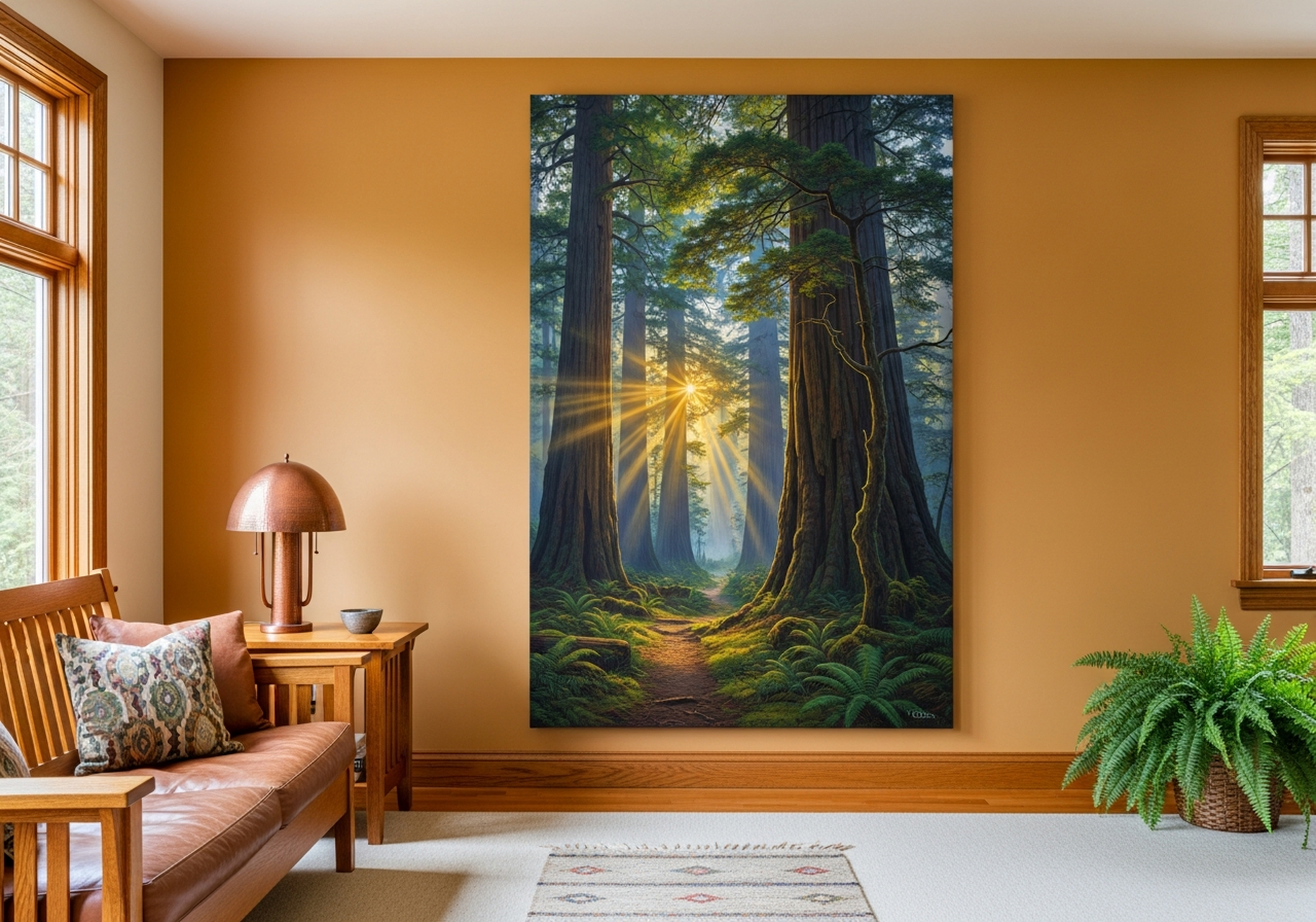
Old growth redwoods and golden light filtering through the forest canopy make this piece one of the most immersive in our collection. The vertical composition of the trees mirrors the vertical movement of climbing stairs, making it an especially intuitive choice for a staircase wall. Hang this at the mid-staircase tier, around stair four or five, at 40 to 45 cm wide (16 to 18 inches). The warm amber light in the forest scene ties it visually to the gold tones in the Alpine Mountain piece below, creating cohesion without repetition. In our experience, forest scenes with strong vertical tree trunks are among the most universally loved subjects on staircase walls because they echo the upward movement of the architecture itself.
View the Sunbeam Forest Canvas
4. Native American Elder Canvas Wall Art
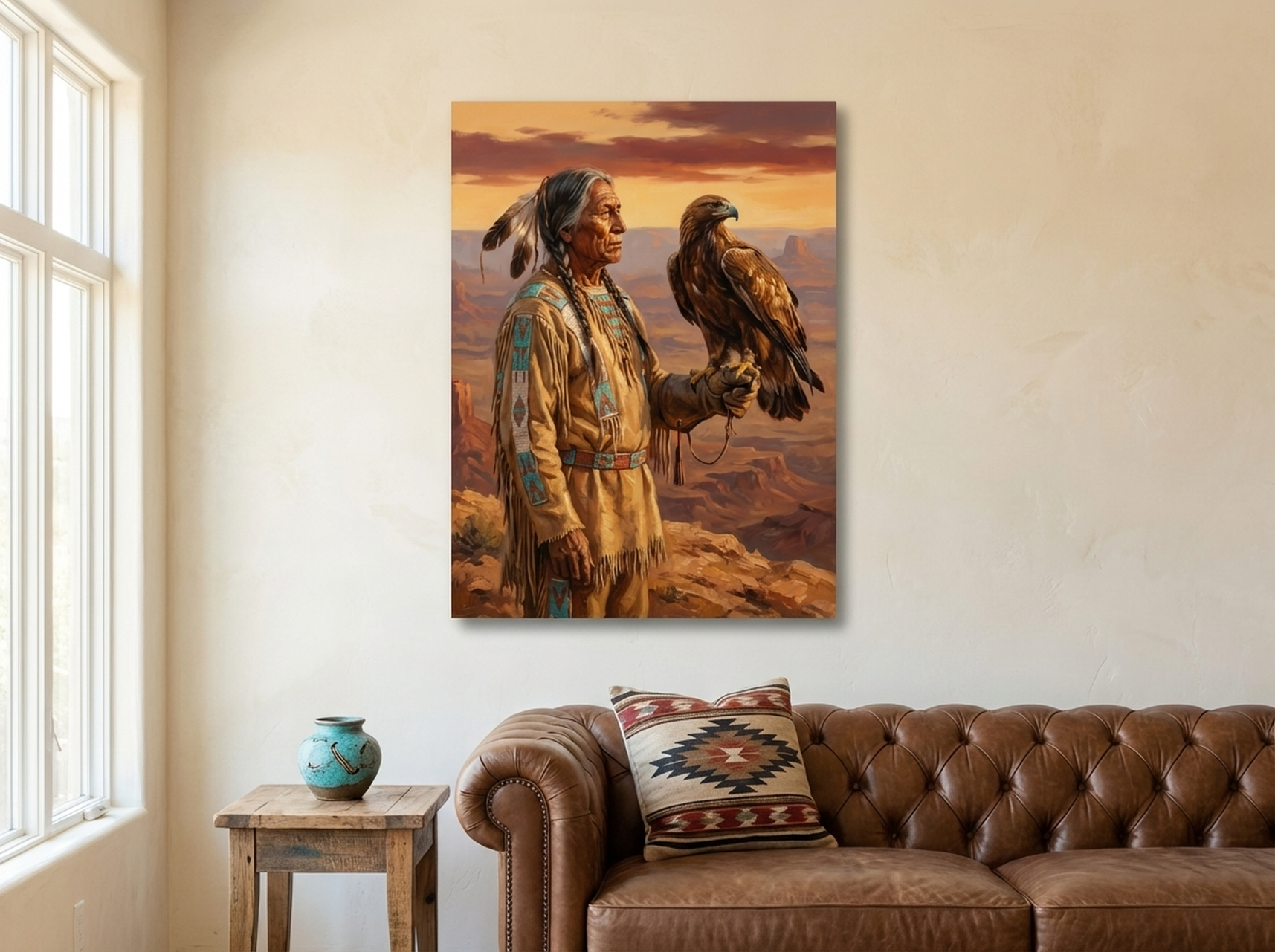
A portrait subject introduces human presence into what is often an all-landscape staircase gallery, creating an unexpected focal point that rewards close inspection at eye level mid-climb. The amber and terracotta palette of this eagle spirit portrait ties directly into the earth tone thread running through the Canyon Strata and Sunbeam Forest pieces. Hang it at the upper-mid staircase position, around stair five or six, at 38 to 42 cm wide (15 to 17 inches). The eagle imagery carries rich symbolic meaning related to vision and elevation, a fitting subject for the literal act of ascending in your own home. The dark background makes this piece stand out from lighter landscapes around it without disrupting the overall color family.
View the Native American Elder Canvas
5. Wildflower Meadow Canvas Wall Art
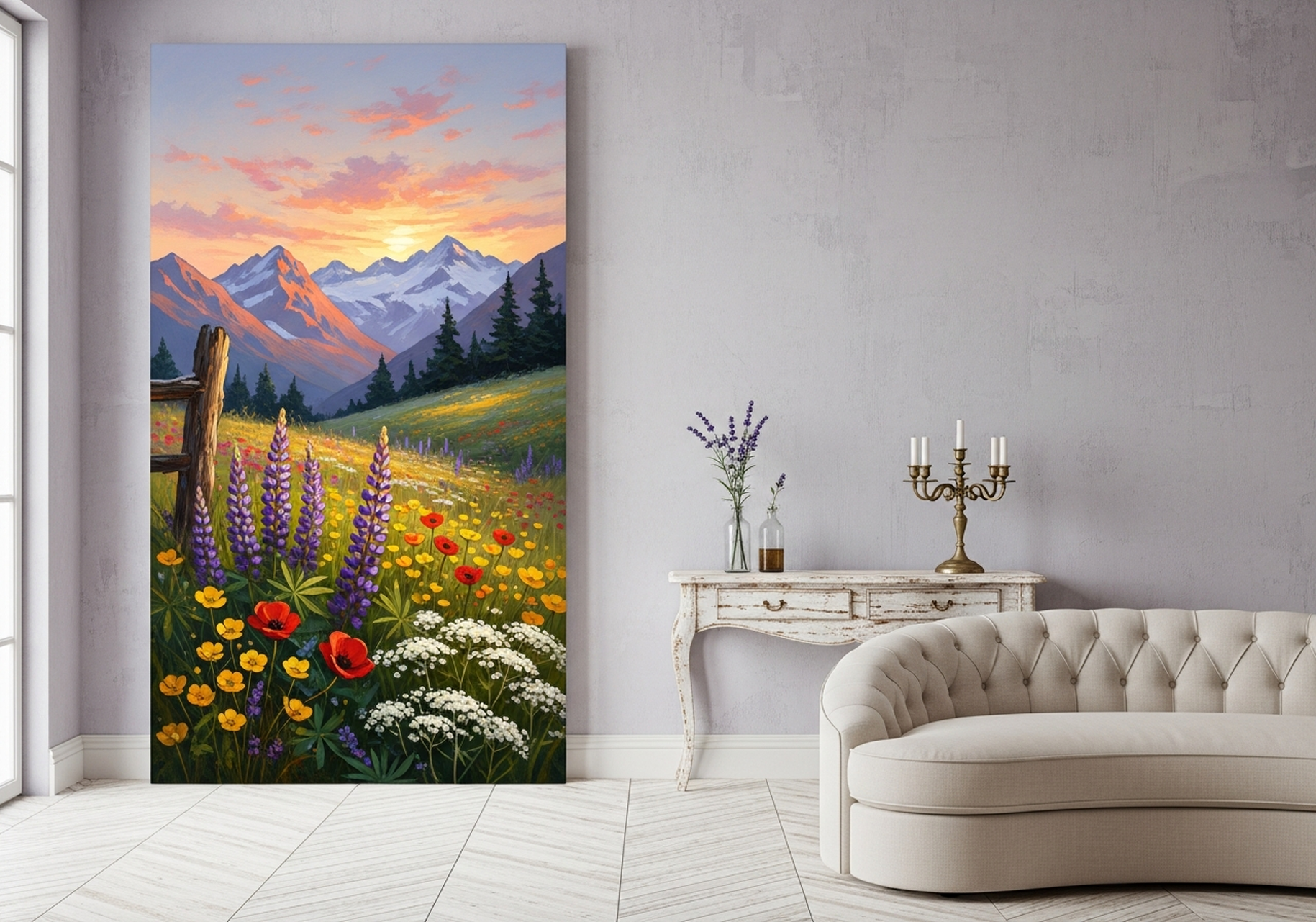
The Wildflower Meadow canvas brings softness and seasonal warmth to the upper portion of your staircase gallery. Its combination of flowering foreground and mountain backdrop gives the composition two layers of depth, which reads beautifully from the angle you approach it going up stairs. Place it near the top of the arrangement, at stair seven or eight, sized at 35 to 40 cm wide (14 to 16 inches). The floral detail rewards close-up viewing as you pass, which is exactly the experience you want in the upper staircase where foot traffic slows. We have found that floral and botanical subjects serve as natural visual conclusions to a landscape-themed staircase gallery, bringing the journey from mountains to meadow to a satisfying close near the landing.
View the Wildflower Meadow Canvas
6. Allium Floral Canvas Wall Art
The Allium Floral impasto piece delivers luxury and detail in a compact format ideal for the final position at the top of your staircase gallery. The lavender and deep purple tones offer a colour shift from the warmer earth palette of the lower and mid pieces, signaling the end of the visual journey with a flourish. Use this as a closing accent piece at the landing-adjacent position, sized at 30 to 35 cm wide (12 to 14 inches). The impasto technique means the textured surface catches light differently depending on the time of day, adding quiet dynamism to what might otherwise be a static display. We particularly love this piece at staircase tops because arriving at the landing and being greeted by a single dramatic floral gives the ascent a sense of reward and arrival.
Placement Guide with Measurements
Use this section as your reference when marking walls. All measurements assume a standard residential staircase with a 17 to 20 cm (7 to 8 inch) riser height and a 25 to 28 cm (10 to 11 inch) tread depth.
- Centerline height: 144 to 152 cm (57 to 60 inches) measured vertically from the top of each stair tread to the center of the artwork above it. Mark this point at your bottom stair and your top stair, then connect them with a light chalk line or painter's tape to establish the diagonal.
- Horizontal spacing between frames: 15 to 20 cm (6 to 8 inches) edge to edge. For a tight staircase with 8 or fewer stairs, use 15 cm. For a long staircase with 12 or more stairs, use 18 to 20 cm to fill the wall appropriately.
- Bottom anchor piece center: Should sit on your diagonal centerline, centered above stair tread one or two.
- Stagger vertically: On a mixed gallery, let alternate pieces sit 5 to 8 cm (2 to 3 inches) above or below the exact centerline to create organic rhythm. Never stagger more than 10 cm or the arrangement loses its diagonal coherence.
- Clearance from handrail: Keep at least 15 cm (6 inches) between your lowest canvas edge and the top of the handrail to prevent visual crowding and physical contact risk.
- Clearance from ceiling: On the upper staircase near the landing where ceiling height drops, allow at least 20 cm (8 inches) from canvas top to ceiling.
- Stud anchoring: For canvases 46 cm (18 inches) or wider, always locate and use a stud. On angled staircase walls, studs run vertically so a standard stud finder works normally.
Also read: How to Light Wall Art Like a Gallery for information on adding picture lights or directional spotlights along your staircase gallery for evening ambiance.
5 Common Mistakes to Avoid on Staircase Walls
- Hanging all pieces at the same height from the floor. A staircase wall requires a diagonal centerline, not a horizontal one. Pieces hung at a consistent floor height will look like they are sliding downhill on one side of the composition.
- Using frames that are too small. Small frames (under 25 cm / 10 inches wide) disappear on staircase walls because they are typically viewed from several feet away at an angle. Anchor with substantial pieces and only use small accents between larger canvases, never as the primary pieces.
- Ignoring the handrail as a competing element. The handrail itself is a strong diagonal line. If your gallery centerline does not closely parallel the handrail angle, the two lines will visually conflict. Before hanging anything, hold a long level against the top of your handrail and compare its angle to your planned diagonal.
- Overcrowding the arrangement. The instinct to fill every inch of a staircase wall leads to a cluttered look. Negative space is not wasted space. A gallery with consistent 15 to 20 cm gaps reads as curated; one with 5 cm gaps reads as storage.
- Mixing too many frame colours without a plan. Black, white, natural wood, gold, and silver frames can all coexist, but only if at least two frames share the same finish and colour to anchor the mix. Completely random frame finishes look accidental rather than eclectic.
Frequently Asked Questions
- How high should staircase wall art be hung?
- The center of each artwork should sit 144 to 152 cm (57 to 60 inches) above the top of each stair tread directly below it. This keeps art at eye level as you walk up the stairs. Use this measurement at your lowest stair and your highest stair, connect those two points with a diagonal guideline, and hang all pieces so their centers rest on that line.
- How many pieces of art do I need for a staircase gallery wall?
- For a standard residential staircase of 12 to 14 steps, 5 to 8 pieces of art create a full gallery feel without overcrowding. Shorter staircases of 8 steps or fewer work well with 3 to 5 pieces. You can always add accent pieces between your main pieces to fill gaps as your collection grows.
- What size art should I hang at the bottom of the staircase?
- Your anchor piece at the bottom of the staircase should be the largest in the arrangement, typically 45 to 60 cm wide (18 to 24 inches). As you go higher, the pieces step down slightly in size to around 30 to 38 cm wide (12 to 15 inches) near the landing.
- What spacing should I leave between frames on a staircase wall?
- Leave 15 to 20 cm (6 to 8 inches) between frame edges on a staircase wall. Closer than 15 cm looks cramped; farther than 20 cm makes the pieces look disconnected.
- Should staircase wall art follow the angle of the stairs or hang straight?
- Individual pieces should always hang straight and level, never tilted to match the staircase angle. It is the placement of the pieces as a group that follows the diagonal, with each frame hanging level but positioned progressively higher as the staircase rises.
- Can I use canvas prints without frames on a staircase wall?
- Yes, and we highly recommend it for modern and contemporary homes. Frameless gallery-wrapped canvases have visually lighter edges, meaning you can use slightly larger sizes without the wall feeling heavy. Gallery-wrapped canvases with painted edges work especially well because the edge colour extends the composition around the corner.
Quick Reference Table
| Product | Best For | Suggested Size | Link |
|---|---|---|---|
| Alpine Mountain Canvas | Bottom anchor piece | 61 x 46 cm (24 x 18 in) | View |
| Canyon Strata Canvas | Second tier, earth tone bridge | 50 x 38 cm (20 x 15 in) | View |
| Sunbeam Forest Canvas | Mid-staircase, vertical subject | 45 x 60 cm (18 x 24 in) | View |
| Native American Elder Canvas | Upper-mid, portrait focal point | 40 x 50 cm (16 x 20 in) | View |
| Wildflower Meadow Canvas | Upper staircase, soft close | 38 x 30 cm (15 x 12 in) | View |
| Allium Floral Canvas | Landing-adjacent accent | 30 x 30 cm (12 x 12 in) | View |
Your Staircase Deserves Better Than a Bare Wall
A gallery wall going up your staircase is one of the highest-impact, lowest-effort upgrades you can make to your home. Every time you walk up those stairs, you get to experience a curated collection of art. Every guest who visits comments on it. And because a staircase is a transitional space rather than a living room centerpiece, you have tremendous creative freedom to experiment with subjects, sizes, and arrangements that you might not risk in a more prominent space.
Start with one strong anchor piece at the base, establish your diagonal, and build the arrangement one piece at a time. The collection does not have to be complete before it looks beautiful. Explore the full Heva Unique Art Gallery collection to find the pieces that will make your staircase wall a gallery worth climbing toward.