Gallery Wall Art Layout Ideas for Every Room
The Heva Team
Art Curators & Interior Design Enthusiasts · February 11, 2026 · 16 min read
Gallery wall ideas come down to layout, spacing, and the right mix of pieces. This guide covers four proven layouts with exact measurements, spacing formulas, and product picks that work together.
You have picked the art. You have the wall. But between "I want a gallery wall" and "this looks incredible" sits one decision that most people get wrong: the layout. Grid, salon, horizontal line, staircase, or themed -- each arrangement follows different geometry, different spacing, and different visual rules. Choose the wrong layout for your wall shape and the entire display falls flat, no matter how beautiful the individual pieces are. This guide breaks down five proven gallery wall layouts with exact measurements, spacing formulas, and product recommendations so you can pick the arrangement that fits your room and your style.
Ready to browse? Shop best-selling canvas prints or keep reading for layout templates, spacing rules, and our top picks for every arrangement style.
Why Layout Matters More Than the Art Itself
A 2019 study published in the journal Environment and Behavior found that spatial arrangement affects perception of visual coherence more than the content of the individual elements. Translated to your living room wall: six mismatched prints in a tight grid will look more intentional than six coordinated prints scattered randomly. The layout is the invisible frame that tells your eye "these pieces belong together." Without it, even expensive art looks like a yard sale.
The five layouts in this guide cover every wall shape and personality type. The grid is for perfectionists. The salon is for collectors. The horizontal line is for minimalists. The staircase is for hallways and split-level homes. The themed layout is for storytellers. Each one has specific rules, and breaking those rules is what separates a gallery wall that impresses from one that confuses.
If you are not sure which size canvases to start with, our guide on choosing the perfect wall art size covers exact dimensions for every room type.
The Grid Layout: Clean Lines and Instant Impact
The grid is the most forgiving gallery wall layout and the best starting point for anyone hanging a multi-piece display for the first time. Every piece is the same size. Every gap is identical. The result looks intentional even if your measurement skills are average at best.
How it works: Select 4, 6, or 9 pieces of identical dimensions. Arrange them in a 2x2, 2x3, or 3x3 formation. Keep exactly 5 cm (2 inches) between each frame on all sides. Align the outer edges so the grid reads as one unified rectangular block from across the room.
Best wall size: A 2x3 grid of 41 by 51 cm (16 by 20 inch) canvases with 5 cm (2 inch) gaps creates a total footprint of roughly 87 by 159 cm (34 by 63 inches). This suits walls between 120 and 240 cm (47 and 94 inches) wide. Narrower walls feel cramped. Wider walls leave too much blank space flanking the arrangement.
The tonal consistency rule: In a grid, the subjects do not need to match, but the tonal range should. A set of pieces that all sit within the same warm or cool colour family creates a grid that reads as a single composition rather than a patchwork. Abstract landscapes with flowing gold and amber tones are ideal grid candidates because their colour palette bridges naturally from one frame to the next.
Fluid Abstract Landscape Canvas
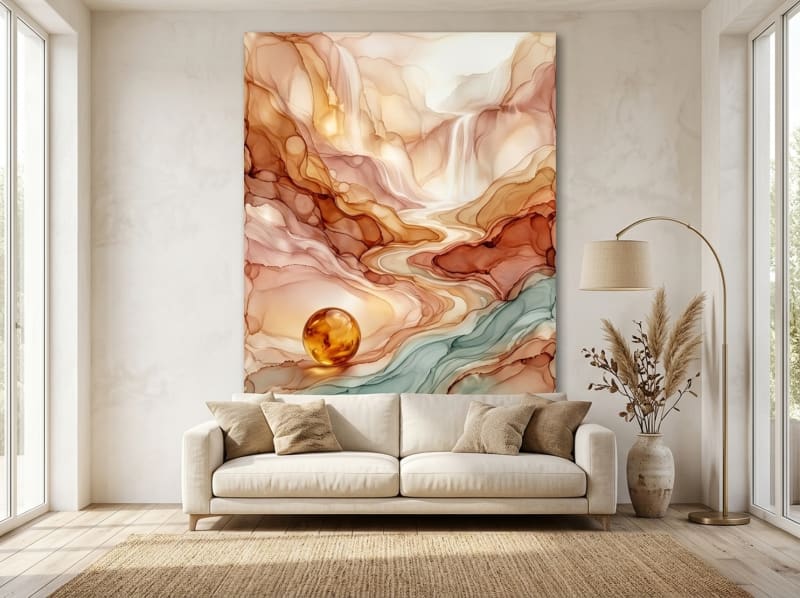
This abstract landscape blends gold, amber, and teal into a fluid horizon line that works beautifully as a grid element. The colour palette is warm enough to pair with earth-toned companions but has enough teal contrast to avoid monotony. Hang four of these in a 2x2 grid above a console table, or use one as the anchor in a mixed grid where the other five pieces echo the gold and amber tones. The impasto texture catches light at different angles, which adds depth to a flat grid arrangement. This piece fits living rooms, dining areas, and home offices where you want warmth without heaviness.
View the Fluid Abstract Landscape Canvas
View the Fluid Abstract Landscape Canvas
The Salon Layout: Curated Chaos Done Right
The salon style is what most people picture when they imagine a gallery wall: different sizes, different subjects, arranged in a seemingly organic cluster. The key word is seemingly. A well-executed salon wall follows invisible rules that keep the arrangement from tipping into chaos. Interior designer Emily Henderson outlines a reliable process for salon walls on her blog at Style by Emily Henderson, including her paper-template method that prevents drilling regrets.
The anchor rule: Start with your largest piece and place it slightly off-centre, roughly one-third from the left edge of your planned arrangement. Build outward from this anchor. Every subsequent piece should relate to the anchor through colour, subject, or frame style.
The two-thirds rule: At least two-thirds of your pieces should share a common element. That element could be a colour (every piece contains some form of gold or cream), a material (all framed canvases rather than a mix of canvases and posters), or a subject family (all nature-inspired). The remaining one-third can be wildcards that introduce surprise and personality.
The imaginary border: Even salon layouts that look irregular should have outer edges that form a rough rectangle or square. Lay your pieces on the floor first and adjust until the perimeter is clean. Ragged outer boundaries make the arrangement look unfinished from a distance.
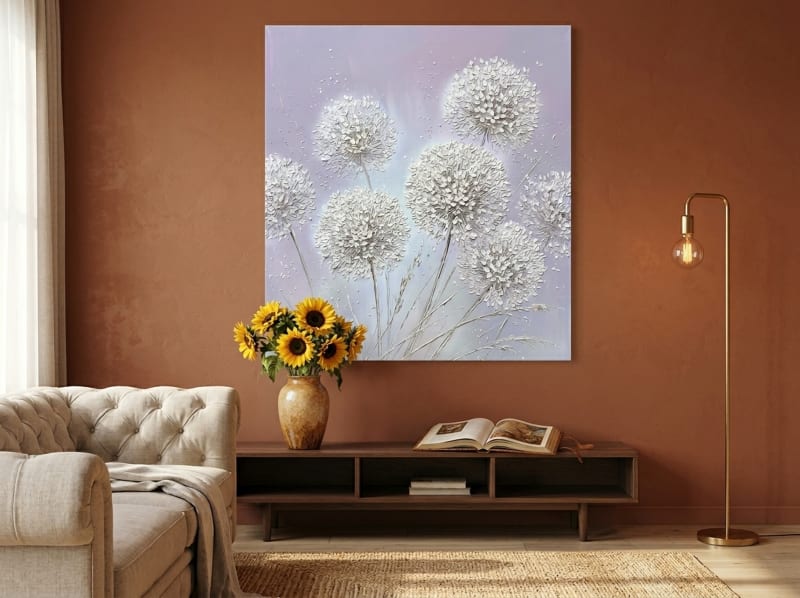
Botanical and floral canvases are natural salon pieces because their organic shapes create visual contrast against structured frames. An impasto floral like an allium painting adds texture and movement that flat prints cannot match.
Allium Floral Impasto Canvas
This allium floral captures the globe-shaped bloom in thick impasto brushstrokes that give the canvas genuine tactile depth. The dominant lavender and purple tones pair naturally with cream, sage, and dusty rose companions in a salon arrangement. Use it as the anchor piece positioned one-third from the left edge, then build outward with smaller botanical or abstract pieces that pick up the lavender thread. The textured surface catches sidelight beautifully, which means salon walls with this piece benefit from a picture light or nearby window. Ideal for bedrooms, reading nooks, and feminine living spaces where you want a focal point with softness.
View the Allium Floral Impasto Canvas
View the Allium Floral Impasto Canvas
The Horizontal Line Layout: Minimalist and Modern
If symmetry is your priority, the horizontal line layout removes all guesswork. Three to five pieces hang in a single row with their centres aligned at 145 to 150 cm (57 to 59 inches) from the floor. This height follows the museum standard that places art at average standing eye level. The result is clean, modern, and particularly effective in hallways, above dining tables, and in home offices.
Spacing: Use 5 to 8 cm (2 to 3 inches) between each piece. Tighter spacing at 5 cm reads as a unified series where the pieces form one continuous visual band. Wider spacing at 8 cm reads as individual pieces that share a wall and a common centre line but retain their independence.
Size variation: You can mix sizes in a horizontal line, but the centre alignment must remain consistent. If one piece is taller than the others, its vertical centre should still sit at the same height as the shorter pieces. This creates an even visual rhythm despite the size difference. Landscape-oriented canvases with strong horizontal compositions reinforce the linear flow of this layout.
For detailed instructions on measuring and marking nail positions, see our complete guide on how to hang wall art.
Alpine Mountain Impasto Canvas
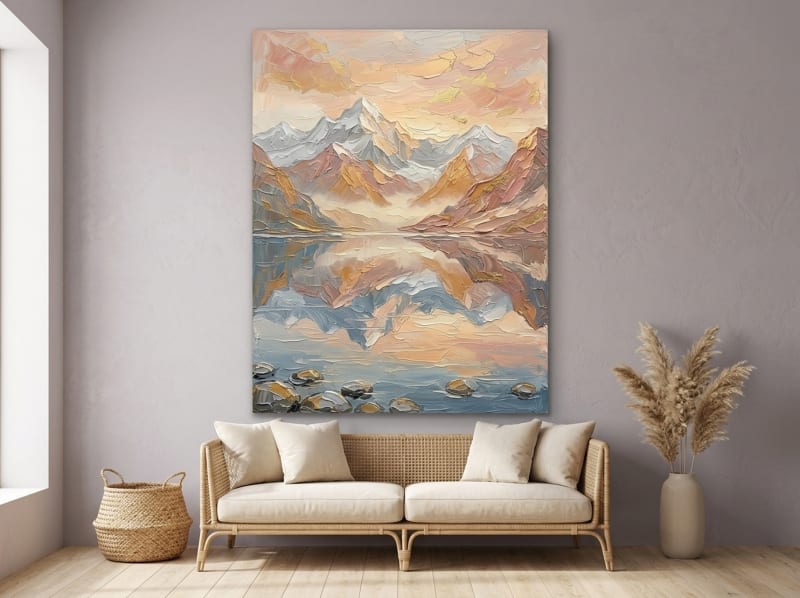
This alpine mountain scene uses thick impasto brushwork to create a luminous reflection of peach, gold, and soft blue. The strong horizontal composition -- sky meeting mountain meeting water -- reinforces the linear flow of a horizontal line layout perfectly. Place it as the centre piece in a row of three or five, flanked by complementary landscape or abstract pieces that echo the peach and gold palette. The warm tones work in south-facing rooms where natural light brings out the texture of the paint surface. Best suited for living rooms, dining rooms, and wide hallway walls above 180 cm (71 inches) where the horizontal arrangement has room to breathe.
View the Alpine Mountain Impasto Canvas
View the Alpine Mountain Impasto Canvas
The Staircase Layout: Art That Follows the Climb
Staircase walls are among the trickiest spots for art because the wall angle changes your sight line with every step. The solution is a diagonal arrangement that follows the incline of the staircase itself.
How to measure: Find the pitch angle of your staircase by measuring the rise (vertical height) and run (horizontal depth) of a single step. Most residential stairs have a pitch between 35 and 37 degrees. Your art should follow this same diagonal. Place the centre of each piece along an imaginary line that runs parallel to the stair handrail, maintaining a consistent distance from the rail.
Vertical positioning: Each piece should sit with its centre approximately 150 cm (59 inches) above the step it is closest to. As you walk up the stairs, each piece appears at eye level when you reach its corresponding step. This creates a rhythm of discovery -- you encounter each piece at the perfect viewing moment.
Number of pieces: Three to five works best. Fewer than three looks sparse in a stairwell. More than five creates visual noise in a transitional space where people are actively moving. Keep the spacing between pieces at 15 to 20 cm (6 to 8 inches) measured along the diagonal line. This wider gap accounts for the natural distance between steps. The Mixtiles blog provides additional visual examples of staircase arrangements at Mixtiles gallery wall layouts.
Delicate, detailed pieces work especially well on staircases because viewers pause briefly at each step. A botanical or nature study with fine detail rewards that moment of close attention better than a bold abstract that needs distance to read.
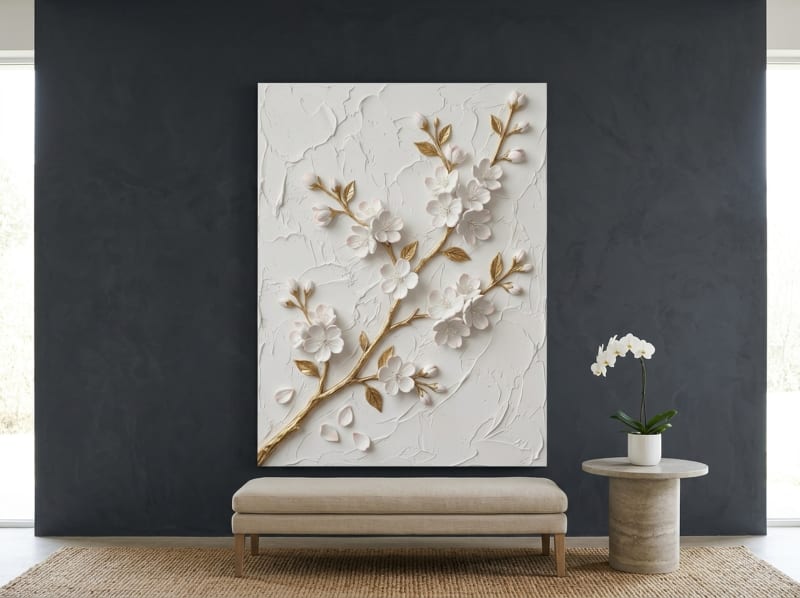
Cherry Blossom Relief Canvas
This cherry blossom canvas features a sculptural relief texture that creates actual shadow and depth on the surface. The white and gold palette is neutral enough to complement almost any staircase wall colour, from warm cream to cool grey to deep charcoal. The delicate branch and blossom detail invites close viewing, which makes it ideal for a staircase where viewers naturally slow down at each step. Use three of these in ascending positions along the stairwell diagonal, or combine one with complementary botanical and nature pieces that share the white and gold thread. The relief texture catches overhead and side light differently at each stair position, adding visual interest as you climb.
View the Cherry Blossom Relief Canvas
View the Cherry Blossom Relief Canvas
The Themed Layout: One Story Across Many Frames
A themed gallery wall tells a single story through multiple pieces. Unlike the salon layout, which celebrates variety, the themed layout demands cohesion. Every piece connects to a central narrative: a colour story, a cultural heritage, a single artistic movement, or a shared subject matter like nature, architecture, or portraiture.
Colour story themes: Choose three to five pieces that all contain the same dominant colour, even if the subjects differ completely. A gold-themed gallery wall might include an abstract landscape with gold leaf accents, a portrait with gold jewellery, and a botanical with golden autumn leaves. The gold thread unifies pieces that would otherwise look unrelated.
Cultural themes: A gallery wall celebrating a specific artistic tradition -- Art Nouveau, Impressionism, African textile patterns, Japanese woodblock prints -- creates a museum-quality display that educates as it decorates. Keep all pieces within one tradition for maximum impact.
Portrait themes: A wall of portraits in different styles (realistic, abstract, mosaic) creates a striking display when the colour palette stays consistent. Gold, black, and jewel tones tie portrait styles together regardless of era or technique.
For inspiration on using abstract art in living room gallery walls, our dedicated guide covers colour theory and placement strategies that apply directly to themed arrangements.
Klimt Mosaic Portrait Canvas
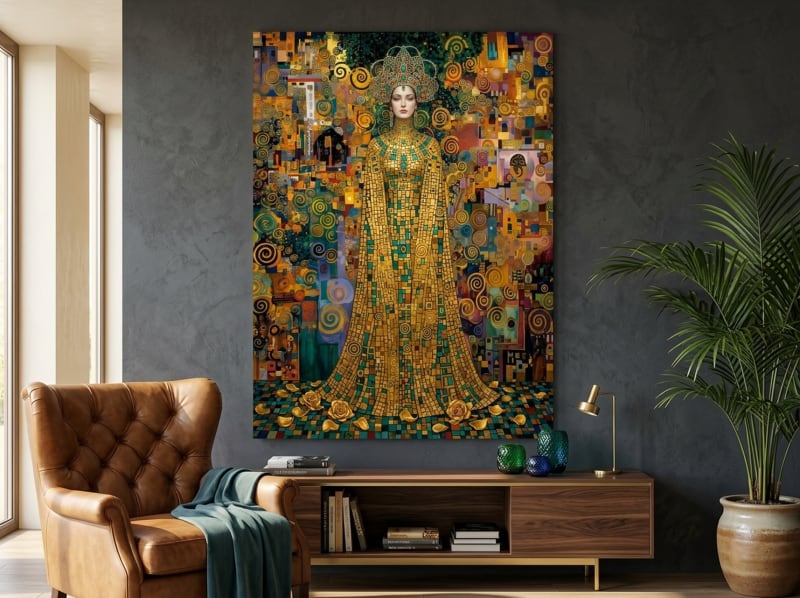
This Klimt-inspired mosaic portrait brings Art Nouveau luxury to a themed gallery wall. The dominant gold, emerald, and deep blue palette references Gustav Klimt's iconic decorative style, and the mosaic patterning adds geometric complexity that rewards extended viewing. Use it as the anchor piece in a gold-themed or Art Nouveau-themed gallery wall. Surround it with complementary pieces that feature gold accents, geometric patterns, or jewel-tone palettes to build a cohesive themed narrative. The rich surface detail makes this a natural statement piece for formal living rooms, dining rooms, and entryways where guests pause and look closely.
View the Klimt Mosaic Portrait Canvas
View the Klimt Mosaic Portrait Canvas
Universal Spacing Rules for Every Layout
The 5 cm (2 Inch) Standard
For gallery walls where pieces are grouped together, 5 cm (2 inches) between frames is the industry standard used by galleries and interior designers worldwide. This gap is small enough that pieces read as a unified group but large enough that each piece retains its own visual breathing room. Going below 3 cm (1.2 inches) makes frames look cramped and creates distracting shadow lines. Going above 10 cm (4 inches) makes individual pieces look unrelated rather than part of a composed arrangement.
Distance from Furniture
If your gallery wall sits above a sofa, console table, or sideboard, leave 15 to 25 cm (6 to 10 inches) between the top of the furniture and the bottom edge of the lowest piece. Less than 15 cm (6 inches) and the art appears to rest on the furniture surface. More than 30 cm (12 inches) and the visual connection between furniture and wall art breaks completely, leaving the arrangement looking like it is floating independently.
The 57-Inch Centre Line
Museums and professional galleries hang art so the vertical centre of each piece sits at 145 cm (57 inches) from the floor. This corresponds to average standing eye level for most adults. For multi-piece gallery walls, apply this rule to the centre of the entire arrangement rather than each individual piece. The midpoint of your complete gallery wall composition should fall at or near this 145 cm (57 inch) mark.
Outer Margin Proportions
The total width of your gallery wall arrangement should be 55 to 75 percent of the wall width or the furniture width below it. A gallery wall above a 200 cm (79 inch) sofa should span 110 to 150 cm (43 to 59 inches). This proportion keeps the arrangement visually grounded and connected to the room. Narrower arrangements look like an afterthought. Wider arrangements make the furniture beneath look undersized.
Our Top 6 Picks for Gallery Wall Arrangements
Each canvas in this guide has been selected because it plays a specific role in gallery wall compositions. Whether you need a grid anchor, a salon wildcard, a staircase detail piece, or a small-format accent for mixed-size layouts, these six cover every arrangement type discussed above. Here is the final pick designed specifically for mixed-size gallery walls.
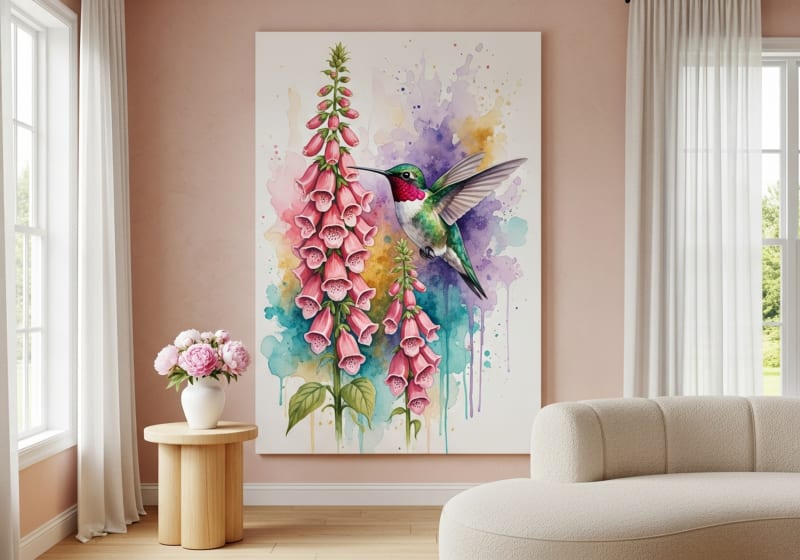
Hummingbird Watercolor Canvas
When you mix sizes in a gallery wall, the smallest piece needs enough detail and colour intensity to hold its own against larger neighbours. This hummingbird watercolor delivers exactly that. The ruby-throated bird pops against a soft background of pink, green, and purple, and the fine feather detail rewards close inspection even at a smaller scale. Use it as a small-format accent in a salon layout alongside larger anchor pieces, as a paired companion in a horizontal line arrangement, or as a standalone piece in a staircase sequence where each step reveals new detail. The floral and nature palette threads naturally into botanical, landscape, and wildlife gallery walls without clashing. The watercolor style adds softness and transparency that balances heavier impasto and relief textures from other pieces in the arrangement.
View the Hummingbird Watercolor Canvas
View the Hummingbird Watercolor Canvas
Common Gallery Wall Mistakes to Avoid
1. Hanging Without Paper Templates
The single biggest gallery wall mistake is drilling holes without testing the arrangement first. Cut paper or newspaper to the exact size of each frame. Tape the templates to the wall with painter's tape. Live with the layout for at least 24 hours before you commit to nail holes. You will almost certainly adjust at least one position, and paper is far more forgiving than putty and touch-up paint.
2. Ignoring the Imaginary Border
Every gallery wall, regardless of layout type, needs clean outer edges. Even a salon arrangement should form a rough rectangle when viewed from across the room at 3 metres (10 feet) or more. Ragged perimeters make the display look unfinished and unplanned. Step back frequently during your floor planning stage and check whether the outer boundary reads as a recognisable geometric shape.
3. Mixing Too Many Frame Styles
Two frame styles is interesting. Three is adventurous. Four or more is distracting. If your pieces come in different frame finishes, limit yourself to two complementary options: black and natural wood, white and gold, or dark walnut and brass. Canvas prints on stretcher bars count as their own frame style, so factor that into your total count before adding framed pieces to the mix.
4. Starting from the Edges and Working Inward
Always start with the anchor piece, usually the largest, and build outward toward the edges. Starting from the corners and working inward almost always results in an awkward gap at the centre that is too small for a standard frame and too large to leave empty. Centre-out placement ensures the most important piece gets the best position.
5. Forgetting Deliberate Lighting
A gallery wall deserves focused lighting. Overhead recessed spotlights, picture lights mounted above the arrangement, or track lighting aimed at a 30-degree angle all highlight the art properly. Without dedicated light, textured pieces like impasto canvases lose their dimensional quality entirely, and the entire arrangement disappears into the wall after sunset. Budget for lighting when you budget for the art itself.
Frequently Asked Questions
How much space should I leave between gallery wall frames?
The standard spacing is 5 cm (2 inches) between frames for grid, salon, and horizontal line layouts. For staircase layouts, increase the gap to 15 to 20 cm (6 to 8 inches) because the diagonal arrangement and viewer movement require more breathing room. Never go below 3 cm (1.2 inches), which creates cramped shadow lines between frames.
How many pieces do I need for a gallery wall?
The minimum is three pieces. Fewer than three reads as separate art rather than a gallery wall. The sweet spot for most residential walls is five to seven pieces. Above nine, the arrangement becomes difficult to balance without professional help. Start with three or four and add pieces over time as you find complementary works that fit your chosen layout.
What is the best gallery wall layout for beginners?
The grid layout is the most forgiving for first-time gallery wall builders. Choose four or six identical-sized canvases, arrange them in a 2x2 or 2x3 formation with 5 cm (2 inch) gaps, and align all outer edges. The symmetry does the design work for you, so the only skill required is accurate measuring and level hanging.
Can I mix different art styles on the same gallery wall?
You can mix styles successfully if you maintain one unifying thread across all pieces. The safest thread is a shared colour that appears in every piece, even as a small accent. A gallery wall mixing abstract, portrait, and landscape styles will hold together if every piece contains gold tones, for example. Limit yourself to three style categories maximum to keep the arrangement readable.
What height should gallery wall art hang at?
The centre of your gallery wall arrangement should sit at approximately 145 cm (57 inches) from the floor, which is average standing eye level used by most museums and galleries. When hanging above furniture like a sofa or console table, the bottom edge of the lowest piece should be 15 to 25 cm (6 to 10 inches) above the furniture top. This keeps the art visually connected to the furniture without looking like it is resting on it.
Which gallery wall layout works best for a staircase?
The staircase layout, where art follows the incline angle of the stairs, is specifically designed for this space. Place each piece so its centre sits 150 cm (59 inches) above the nearest step. Use three to five pieces spaced 15 to 20 cm (6 to 8 inches) apart along the diagonal. More than five pieces creates visual noise in a transitional space. Detailed pieces like botanicals and wildlife studies work well because viewers naturally pause at each step.
Quick Reference: Which Piece Fits Your Gallery Wall
| Product | Best For | Dominant Colours | Link |
|---|---|---|---|
| Fluid Abstract Landscape Canvas | Grid layouts, tonal consistency | Gold, amber, teal | View |
| Alpine Mountain Impasto Canvas | Horizontal line layouts, centre piece | Peach, gold, soft blue | View |
| Allium Floral Impasto Canvas | Salon layouts, anchor piece | Lavender, purple, cream | View |
| Klimt Mosaic Portrait Canvas | Themed layouts, statement anchor | Gold, emerald, deep blue | View |
| Cherry Blossom Relief Canvas | Staircase layouts, detail piece | White, gold, blush pink | View |
| Hummingbird Watercolor Canvas | Mixed sizes, small accent | Pink, green, purple | View |
A gallery wall is not a collection of art. It is a single composition made from multiple pieces, and the layout you choose determines whether it reads as curated or chaotic. Start with the grid if you want certainty. Try the salon if you want personality. Use the horizontal line for modern simplicity. Follow the staircase diagonal for hallways and split-level entryways. Build a themed wall for storytelling. Whatever layout you pick, measure twice, use paper templates, and invest in pieces that share a colour thread. Browse our best-selling canvas prints to start building your gallery wall today.