Wall Art for High Ceilings: Fill the Space Like a Pro
The Heva Team
Art Curators & Interior Design Enthusiasts · April 6, 2026 · 16 min read
You finally have those soaring, dramatic ceilings you have always dreamed of. The room has incredible architectural presence. And yet, something feels off. The walls stretch upward in a vast expanse of emptiness, making the space feel cold and unfinished rather than grand and luxurious. This is one of the most common design challenges homeowners face: knowing exactly how to choose wall art for high ceilings that fills the space with intention, not just fills it.
The good news is that high ceilings are one of the greatest gifts a room can have. With the right approach to scale, style, and placement, those tall walls become the most powerful design feature in your home. This guide walks you through everything you need to know, from understanding visual proportion to selecting specific statement pieces that were made for dramatic vertical space.
Ready to transform your empty wall? Browse our full collection of oversized statement canvas art and find the piece that fills your space with meaning.
Why Scale Matters for High Ceilings
Before choosing any piece of wall art for high ceilings, you need to understand one fundamental principle: proportion is everything. The human eye constantly reads spatial relationships. When you walk into a room, your brain immediately measures the relationship between furniture, walls, and art. When those proportions are off, the room feels wrong, even if you cannot immediately identify why.
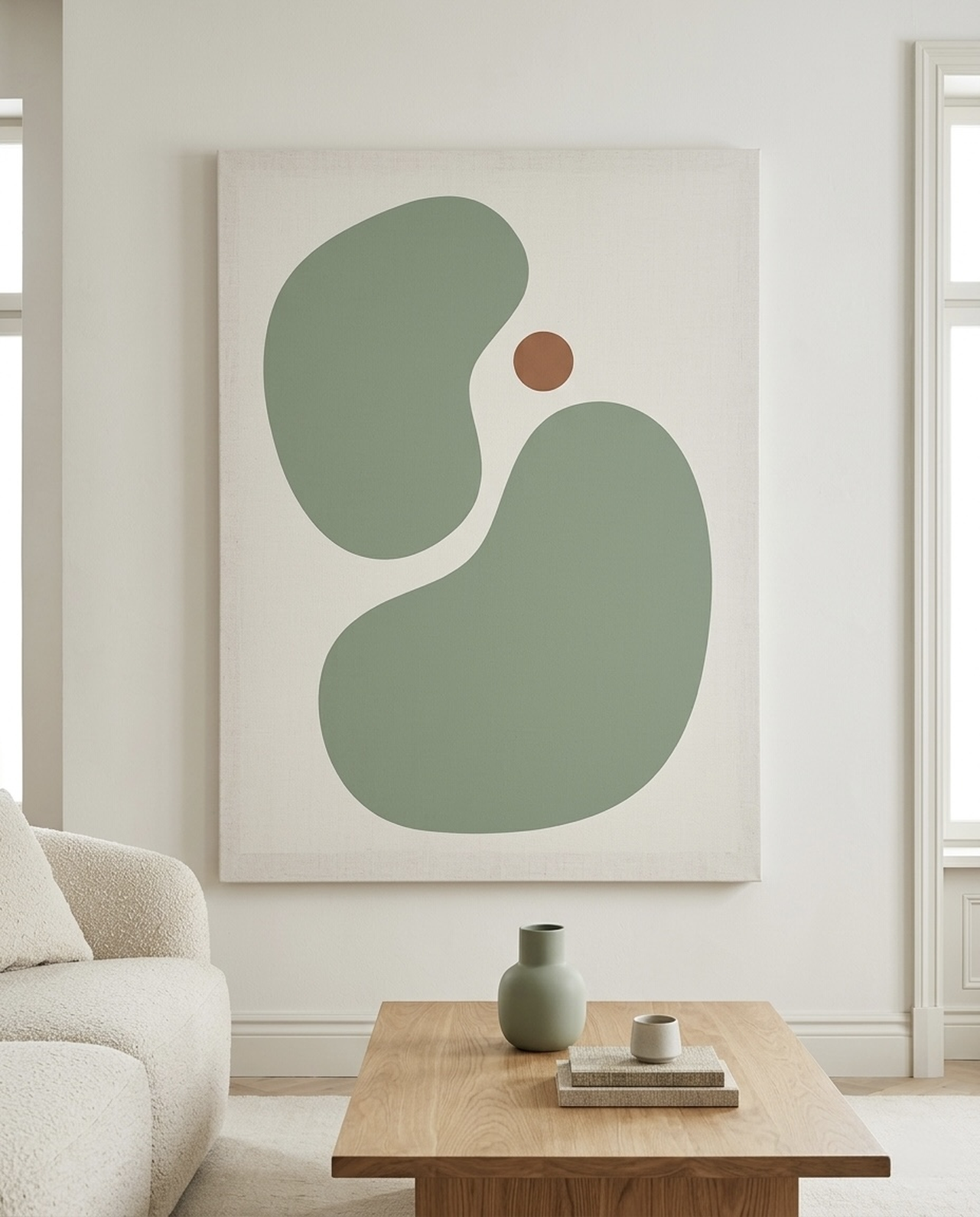
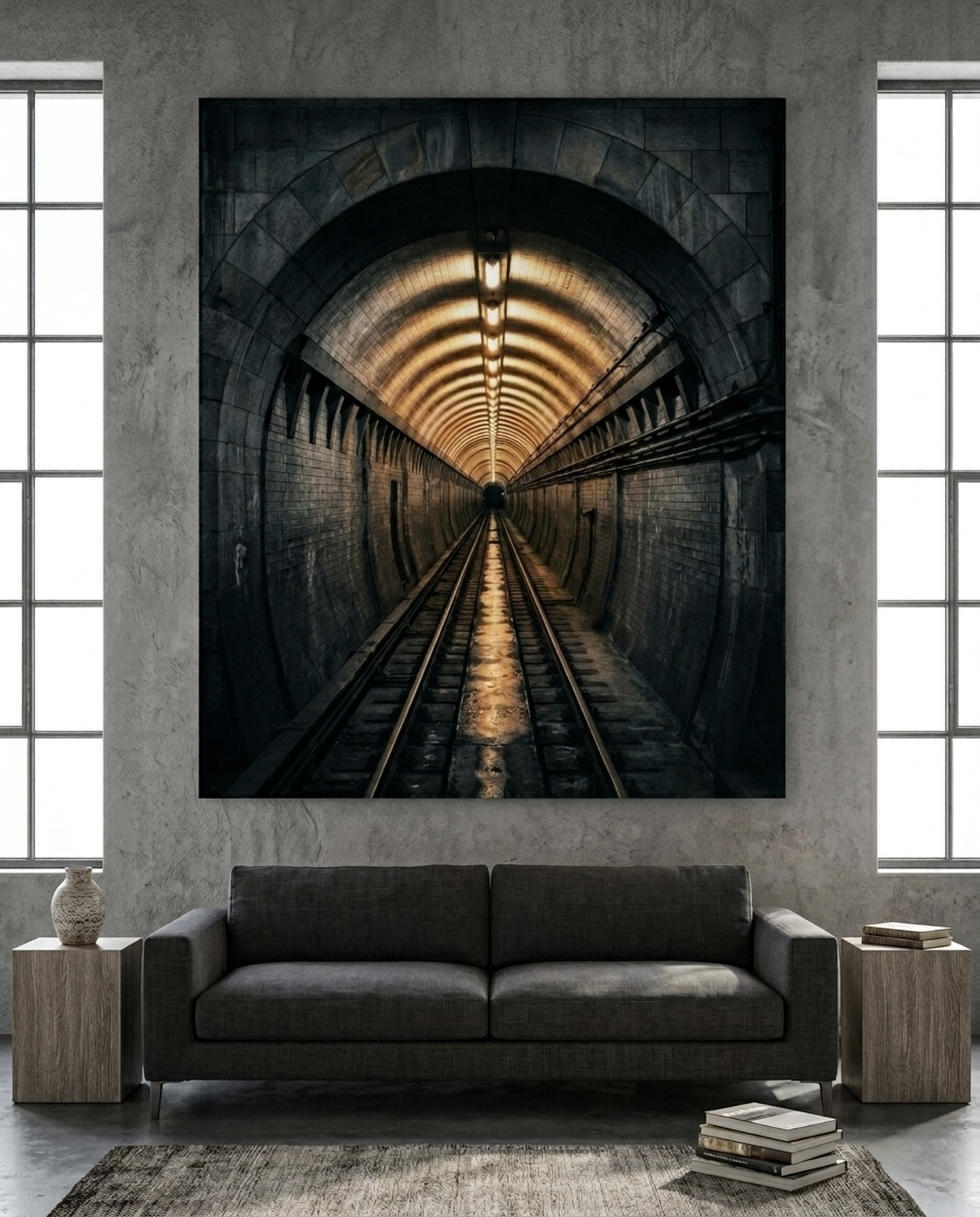
In a standard 8-foot ceiling room, a 24-inch canvas might feel just right above a sofa. Take that same canvas and hang it in a room with 12-foot ceilings, and it shrinks. Visually, it becomes a small rectangle floating in a sea of wall. The room does not feel cozy or artistic. It feels unfinished.
The Rule of Visual Weight
Visual weight is the perceived heaviness or mass of an object in a composition. A large, colorful piece of art carries significant visual weight. A small, delicate sketch carries very little. High-ceiling rooms require visual weight near eye level to ground the space and prevent that cavernous, echoing feeling.
Think of it this way: your furniture sits at human scale, from the floor up to about 6 or 7 feet. Everything above that is "ceiling territory." If your art does not bridge between the human zone and the ceiling zone, you end up with a visual gap that feels empty and unresolved. Large-scale art fills that gap, creating a continuous visual flow from floor to ceiling.
The 60 to 75 Percent Rule
A practical guideline for sizing large wall art for high ceilings is to aim for art that covers 60 to 75 percent of your available wall width. This is the sweet spot between underwhelming and overwhelming. For a wall that is 96 inches (244 cm) wide, this means your artwork or art arrangement should span roughly 57 to 72 inches (145 to 183 cm) in width.
Height follows a similar logic. In a 10-foot (305 cm) ceiling room, you want art that is at least 40 to 48 inches (101 to 122 cm) tall. In a 12-foot (366 cm) ceiling space, consider pieces 54 to 72 inches (137 to 183 cm) tall. The art must have enough vertical presence to feel intentional, not incidental.
For more ideas on sizing oversized pieces, read our guide on large canvas wall art statement ideas.
Best Art Styles for Dramatic Height
Not all art styles are equal when it comes to high-ceiling rooms. The architectural drama of a tall space calls for art that can hold its own, styles with visual boldness, rich color, and compositional confidence. Here are the styles that work best.
Baroque and Neo-Baroque
Baroque art was literally invented for grand spaces. Originally created for cathedrals, palaces, and the homes of aristocrats (all of which had extraordinarily high ceilings), baroque style features dramatic lighting, rich jewel tones, ornate detail, and bold compositions. When you hang a baroque-inspired piece in a high-ceiling room, you are placing it exactly where it belongs.
Look for pieces with deep burgundy, cobalt, forest green, and gold color palettes. The Lioness Canvas Wall Art in Burgundy Gold is a perfect example of neo-baroque power applied to contemporary living spaces. The richness of the palette and the commanding subject matter fill vertical wall space with authority.
Editorial and Metallic Art
Editorial-style art, characterized by bold graphic presence, strong contrast, and metallic accents, is one of the best choices for statement wall art in high-ceiling spaces. The high contrast makes the piece visible and impactful from across a large room. Metallic gold and silver tones catch light beautifully on tall walls where natural light may shift dramatically throughout the day.
The Gold King Portrait Canvas Wall Art exemplifies this approach. The black and cobalt background with bold gold editorial detailing creates a piece that commands attention even in a room with 14-foot ceilings. This is exactly the kind of visual anchor that transforms an empty tall wall into a deliberate design choice.
Mosaic and Pattern-Rich Art
Mosaic art and richly patterned pieces carry high visual density, meaning they reward close inspection while also reading beautifully from a distance. This dual-range visibility is crucial for high-ceiling rooms, where you need art that works both when you are standing in front of it and when you are seated across the room.
Klimt-inspired mosaic art, with its intricate gold leaf patterns and jewel-tone figure compositions, is particularly well-suited to tall walls. The detail creates visual complexity that fills space without relying solely on sheer size. You can read about achieving this luxury look in our post on luxury wall art that looks expensive at home.
Oversized Abstract and Texture Art
Large abstract pieces and texture-focused art such as animal prints, botanical, and impasto styles work exceptionally well as oversized canvas art for high-ceiling rooms. They can be scaled to any size without losing compositional integrity because the subject matter is not dependent on precise figurative proportion.
A terracotta leopard print canvas, for example, becomes richer and more dramatic at 48 inches than at 24 inches. The texture and pattern breathe at scale in a way that smaller reproductions cannot achieve.
Sizing and Placement Guide for Tall Walls
Here is the practical breakdown for hanging wall art for high ceilings at different ceiling heights. All measurements are given in both inches and centimeters.
10-Foot Ceilings (305 cm)
At 10 feet, you are working with approximately 8 feet (244 cm) of usable wall space above typical furniture. Recommended art height: 40 to 54 inches (101 to 137 cm). Center the piece at 60 inches (152 cm) from the floor. For above-sofa placement, leave 8 to 10 inches (20 to 25 cm) between the top of the sofa and the bottom of the art frame.
12-Foot Ceilings (366 cm)
At 12 feet, you have significant vertical territory to work with. Recommended art height: 54 to 72 inches (137 to 183 cm). Center at 62 to 65 inches (157 to 165 cm) from the floor. Consider using two stacked pieces or a vertically-oriented canvas to emphasize the ceiling height rather than fight against it.
14-Foot and Higher Ceilings
For truly grand spaces with ceilings above 14 feet (427 cm), consider art that spans 66 to 84 inches (168 to 213 cm) in height. At this scale, a single oversized canvas becomes the architectural anchor of the room. Alternatively, a curated arrangement of three large pieces in a vertical grouping can achieve the same effect with more compositional variety.
Placement Rules That Always Work
- Center at eye level (57 to 65 inches / 145 to 165 cm from floor to center), not at ceiling midpoint
- Keep at least 8 inches (20 cm) between furniture tops and frame bottoms
- Maintain 4 to 6 inches (10 to 15 cm) from adjacent architectural elements such as windows and doors
- For gallery walls on tall surfaces, the center of the overall arrangement follows the same eye-level rule
- Use picture rail systems for heavy oversized canvases on tall walls, as they distribute weight more safely than single-point anchors
For a deeper exploration of composition strategies, see our guide to oversized wall art ideas for big empty walls.
6 Statement Picks for High-Ceiling Rooms
Each of the following pieces was selected specifically for its ability to fill vertical wall space with authority. These are not delicate accent pieces. These are room-defining statements. Every one ships as a premium canvas print with optional framing in Black, Espresso, White, or Natural wood frames.
1. Klimt Mosaic Portrait: Gold Luxury That Commands Space
The Klimt Mosaic Portrait Canvas Wall Art brings the full weight of Art Nouveau grandeur to your tall wall. Gold mosaic detailing and rich jewel tones create layered visual complexity that fills space without relying on sheer size alone, though ordering it in the largest available size is always recommended for high-ceiling rooms.
2. Klimt Urn Trio: Vertical Composition for Tall Walls
When you need art that naturally draws the eye upward, the Klimt Urn Trio Canvas Wall Art delivers. The three-element vertical composition mirrors the architecture of tall walls, making it feel at home on any surface over 10 feet. Gold and jewel tones keep it firmly in luxury territory.
3. Gold King Portrait: Editorial Metallic Statement
For homeowners who want bold, contemporary luxury wall art rather than classical references, the Gold King Portrait Canvas Wall Art is the answer. The dramatic contrast between the black-cobalt background and the editorial gold details creates a piece with instant visual authority on a tall wall.
4. Terracotta Leopard Print: Bold Texture at Scale
Pattern and texture art scales beautifully. The Leopard Print Canvas Wall Art in Terracotta proves that animal print, when executed with warmth and sophistication, belongs in luxury interiors. The terracotta palette grounds the room while the bold pattern provides the visual weight that tall walls demand.
5. Baroque Lioness: Drama You Can Feel Across the Room
The Lioness Canvas Wall Art in Burgundy Gold is pure baroque drama applied to a contemporary canvas. Deep burgundy, burnished gold, and a commanding subject create a piece that holds its own in even the grandest room. This is the kind of art that makes guests stop and look.
6. White Tiger Bathtub: Surreal Luxury for the Unexpected Wall
The White Tiger Bathtub Canvas Wall Art is for the homeowner who wants their high-ceiling space to be a genuine conversation piece. Marble, gold, and a surreal luxury concept combine into a statement that is impossible to ignore. Equally stunning in a primary bedroom, bathroom, or living room with dramatic vertical walls.
5 Common Mistakes to Avoid
Even with the best intentions, high-ceiling wall art placement goes wrong in predictable ways. Here are the five mistakes to avoid, and what to do instead.
Mistake 1: Choosing Art That Is Too Small
This is by far the most common error. A piece that feels substantial in a standard room becomes a tiny rectangle on a 12-foot wall. The rule of thumb: always size up at least one category when purchasing for a high-ceiling space. If you would normally buy a 24-inch piece, buy a 36 or 40-inch piece instead. If you were considering 36 inches, consider 48 to 54 inches.
Mistake 2: Hanging Art Too High
Many people make the mistake of centering art at the wall's midpoint, which on a 12-foot wall means the center of the piece is at 72 inches (183 cm) or higher. This disconnects the art from the living space below. People cannot properly see or connect with art that is hanging at or above their eye line. Keep the center at 57 to 65 inches (145 to 165 cm) regardless of ceiling height.
Mistake 3: Using Delicate or Minimalist Art
Thin-line drawings, small watercolor prints, and minimalist line art lose all visual impact on tall walls. These styles require proximity to be appreciated. On a high-ceiling wall, the viewer is often 10 to 20 feet away, and delicate work simply disappears. Reserve these styles for intimate spaces. For tall walls, choose bold, rich, and visually dense art.
Mistake 4: Ignoring Vertical Orientation
Horizontal landscapes and panoramic pieces are natural choices for wide walls. But for high-ceiling rooms, vertically-oriented compositions use the height of the wall to your advantage. A tall portrait, a vertically-stacked composition, or a series of narrow tall pieces draws the eye upward and celebrates the ceiling height rather than ignoring it.
Mistake 5: Not Anchoring the Art to the Room
Art that floats in empty space with no furniture beneath it looks unmoored, regardless of size. Always anchor your statement art to a piece of furniture or architectural element below: a sofa, console table, fireplace, or built-in shelving. The vertical distance from the furniture surface to the bottom of the frame should be 8 to 12 inches (20 to 30 cm) maximum. This connection grounds the art in the room's living zone.
Explore more strategies in our guide to creating a focal point with accent wall art.
Frequently Asked Questions
What size wall art is best for high ceilings?
For high ceilings (10 feet and above), aim for artwork that is at least 40 inches (101 cm) tall. Oversized pieces measuring 48 to 72 inches (122 to 183 cm) in height work best because they fill vertical space and maintain visual proportion. As a rule, your art should cover 60 to 75 percent of the available wall width.
How high should you hang art on a tall wall?
The standard rule is to center the artwork at eye level, which is approximately 57 to 60 inches (145 to 152 cm) from the floor to the center of the piece. For very tall walls, you can position the center slightly higher, around 65 inches (165 cm), especially when the seating area is large or the ceiling is 12 feet or more.
Should I use one large piece or a gallery wall for high ceilings?
Both approaches work, but a single oversized statement wall art piece is more impactful and easier to execute on a tall wall. Gallery walls work well if you prefer a curated collection look, but require careful planning to avoid looking cluttered. Start with one large anchor piece (48 inches or larger) before adding smaller complementary pieces around it.
What art styles work best for rooms with high ceilings?
Baroque, editorial, and oversized abstract styles work especially well. These styles are designed with drama and visual weight in mind. Rich color palettes (gold, deep jewel tones, burgundy) and bold compositions hold their own against architectural grandeur. Minimalist or delicate artwork tends to disappear on tall walls.
Can I use multiple smaller pieces instead of one large canvas on a high wall?
Yes, but treat them as a single unified composition. Arrange them in a vertical or grid cluster that collectively spans at least 48 inches (122 cm) in height. Keep consistent frames, color palettes, or themes to unify the grouping. The goal is for the eye to read the collection as one large visual anchor.
What is the most common mistake people make with wall art for high ceilings?
The most common mistake is hanging art that is too small. A piece that looks impressive in a standard room will look like a postage stamp on a 12-foot wall. Always size up by at least one size category when purchasing art for high-ceiling spaces. The second most common mistake is hanging art too high, which disconnects it from the living area below.
Quick Reference Table: Wall Art for High Ceilings
| Ceiling Height | Recommended Art Height | Recommended Art Width | Hang Center At | Best Style |
|---|---|---|---|---|
| 9 ft (274 cm) | 36-48 in (91-122 cm) | 48-60 in (122-152 cm) | 57-60 in (145-152 cm) | Bold portrait, abstract |
| 10 ft (305 cm) | 40-54 in (101-137 cm) | 54-72 in (137-183 cm) | 60-62 in (152-157 cm) | Baroque, editorial, mosaic |
| 12 ft (366 cm) | 54-72 in (137-183 cm) | 60-84 in (152-213 cm) | 62-65 in (157-165 cm) | Oversized statement, baroque |
| 14 ft+ (427+ cm) | 66-84 in (168-213 cm) | 72-96 in (183-244 cm) | 63-66 in (160-168 cm) | Gallery wall or single oversized |
Ready to Fill Your High Ceilings with Art That Belongs There?
High ceilings are one of the most coveted architectural features in any home. They create drama, openness, and a sense of grandeur that smaller rooms simply cannot achieve. But that potential is only realized when the walls are dressed with art that matches the scale and ambition of the space.
Whether you are drawn to the gold mosaic luxury of Klimt-inspired pieces, the commanding presence of baroque animal art, or the bold drama of editorial metallic portraits, the key is choosing art that was made for visual impact. Small art on tall walls is the most common and most fixable decorating mistake in high-ceiling homes.
Every piece in the HEVA collection is designed with visual weight and scale in mind. These are not decorations. They are statements.
Explore the full HEVA collection at hevauniqueartgallery.com and find the statement piece that finally does justice to your beautiful high-ceiling space.