Egyptian Wall Art: Ancient Meets Modern
The Heva Team
Art Curators & Interior Design Enthusiasts · March 25, 2026 · 14 min read
Bring ancient Egypt into your modern home with Egyptian wall art. Hieroglyphs, pharaohs, and gold-accented prints that blend history with contemporary style.
Few artistic traditions carry the weight and wonder of ancient Egypt. From the gold-leafed tomb walls of the Valley of the Kings to today's gallery-ready canvas prints, Egyptian wall art bridges nearly 5,000 years of human creativity in a single frame. Whether you are drawn to the watchful gaze of Anubis, the elegant profile of Nefertiti, or the mesmerising geometry of hieroglyphic borders, adding a piece of Egyptian-inspired art to your home is one of the most impactful decorating choices you can make.
Ready to browse our Egyptian-inspired collection? Or keep reading for our top picks and expert tips.
A Brief History of Egyptian Art
Egyptian art is among the oldest and most codified visual traditions on the planet, spanning from roughly 3100 BCE to 30 BCE -- more than three millennia of continuous artistic production. Unlike Western art, which prizes individual expression, ancient Egyptian art was governed by strict conventions: figures were depicted with the head in profile, the shoulders frontal, and the legs in profile again, creating that instantly recognisable flat, hierarchical style. Every element carried symbolic meaning. Size indicated status -- a pharaoh was always larger than a servant -- and colour conveyed cosmic significance, with gold representing the flesh of the gods and lapis lazuli echoing the night sky.
Wall paintings and bas-reliefs decorated every major structure: temples at Luxor and Karnak, the mortuary complex at Deir el-Bahri, and thousands of private tombs along the Nile Valley. These were not merely decorative -- they were magical acts, designed to sustain the deceased in the afterlife and honour the pantheon of gods. As the art historian E.H. Gombrich noted, Egyptian artists were not trying to create an impression of how things look; they were drawing what they knew to be true about the world.
Today, modern designers and collectors are rediscovering the power of these ancient forms. According to Britannica's overview of Egyptian art, the tradition's enduring appeal lies in its combination of graphic boldness, spiritual depth, and extraordinary craftsmanship -- qualities that translate remarkably well to contemporary canvas art. Learn more about African heritage art styles in our dedicated guide.
The Victorian era sparked the first modern wave of Egyptomania following Napoleon's 1798 expedition and later the discovery of Tutankhamun's tomb in 1922. Each revival brought Egyptian motifs into architecture, jewellery, and interior design. The current resurgence is different: rather than treating Egypt as exotic spectacle, contemporary collectors engage with it as a living heritage, seeking pieces that honour the culture's intellectual and spiritual depth.
Key Egyptian Symbols and Their Meanings
Understanding the symbolism behind Egyptian motifs helps you choose art that resonates on a deeper level -- and gives you a genuinely fascinating story to share when guests ask about your home decor.
The Eye of Horus (Wedjat)
One of the most recognisable symbols in Egyptian art, the Eye of Horus represents protection, royal power, and good health. According to myth, the sky god Horus lost his eye in battle and had it magically restored, making the symbol synonymous with healing and wholeness. In modern interiors, the Eye works beautifully as a graphic focal point -- pair it with navy and gold accents for maximum impact.
The Ankh
Often called the "key of life," the Ankh is a cross topped with a loop and symbolises eternal life and immortality. Gods and pharaohs are frequently depicted holding an Ankh to their nostrils, breathing in the breath of life. As wall art, the Ankh carries a timeless, meditative quality that suits studies, meditation rooms, and bedrooms alike.
The Scarab Beetle (Khepri)
The scarab beetle was associated with Khepri, the god of the rising sun, and represented rebirth and transformation. Scarab amulets were among the most common protective charms in ancient Egypt. In contemporary art, the scarab's intricate form lends itself to highly detailed, jewel-toned prints that reward close inspection.
The Lotus Flower
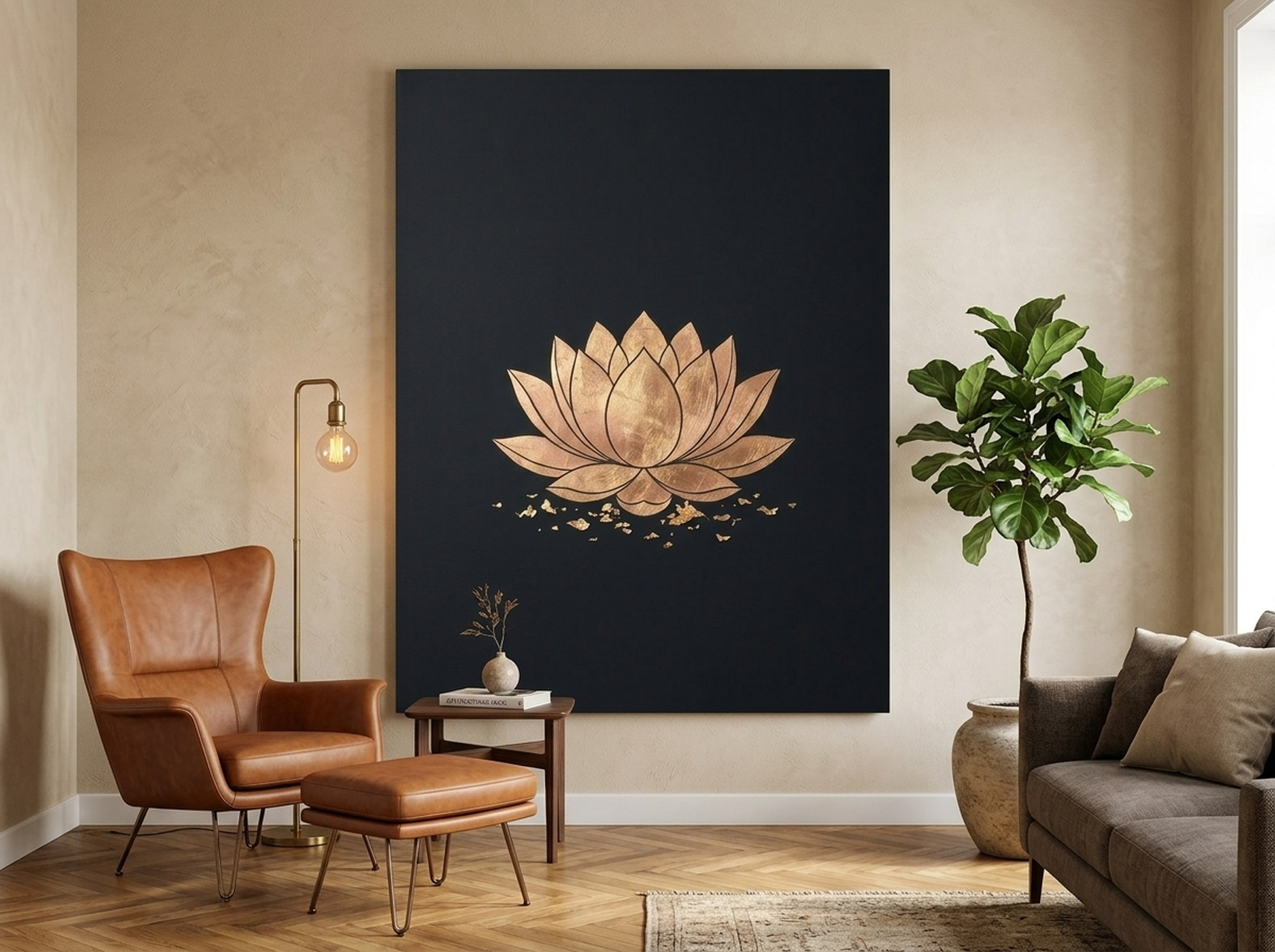
The lotus rises from muddy water to bloom in pristine beauty each morning, making it the perfect symbol of creation, rebirth, and the sun. It appears throughout Egyptian iconography -- on column capitals, in tomb paintings, and as an offering to the gods. Gold-leaf lotus prints bring a serene, spa-like energy to bathrooms and master bedrooms.
Anubis
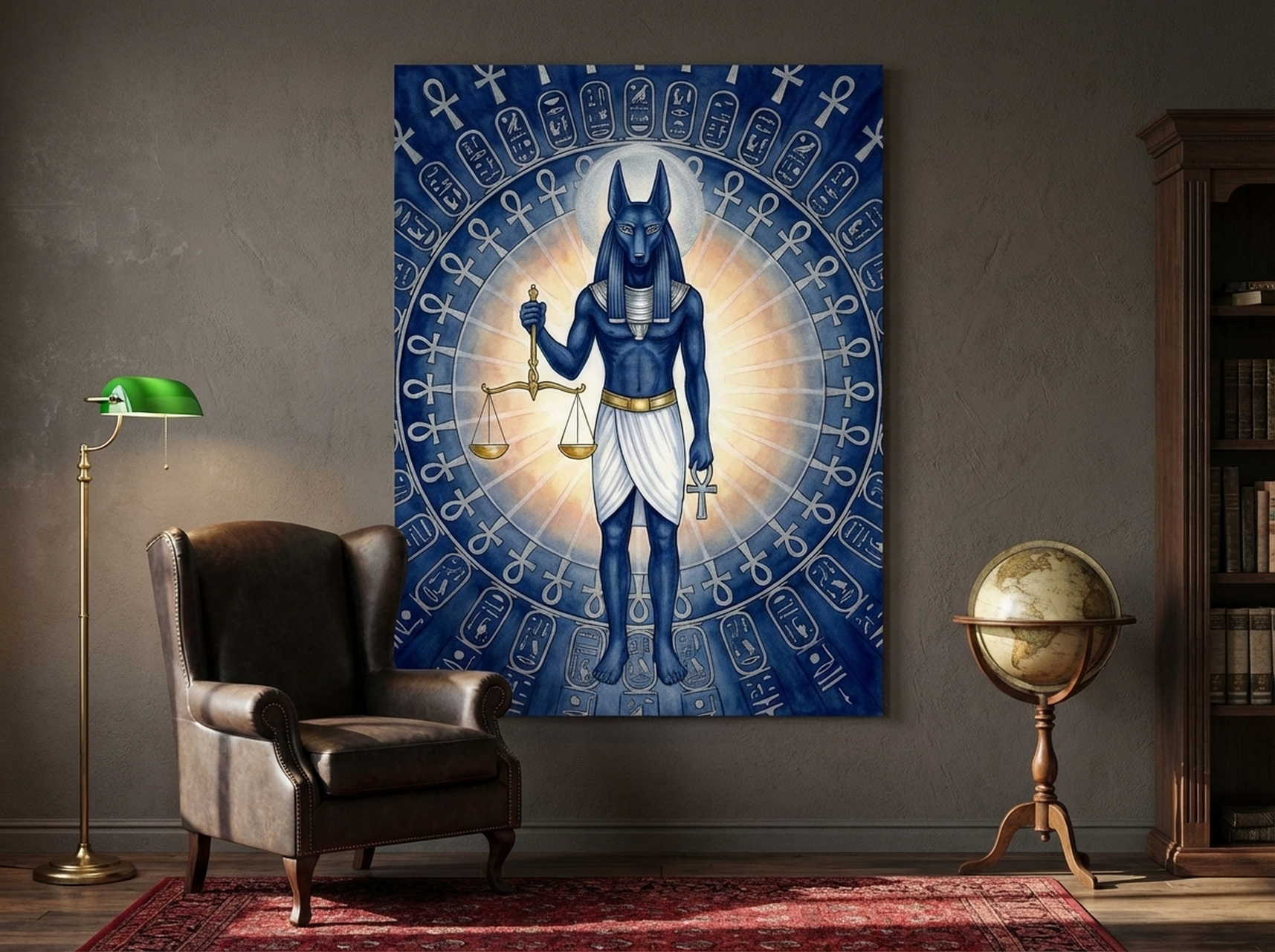
The jackal-headed god of the dead and the afterlife, Anubis presided over the weighing of the heart -- the moment of divine judgement. Far from being a figure of dread, Anubis was considered a protector of the dead, guiding souls safely to the afterlife. As wall art, Anubis commands attention with his distinctive silhouette and makes a powerful statement in home offices and dark-academia inspired spaces.
Nefertiti
Queen Nefertiti, whose name means "the beautiful one has come," is one of the most iconic figures in Egyptian history. Her portrait bust, discovered in 1912, has become a global symbol of feminine power and ancient beauty. Nefertiti-inspired canvas art is among the most sought-after Egyptian pieces for modern homes, bridging ancient royalty with contemporary aesthetic sensibility. See our guide to luxury wall art for more inspiration.
How to Incorporate Egyptian Motifs in Modern Interiors
Egyptian art is bold by nature, and the key to integrating it successfully is knowing how much to layer and where to let it breathe. Here are the core principles.
Colour Psychology: The Egyptian Palette
The traditional Egyptian colour palette is built around four anchor tones:
- Gold: The colour of divinity and the sun. Use it as the dominant metallic accent throughout the room -- in cushion trims, lamp bases, and picture frames -- to create visual coherence with Egyptian wall art.
- Navy Blue (Lapis Lazuli): The night sky and the primordial waters of creation. Navy is grounding and sophisticated, making it an ideal wall colour behind gold-toned Egyptian prints.
- Terracotta: The colour of the desert sands and sun-baked clay. Warm terracotta cushions, rugs, or throws create an earthy counterpoint to metallic Egyptian art.
- Ivory and Cream: The colour of papyrus and linen. Ivory walls are the most neutral backdrop for Egyptian wall art, allowing every detail of the artwork to sing.
Styling Approaches
There are three distinct ways to incorporate Egyptian art into a modern home:
- The Singular Statement: One large-format canvas (80 x 100 cm / 32 x 40 in or larger) on a dedicated feature wall. This approach is the most powerful and works in both minimalist and maximalist rooms.
- The Curated Gallery Wall: A grouping of three to five smaller prints (40 x 50 cm / 16 x 20 in each) arranged in a grid or salon-style cluster. Mix Egyptian motifs with related themes -- sacred geometry, ancient mythology, or abstract gold art -- for a cohesive narrative.
- The Layered Collector: Egyptian wall art as one anchor piece in a richly layered room that includes other cultural heritage art, natural materials (linen, rattan, stone), and artisanal objects. This is the hardest approach to execute but the most rewarding when done well.
For detailed advice on building a gallery arrangement, visit our complete gallery wall layout guide.
Placement Guide: Size and Height Rules
Correct placement transforms good art into great interior design. Follow these rules for flawless hanging every time.
Height Rule
The centre of the canvas should sit at 145--150 cm (57--59 in) from the floor. This places the visual midpoint of the artwork at average adult eye level. In rooms with very high ceilings (above 3 m / 10 ft), you can raise this to 160 cm (63 in) without losing the intimate connection with the art.
Width Rule for Sofas and Beds
Above a sofa or bed headboard, the art should span 55--75% of the furniture's width. For a standard 200 cm (79 in) sofa, aim for a canvas or canvas grouping 110--150 cm (43--59 in) wide. The bottom of the frame should sit 15--20 cm (6--8 in) above the sofa back.
Common Size Guide for Egyptian Art
| Room | Recommended Size (cm) | Recommended Size (inches) |
|---|---|---|
| Living Room Feature Wall | 80 x 100 -- 100 x 120 | 32 x 40 -- 40 x 48 |
| Bedroom Above Headboard | 60 x 80 -- 80 x 100 | 24 x 32 -- 32 x 40 |
| Home Office | 50 x 70 -- 60 x 80 | 20 x 28 -- 24 x 32 |
| Hallway | 40 x 60 -- 50 x 70 | 16 x 24 -- 20 x 28 |
For a deeper dive into sizing principles, our wall art size guide for living rooms covers every scenario. (source: Britannica)
Our Top 6 Egyptian Wall Art Picks
There are no dedicated "Egyptian" products in every collection, so we have handpicked the pieces from our gallery that most authentically capture the spirit of ancient Egypt -- through symbolism, colour, mythology, and that unmistakable sense of regal grandeur.
1. Nefertiti Stained Glass Canvas Wall Art
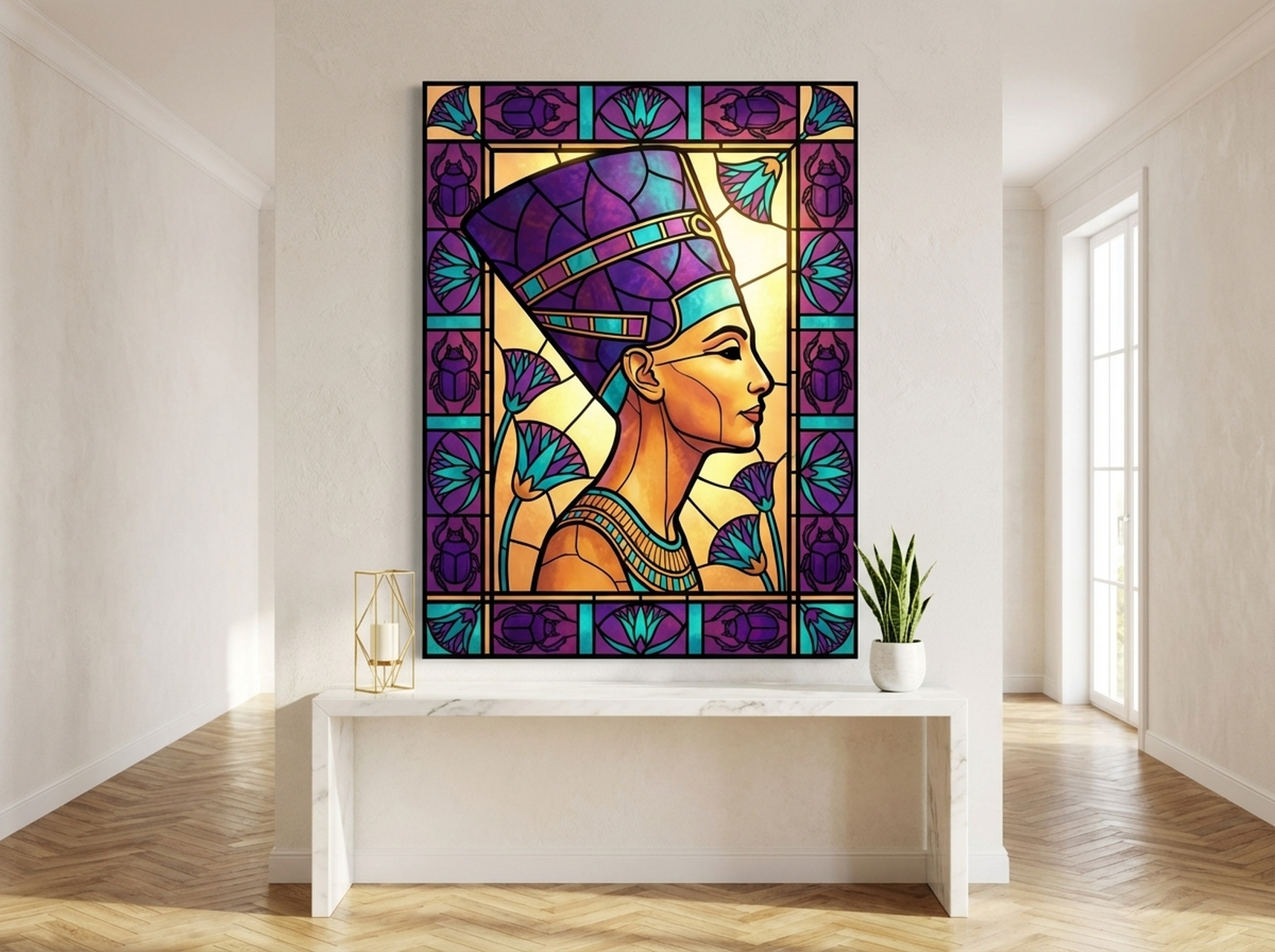
This extraordinary canvas reimagines the legendary Queen Nefertiti in a cathedral-style stained glass treatment, flooding her portrait with amethyst, turquoise, and deep gold. The mosaic quality echoes the jewel-encrusted ornaments of the royal court and brings an almost spiritual luminosity to any wall. Ideal for living rooms, master bedrooms, or a dramatic hallway statement, it works best at 60 x 80 cm (24 x 32 in) or larger. Hang it against deep navy or charcoal walls for a showstopping effect, or let it pop against pure white for gallery-level impact.
View the Nefertiti Stained Glass Canvas
2. Anubis Egyptian God Canvas Wall Art
The jackal-headed god of the afterlife is rendered here in an intricate mandala framework, merging ancient Egyptian mythology with the sacred geometry of Islamic and Mandala traditions. The midnight blue and silver palette is cool, commanding, and utterly distinctive. This piece is made for home offices, libraries, dark academia reading nooks, and any space where you want to signal intellectual depth and a love of world mythology. Size it at 50 x 70 cm (20 x 28 in) or above to let the mandala detail breathe.
View the Anubis Egyptian God Canvas
3. African Warrior King Canvas Wall Art
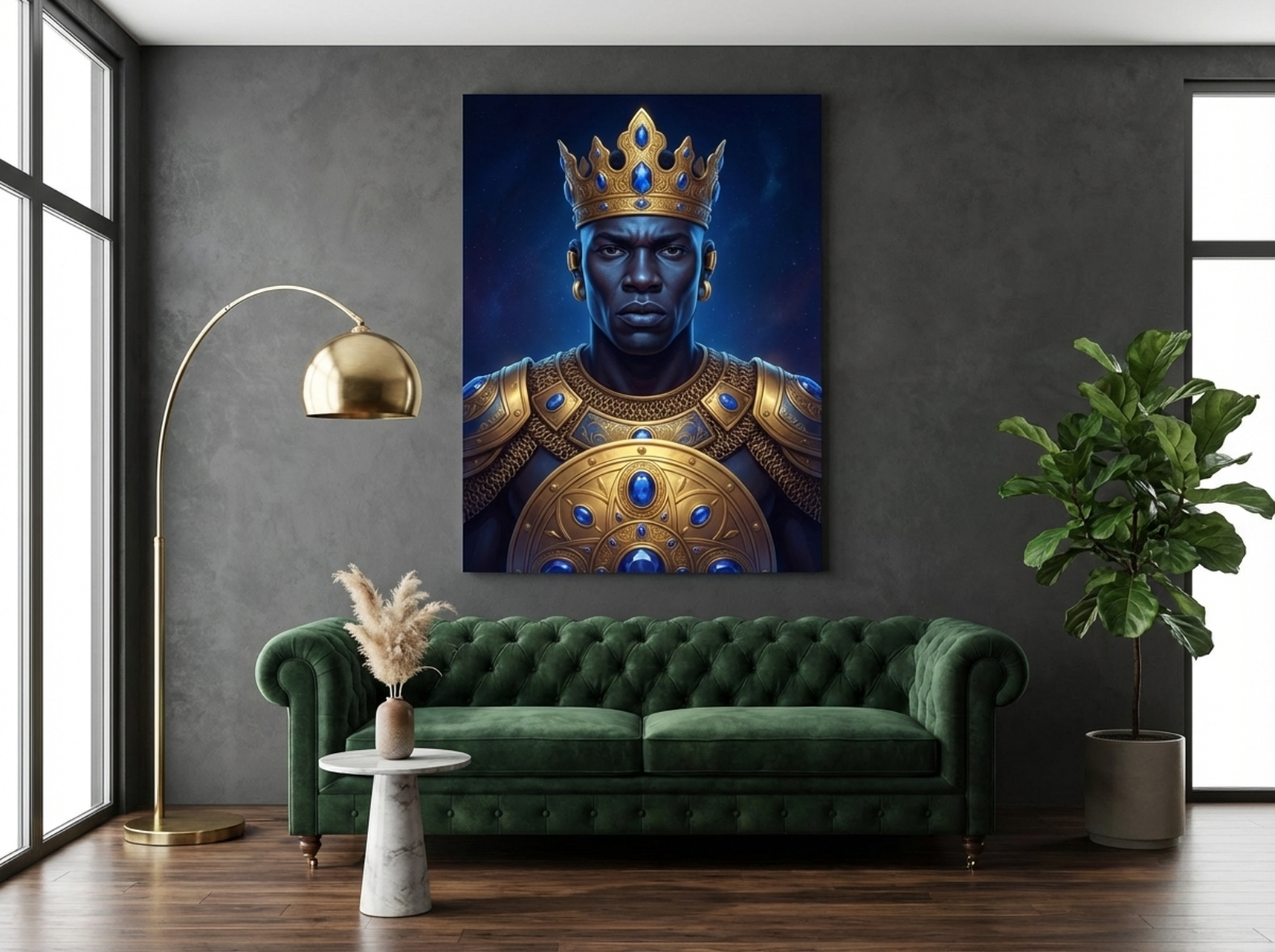
This striking portrait channels the regal grandeur of the pharaonic tradition through a contemporary Afrocentric lens. The warrior king is depicted in ceremonial gold armour against a rich navy ground, evoking the powerful portraits of Egyptian royalty seen on temple walls from Luxor to Abu Simbel. It makes a bold statement above a fireplace or as a feature wall anchor in a living room or dining room. Hang at 80 x 100 cm (32 x 40 in) to command the space with appropriate authority.
View the African Warrior King Canvas
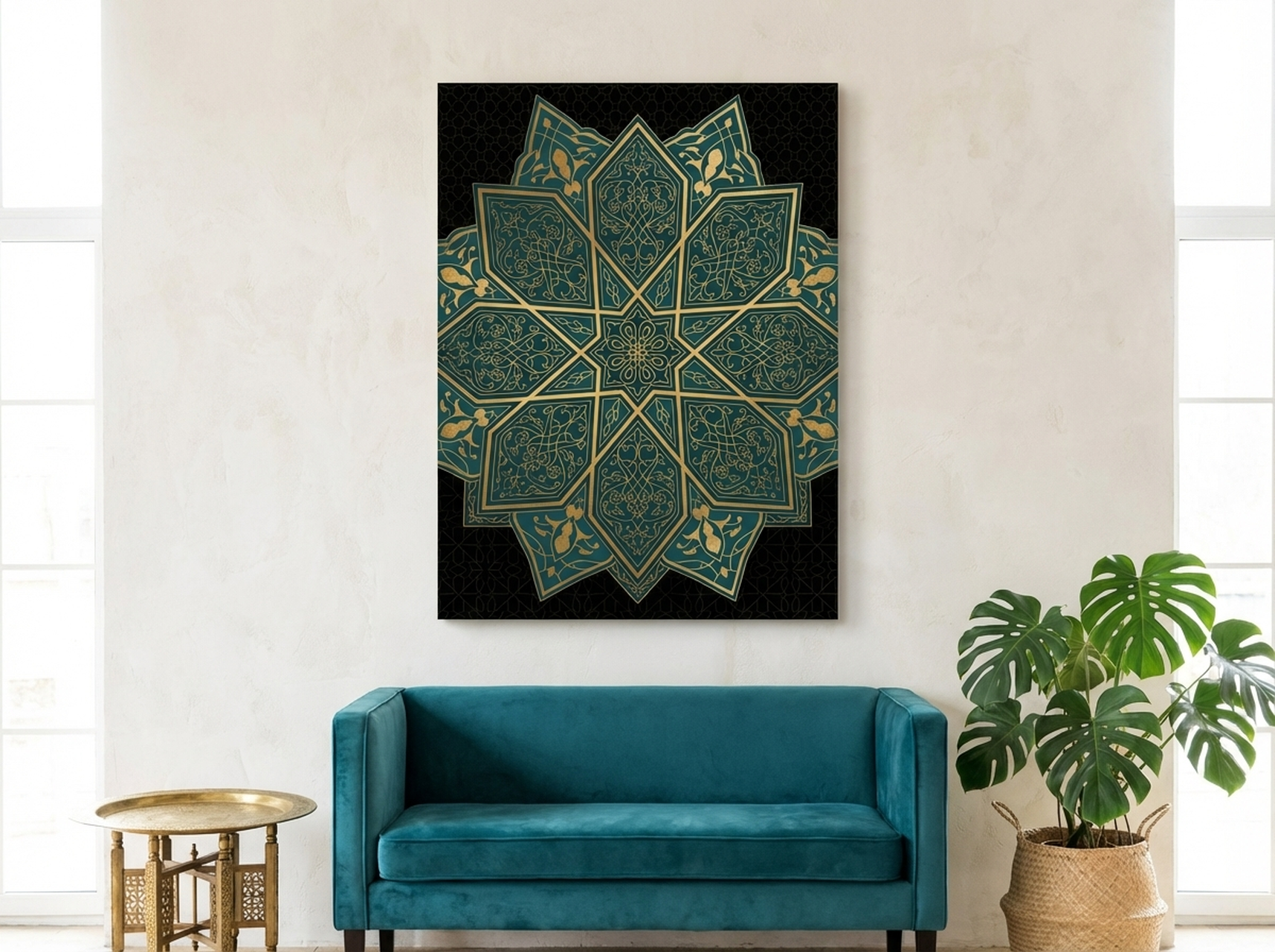
4. Islamic Geometric Star Canvas Wall Art
While rooted in Islamic geometric tradition, this dazzling teal and gold star pattern shares deep visual DNA with Egyptian sacred geometry -- the same mathematical precision and spiritual intention that governed the design of the Great Pyramid and the temples of Karnak. The Arabesque zellige pattern transforms a wall into a window of pure geometric rapture. It suits living rooms, dining rooms, and hallways in homes with Mediterranean, Moroccan, or ancient world aesthetic sensibilities. Works best at 60 x 60 cm (24 x 24 in) square or as part of a paired arrangement.
View the Islamic Geometric Star Canvas
5. Klimt Urn Trio Canvas Wall Art
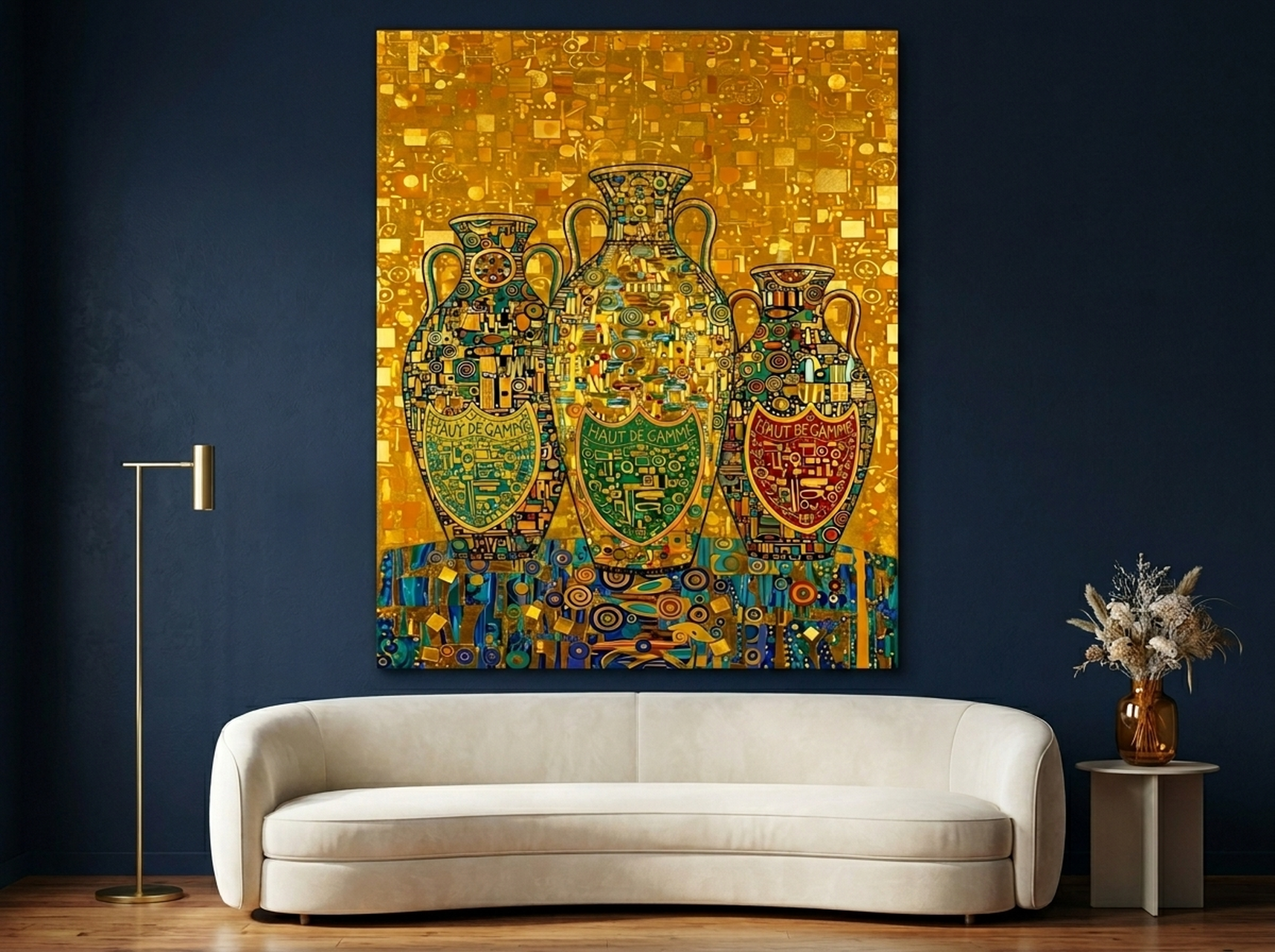
Gustav Klimt's gold-ground technique was directly inspired by Byzantine mosaic and -- further back -- the gold-leaf decoration of Egyptian royal tombs. This Klimt-inspired urn trio captures that lineage perfectly, wrapping its decorative vessels in sumptuous gold mosaic patterns against jewel-toned grounds. It is a sophisticated choice for living rooms, hallways, and dining rooms where you want to signal art-historical knowledge alongside aesthetic flair. At 40 x 120 cm (16 x 48 in) in a triptych format, it fills a wide horizontal wall with elegant precision.
View the Klimt Urn Trio Canvas
6. Lotus Flower Canvas Wall Art
The lotus is the quintessential Egyptian sacred symbol of rebirth, purity, and the daily renewal of the sun -- and this gold-leaf and black minimalist interpretation distils that ancient power into a quietly stunning modern print. The restrained composition makes it one of the most versatile Egyptian-themed pieces in our collection: it suits bedrooms, bathrooms, yoga spaces, and any room where you want to introduce ancient symbolism without dominant visual weight. Pairs beautifully with natural linen bedding, warm wood furniture, and soft terracotta accents. A 50 x 70 cm (20 x 28 in) format is ideal for most bedroom walls.
5 Common Mistakes to Avoid with Egyptian Wall Art
- Going too small. Egyptian art is inherently monumental -- it was designed to fill the walls of temples and royal tombs. A canvas that is too small loses all its power. When in doubt, size up by one step.
- Clashing symbolism. Egyptian art carries deep spiritual meaning. Mixing Anubis (god of the dead) with cheerful nursery prints, or placing sacred symbols in bathroom contexts without thought, can feel tonally jarring. Consider the atmosphere you want to create and choose symbols accordingly.
- Ignoring the colour echo rule. Egyptian art's gold, navy, and terracotta palette needs at least one echo in the room -- a gold lamp, a navy cushion, a terracotta vase. Without this, the artwork can feel isolated rather than integrated.
- Over-theming. One or two strong Egyptian pieces are all most rooms need. Filling every wall with hieroglyphic prints tips from sophisticated into themed restaurant territory. Let each piece have space to breathe and speak.
- Hanging too high. A common error in every genre of wall art, but especially costly with Egyptian pieces where facial expressions and symbolic details matter. Keep the centre at 145--150 cm (57--59 in) from the floor, regardless of ceiling height.
Frequently Asked Questions
What is Egyptian wall art?
Egyptian wall art refers to artwork inspired by ancient Egyptian iconography -- including pharaohs, gods such as Anubis and Horus, hieroglyphs, the Eye of Ra, and the Ankh symbol. Modern interpretations translate these motifs onto canvas prints and framed wall art for contemporary interiors.
What size canvas works best for an Egyptian wall art feature wall?
For a statement feature wall, choose a canvas between 60 x 80 cm (24 x 32 in) and 100 x 120 cm (40 x 48 in). This scale ensures the symbolism reads clearly from across a room without overwhelming smaller spaces.
What colours complement Egyptian-themed art?
Egyptian art pairs naturally with a palette of midnight navy, deep terracotta, desert sand, and rich gold. On walls, neutral tones such as warm white, greige, or charcoal grey allow the artwork's own colours to take centre stage.
Can Egyptian wall art work in a modern minimalist home?
Yes. Choose pieces with a graphic, black-and-gold or monochrome palette and mount them with generous white space around the canvas. A single oversized piece on an otherwise bare wall keeps the look refined rather than cluttered.
How high should I hang Egyptian canvas art?
The centre of the canvas should sit at eye level, roughly 145--150 cm (57--59 in) from the floor. Above a sofa, leave a gap of 15--20 cm (6--8 in) between the top of the furniture and the bottom of the frame.
Is Egyptian art appropriate for every room?
Egyptian wall art suits living rooms, home offices, studies, and hallways particularly well. The rich symbolism creates a powerful focal point in high-traffic spaces. For bedrooms, opt for softer, jewel-toned interpretations such as stained-glass or watercolour styles rather than dramatic dark pieces.
Quick Reference Table
| Product | Best For | Dominant Colours | Link |
|---|---|---|---|
| Nefertiti Stained Glass Canvas | Living room, bedroom feature wall | Amethyst, turquoise, gold | View |
| Anubis Egyptian God Canvas | Home office, library, dark academia | Midnight blue, silver, black | View |
| African Warrior King Canvas | Living room statement, above fireplace | Navy, gold, charcoal | View |
| Islamic Geometric Star Canvas | Living room, dining room, hallway | Teal, gold, black | View |
| Klimt Urn Trio Canvas | Living room, hallway, wide horizontal wall | Gold, jewel tones, cream | View |
| Lotus Flower Canvas | Bedroom, bathroom, yoga space | Gold, black, cream | View |
Transform Your Home with the Art of the Ancients
Egyptian wall art is more than a decorating choice -- it is an invitation to live with history, myth, and five millennia of human genius on your walls every day. Whether you choose the luminous regality of Nefertiti in stained glass, the commanding presence of Anubis in midnight blue mandala, or the serene golden lotus of rebirth, each piece carries a story that no other art tradition can match. See our large canvas statement ideas guide for more inspiration on making an impact. As National Geographic notes, ancient Egypt's artistic legacy continues to shape how we see beauty, power, and the sacred -- and there is no better place to honour that legacy than on the walls of your home.