Modern Wall Art Trends 2026: What Designers Buy
The Heva Team
Art Curators & Interior Design Enthusiasts · March 20, 2026 · 15 min read
Professional interior designers reveal their top wall art picks for 2026. From impasto textures to warm earthy palettes, discover the trends shaping designer projects this year.
If you have ever wondered what artwork professional interior designers actually purchase for their clients, you are not alone. The pieces that working designers choose are rarely random. They reflect months of trade-show research, colour forecasting reports, and real-world client feedback. In this guide we break down the specific wall art trends designers are investing in for 2026 so you can bring that same curated eye into your own space.
Ready to browse? Explore our designer-curated collection, or keep reading for our top picks and expert tips.
What You Will Find in This Guide
- Why Texture and Movement Dominate 2026
- The Shift Toward Warm, Earthy Palettes
- Intentional Maximalism and Layered Art Walls
- The Fashion-Art Crossover Designers Love
- 6 Designer-Approved Wall Art Picks for 2026
- How to Hang Art Like a Designer: Measurements and Rules
- Common Mistakes Interior Designers Warn Against
- Designer-Focused Wall Art FAQ
- Quick Reference Table
Why Texture and Movement Dominate 2026
Interior designers have made one thing crystal clear this year: flat, lifeless prints are out. The single biggest shift in designer buying patterns for 2026 is a strong move toward artwork that carries visible texture, whether that comes from impasto brushwork, sculptural relief effects, or heavy palette-knife layering. According to Decorilla's 2026 interior design trends report, tactile surfaces are no longer a niche preference but a mainstream expectation in professional projects.
The reason is practical. A textured canvas print adds depth to a wall in a way that a smooth photograph simply cannot. When mounted above a sofa that sits roughly 25 to 30 cm (10 to 12 inches) below the frame, the shadow play from overhead lighting creates a dynamic effect that changes throughout the day. Designers working on living room projects report that clients consistently gravitate toward impasto-style canvases because they look like original paintings rather than mass-produced reproductions.
Movement is the second half of this trend. Fluid abstracts with sweeping curves, rippling water reflections, and organic flow patterns are replacing rigid geometric grids in designer mood boards. The visual motion keeps the eye moving, which makes a room feel larger and more alive. If you are interested in how colour choices amplify this effect, our guide to the psychology of colours in wall art explores the science behind why warm-toned movement pieces feel so inviting.
The Shift Toward Warm, Earthy Palettes
Cold greys and stark monochromes dominated designer projects from roughly 2018 to 2023. That era is firmly over. In 2026, the palettes designers are specifying lean warm and organic: think terracotta, burnt sienna, golden amber, sage green, and deep walnut tones. These hues connect directly to biophilic design principles that have been steadily gaining traction in commercial and residential interiors alike.
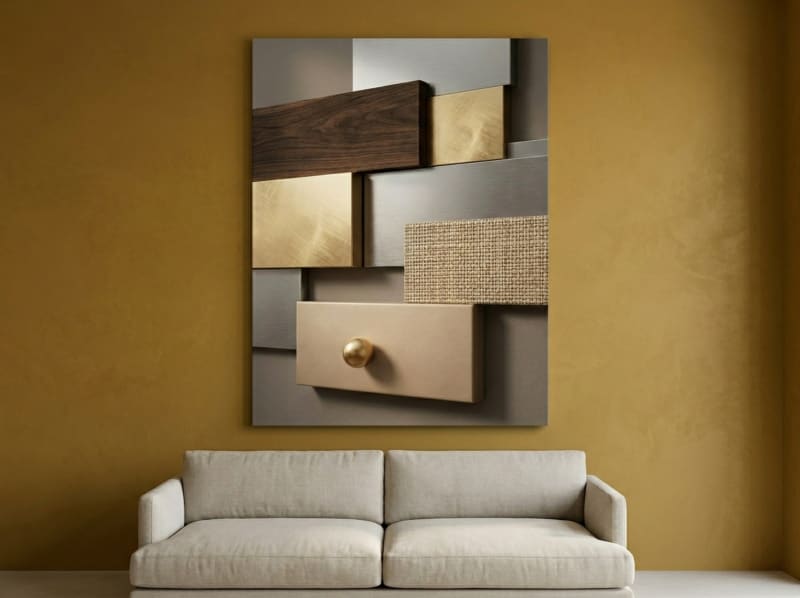
The practical effect on wall art buying is significant. Designers are actively seeking canvases that anchor a room in warmth without competing with furniture. A gold-and-cream abstract over a neutral linen sofa creates a focal point that feels collected rather than decorated. A sage-and-terracotta geometric print beside a walnut credenza ties natural materials together visually. The key measurement designers use: art should occupy roughly 60 to 75 percent of the wall width above the furniture piece it sits over, which translates to approximately 90 to 120 cm (36 to 48 inches) for a standard sofa setup.
This warm palette shift also extends to metal tones within artwork. Designers are choosing canvases with gold leaf effects, brass undertones, and copper highlights over the silver and chrome metallics that ruled mid-decade. If you want to learn how to make a room feel more polished with these choices, our guide to luxury wall art covers specific placement strategies.
Intentional Maximalism and Layered Art Walls
Minimalism is not dead, but it has evolved. Designers in 2026 are practising what the industry calls intentional maximalism, a curated approach where multiple pieces of art, textiles, and decorative objects are layered together with purpose. The difference between clutter and intentional maximalism comes down to a unifying thread: a shared colour family, a consistent frame finish, or a repeating motif.
For wall art, this means designers are buying pieces in sets of two or three rather than one hero canvas. They might pair a large 100 x 75 cm (40 x 30 inch) abstract with two smaller 40 x 50 cm (16 x 20 inch) companion pieces that share a dominant colour. The spacing rule they follow is consistent: 5 to 8 cm (2 to 3 inches) between frames for a grouped arrangement, and 15 to 20 cm (6 to 8 inches) between unrelated pieces on the same wall.
Gallery walls remain popular, but the execution has changed. Designers are moving away from perfectly symmetrical grids toward organic, salon-style arrangements where frames vary in size and orientation. The anchor piece, usually the largest canvas, goes slightly left or right of centre rather than dead middle. This asymmetry feels more collected and personal, which is exactly the feeling clients are requesting. For a step-by-step walkthrough, see our complete gallery wall guide.
The Artfully Walls 2026 wall art trends report confirms that mood-driven art selection is replacing the old approach of simply matching art to furniture upholstery. Designers now ask clients how they want a room to feel before choosing any artwork.
The Fashion-Art Crossover Designers Love
One of the more surprising trends in designer circles this year is the growing overlap between fashion imagery and fine art. Runway silhouettes, editorial poses, and couture-inspired compositions are appearing on canvas in ways that feel elevated rather than commercial. Designers report that clients, particularly those furnishing bedrooms and dressing rooms, are drawn to figurative art that captures movement and elegance without being literal portraiture.
The specific aesthetic designers are gravitating toward combines geometric abstraction with figurative elements. Think a female silhouette rendered in sage and terracotta colour blocks rather than photorealistic detail. This approach allows the artwork to complement a wide range of interior styles, from Scandinavian-modern to Art Deco revival, without anchoring the room to a single era or trend.
Colour restraint is essential in this category. Designers avoid pieces with more than three or four dominant hues, preferring muted earth tones that layer well with textiles. A terracotta-and-cream fashion print beside a velvet headboard creates a connection between the artwork and the tactile quality of the bedding, reinforcing that texture-first philosophy that defines 2026 interiors.
6 Designer-Approved Wall Art Picks for 2026
1. Islamic Geometric Star Canvas Wall Art
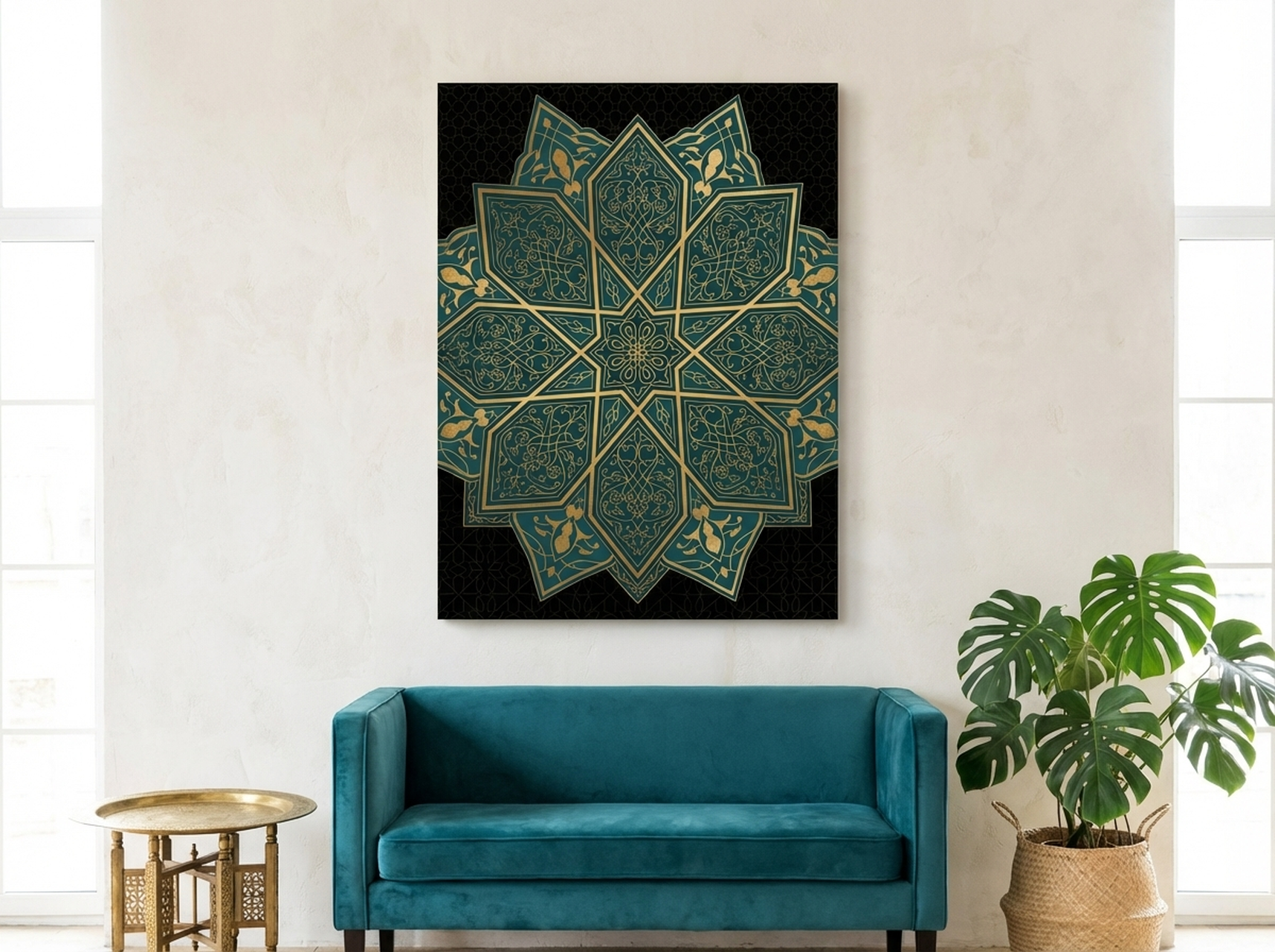
This Arabesque zellige-inspired print is the kind of piece designers reach for when a project calls for cultural richness without literal representation. The interlocking star pattern in deep teal and gold creates a hypnotic focal point that works in formal dining rooms, entryway walls, and even home libraries. At 60 x 90 cm (24 x 36 inches) or larger, the geometric repetition reads as architectural rather than decorative, giving the wall a sense of permanence. Designers pair it with brass hardware and dark wood furniture for a globally inspired look that feels timeless rather than trend-dependent. The black ground anchors the composition, while the teal and gold star pattern catches light beautifully under both natural and artificial sources.
View the Islamic Geometric Star
2. Oversized Rose Impasto Canvas Wall Art
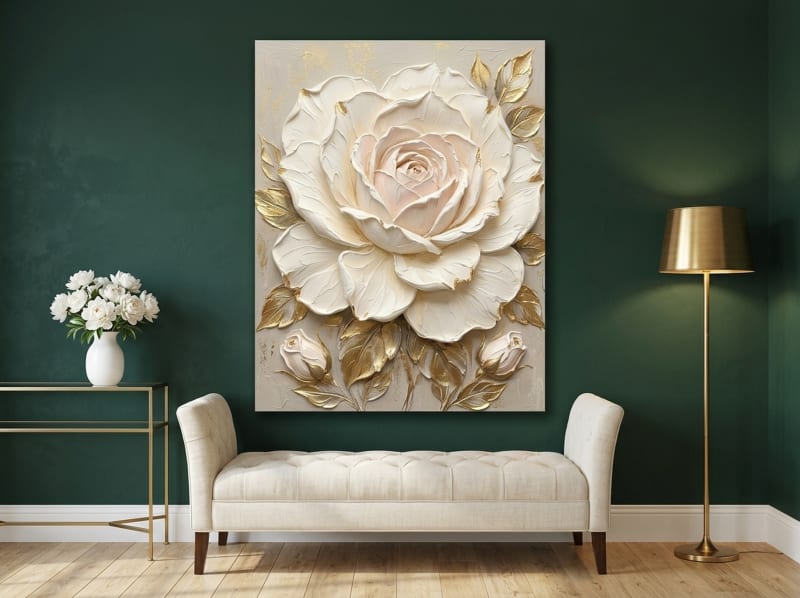
This is the texture trend distilled into a single piece. The heavy impasto brushwork gives this rose composition a sculptural quality that makes it look like an original oil painting rather than a print. Designers are placing oversized florals like this one in master bedrooms and powder rooms where the cream-and-gold palette creates a sense of quiet luxury. The monochromatic approach means it layers effortlessly with white linen bedding, cream upholstery, and warm wood nightstands. Hang it 20 to 25 cm (8 to 10 inches) above a headboard for maximum impact. The subtle gold highlights in the petal edges catch ambient light, adding a gentle shimmer that shifts as the day progresses.
View the Oversized Rose Impasto
3. Klimt Mosaic Portrait Canvas Wall Art
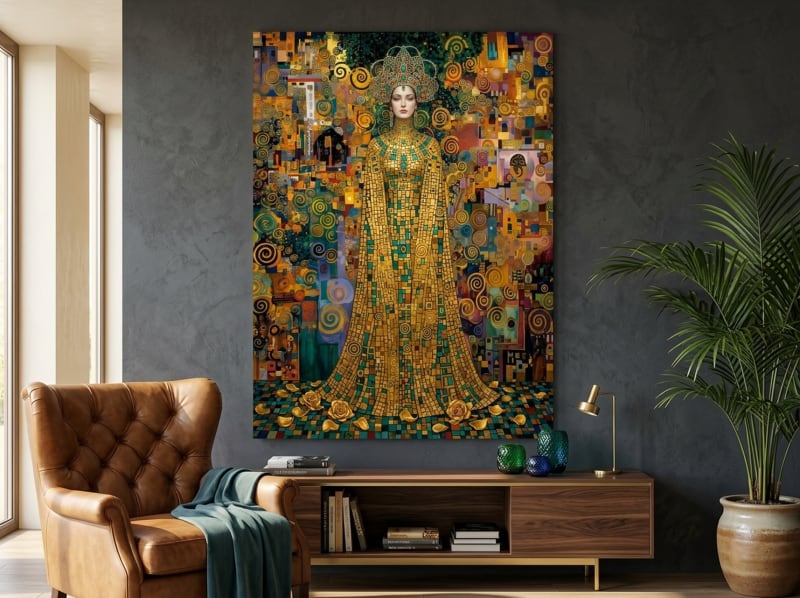
Art Nouveau references are having a strong moment in designer projects, and this Klimt-inspired mosaic portrait captures the movement's signature blend of gold ornamentation and figurative beauty. Designers choose pieces like this for formal living rooms and sitting areas where they want a conversation-starting anchor. The jewel-tone palette of gold, teal, and burgundy adds warmth without overwhelming, while the mosaic patterning connects to the broader geometric trend running through 2026 interiors. Position it at eye level, roughly 145 to 155 cm (57 to 61 inches) from the floor to the centre of the canvas, on a feature wall with subtle ambient lighting. The dense detail rewards close inspection, making it ideal for rooms where guests linger.
View the Klimt Mosaic Portrait
4. Woman and Horse Geometric Canvas Wall Art
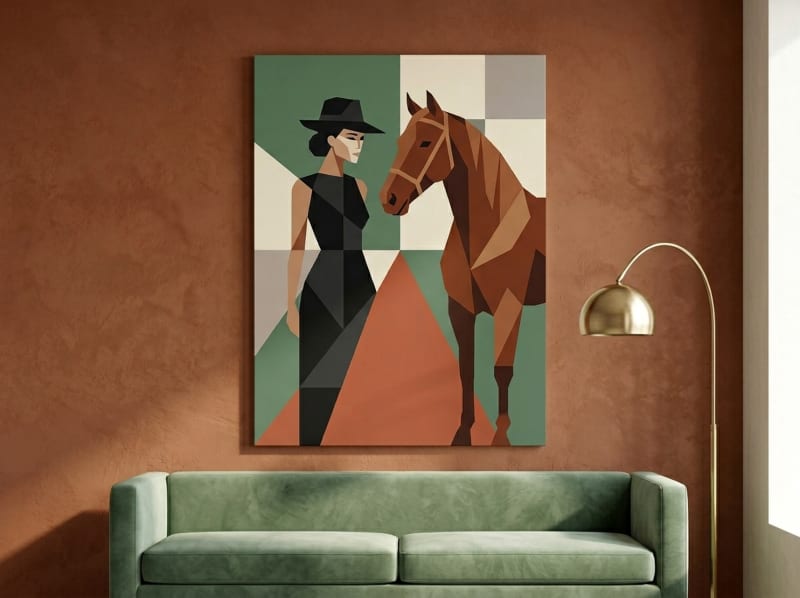
This piece sits squarely at the intersection of fashion and fine art that designers are embracing in 2026. The figurative composition uses flat geometric colour blocks in sage, terracotta, and cream to suggest a woman alongside a horse without relying on photorealistic detail. That abstraction gives it versatility: it works equally well in a contemporary bedroom, a boho-inspired living room, or an eclectic hallway. The earth-tone palette ties into the warm colour shift designers are championing, while the fashion-forward subject matter adds editorial sophistication. Mount it on a wall with at least 30 cm (12 inches) of clear space on each side to let the composition breathe. It pairs beautifully with rattan furniture and linen textiles.
View the Woman and Horse Geometric
5. Alpine Mountain Impasto Canvas Wall Art
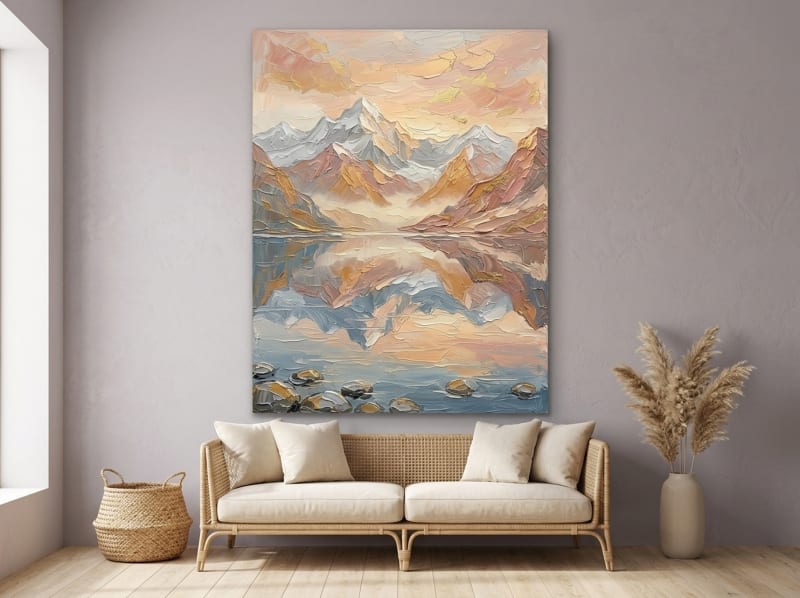
Landscape art is a perennial designer staple, but the execution has shifted dramatically. Where designers once specified crisp landscape photography, they now prefer painterly interpretations with visible brushwork and warm colour grading. This alpine reflection piece checks every 2026 box: impasto texture, a warm peach-and-gold palette, and a composition that evokes nature without literal realism. It is especially popular in living rooms and open-plan spaces where the horizontal format complements long sofa runs. For over-sofa placement, hang the bottom edge 15 to 20 cm (6 to 8 inches) above the sofa back, ensuring the canvas spans at least 60 percent of the sofa width. The water reflection in the lower half adds visual depth that draws the eye downward, grounding the composition.
View the Alpine Mountain Impasto
6. Disco Ball Forest Green Canvas Print
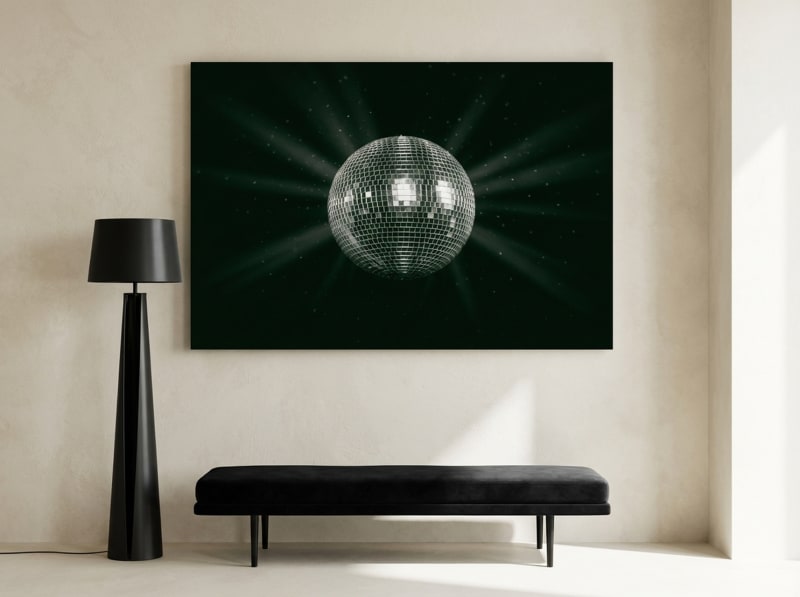
Moody glamour is the dark horse of 2026 designer trends. While warm earthy tones dominate most projects, a growing number of designers are specifying deep forest-green and black-based art for bar areas, media rooms, home offices, and guest bedrooms where a moodier atmosphere is appropriate. This disco ball composition delivers precisely that vibe: the silver reflections against a deep green-black ground create a sense of nightlife sophistication without being overtly party-themed. It appeals to designers working on masculine spaces, music rooms, and entertainment areas. Place it at eye level on a dark-painted accent wall with a single picture light above for dramatic effect. The contrast between the reflective silver facets and the matte green background creates a visual tension that feels deliberately curated.
View the Disco Ball Forest Green
How to Hang Art Like a Designer: Measurements and Rules
Professional interior designers follow a set of precise hanging rules that separate polished interiors from amateur ones. These measurements are based on gallery standards adapted for residential spaces.
Eye-Level Centre Rule: The centre of the artwork should sit 145 to 155 cm (57 to 61 inches) from the floor. This is the gallery standard, and it works in hallways, living rooms, and any wall without furniture directly below.
Above-Sofa Rule: When hanging above a sofa or console, the bottom edge of the frame should be 15 to 20 cm (6 to 8 inches) above the furniture. The artwork should span 60 to 75 percent of the furniture width. A 200 cm (80 inch) sofa calls for a canvas between 120 and 150 cm (48 and 60 inches) wide.
Above-Headboard Rule: In bedrooms, position the bottom edge 20 to 25 cm (8 to 10 inches) above the headboard. Choose artwork that is two-thirds the width of the headboard for balanced proportion.
Gallery Wall Spacing: Maintain 5 to 8 cm (2 to 3 inches) between frames in a grouped arrangement. Use paper templates taped to the wall before committing to nail holes. Start with the largest piece and build outward.
Lighting: Position a picture light 10 to 15 cm (4 to 6 inches) above the frame top. Aim the beam at a 30-degree angle toward the canvas. For larger pieces over 90 cm (36 inches) wide, consider two puck lights spaced 60 cm (24 inches) apart for even illumination.
Narrow Hallways: In corridors less than 120 cm (48 inches) wide, offset the artwork toward the side you approach from. This prevents the feeling of the walls closing in and lets you appreciate the piece as you walk toward it.
Common Mistakes Interior Designers Warn Against
Hanging too high. The single most common mistake homeowners make is mounting art too high on the wall. If you have to tilt your head back to view it, the piece is too high. Use the 145 to 155 cm (57 to 61 inch) centre-point rule as your baseline and adjust from there. This single correction transforms more rooms than any other change.
Choosing art that is too small for the wall. A 30 x 40 cm (12 x 16 inch) canvas on a 300 cm (120 inch) wide wall looks like an afterthought. Designers recommend that artwork fill 60 to 75 percent of the available wall space above furniture, or at least 50 percent of a bare wall. When in doubt, go larger. An oversized piece always makes more impact than an undersized one.
Matching art to paint colour too closely. A beige painting on a beige wall disappears. Designers create interest through tonal contrast: a warm terracotta canvas against an off-white wall, or a deep teal piece against a warm grey. Aim for at least two tones of separation between the dominant art colour and the wall behind it.
Ignoring frame finish. The frame is part of the design, not a neutral wrapper. Black frames sharpen contemporary pieces. Natural wood frames warm Scandinavian and rustic settings. Gold or brass frames elevate traditional and maximalist rooms. A mismatched frame can undercut even the best canvas.
Skipping the picture light. Designers almost always specify lighting for wall art. Even a simple battery-powered LED picture light transforms how a canvas reads in a room. Without targeted illumination, artwork fades into the background once the sun goes down. Budget roughly 15 to 25 dollars for a wireless picture light that mounts above the frame without wiring.
Designer-Focused Wall Art FAQ
What size wall art do interior designers recommend for a living room?
Most designers specify artwork that spans 60 to 75 percent of the sofa width. For a standard 200 cm (80 inch) sofa, that means a canvas between 120 and 150 cm (48 and 60 inches) wide. If you prefer a grouping, the total arrangement width should stay within that same range.
Are canvas prints considered acceptable by professional designers?
Yes. Canvas prints with visible texture, matte finishes, and quality framing are a staple in designer projects at every budget level. The key differentiator is print quality and presentation. A well-framed canvas with an impasto-effect print reads as original art from across a room, which is why designers increasingly specify them for residential clients.
What colours are designers choosing for wall art in 2026?
Warm earth tones dominate: terracotta, golden amber, sage green, cream, and deep walnut browns. Jewel-tone accents in teal, burgundy, and gold add richness. Cool greys and stark whites have largely fallen out of favour in residential projects, though they still appear in commercial settings.
Should wall art match the furniture or contrast with it?
Designers prefer a connection rather than an exact match. The artwork should share one or two colours with the room's palette while introducing at least one new accent tone. This creates visual cohesion without making the space feel formulaic. For example, pair a sage-and-terracotta print with a sage sofa and introduce terracotta through the art alone.
How do designers decide between abstract and figurative art?
The choice depends on the room's purpose. Abstract works suit living areas and open plans where the art needs to appeal broadly. Figurative pieces, particularly fashion-inspired or culturally rooted portraits, work well in more personal spaces like bedrooms, studies, and dining rooms where they can spark conversation.
Is the gallery wall trend still relevant in 2026?
Gallery walls remain popular but the execution has evolved. Designers are moving away from perfectly symmetrical grids toward organic, salon-style arrangements. The anchor piece sits slightly off-centre, and frame sizes vary intentionally. Spacing stays consistent at 5 to 8 cm (2 to 3 inches) between frames to maintain visual coherence.
Quick Reference Table
| Product | Best For | Dominant Colours | Link |
|---|---|---|---|
| Islamic Geometric Star | Dining rooms, entryways, libraries | Teal, gold, black | View |
| Oversized Rose Impasto | Bedrooms, powder rooms | Cream, white, gold | View |
| Klimt Mosaic Portrait | Formal living rooms, sitting areas | Gold, teal, burgundy | View |
| Woman and Horse Geometric | Bedrooms, boho living rooms | Sage, terracotta, cream | View |
| Alpine Mountain Impasto | Living rooms, open-plan spaces | Gold, peach, terracotta | View |
| Disco Ball Forest Green | Bar areas, media rooms, home offices | Black, silver, forest green | View |
Wall art in 2026 is defined by texture, warmth, and intention. The pieces interior designers are buying reflect a broader shift toward art that tells a story, anchors a room in emotion, and rewards close inspection. Whether you start with a single impasto landscape or build a full gallery wall with mixed pieces, the key is choosing art that makes you feel something every time you walk past it.
Ready to find your next designer-worthy piece? Browse our full collection and bring the trends professionals are buying into your own home.